



UNITED NATIONS: Ukraine’s president accused Russia of waging “a criminal and unprovoked aggression” that undermines all norms of war and the UN charter Wednesday at a meeting of the UN Security Council. Volodomyr Zelensky also urged world leaders to strip Russia of its veto power.
The Ukrainian leader told the council that his proposal to end the 19-month war starts with adherence to the charter that ensures the sovereignty and territorial integrity of all 193 UN member nations. He stressed that restoration of all Ukrainian territory is the key to peace.
Before the meeting started, there was intense speculation about whether Zelensky and Russia’s top diplomat, Sergey Lavrov, would clash, speak or totally avoid each other. But no confrontation happened because Zelensky left the council soon after his address.
The meeting started with a clash over his speech. Before Lavrov arrived, Russian UN Ambassador Vassily Nebenzia protested the council president’s decision to allow Zelensky to speak ahead of the 15 council members.
He said Albanian Prime Minister Edi Rama, this month’s council president, was trying to turn the meeting into “a one-man stand-up show,” adding that it would be “nothing more than a spectacle” — a dig at Zelensky’s past as a comedian.
Rama cited the council rule allowing a nonmember to speak first. He added that “this is not a special operation by the Albanian presidency,” eliciting laughter with a quip about Russia’s insistence on referring to its offensive against Ukraine as a “special military operation.”
After another heated exchange over whether Nebenzia had referred to Rama as Albania’s prime minister and a NATO member instead of as the council president, Rama declared: “I take note, and we’ll continue with our session.”
UN Secretary-General Antonio Guterres then briefed the council, reiterating that Russia’s invasion of Ukraine in February 2022 was “in clear violation of the United Nations charter and international law.”
The war “is aggravating geopolitical tensions and divisions, threatening regional stability, increasing the nuclear threat and creating deep fissures in our increasingly multipolar world,” the UN chief warned.
Guterres again condemned the war and repeated his call for “a just and sustainable peace in Ukraine in line with the UN charter and international law — for Ukraine, for Russia and for the world.”
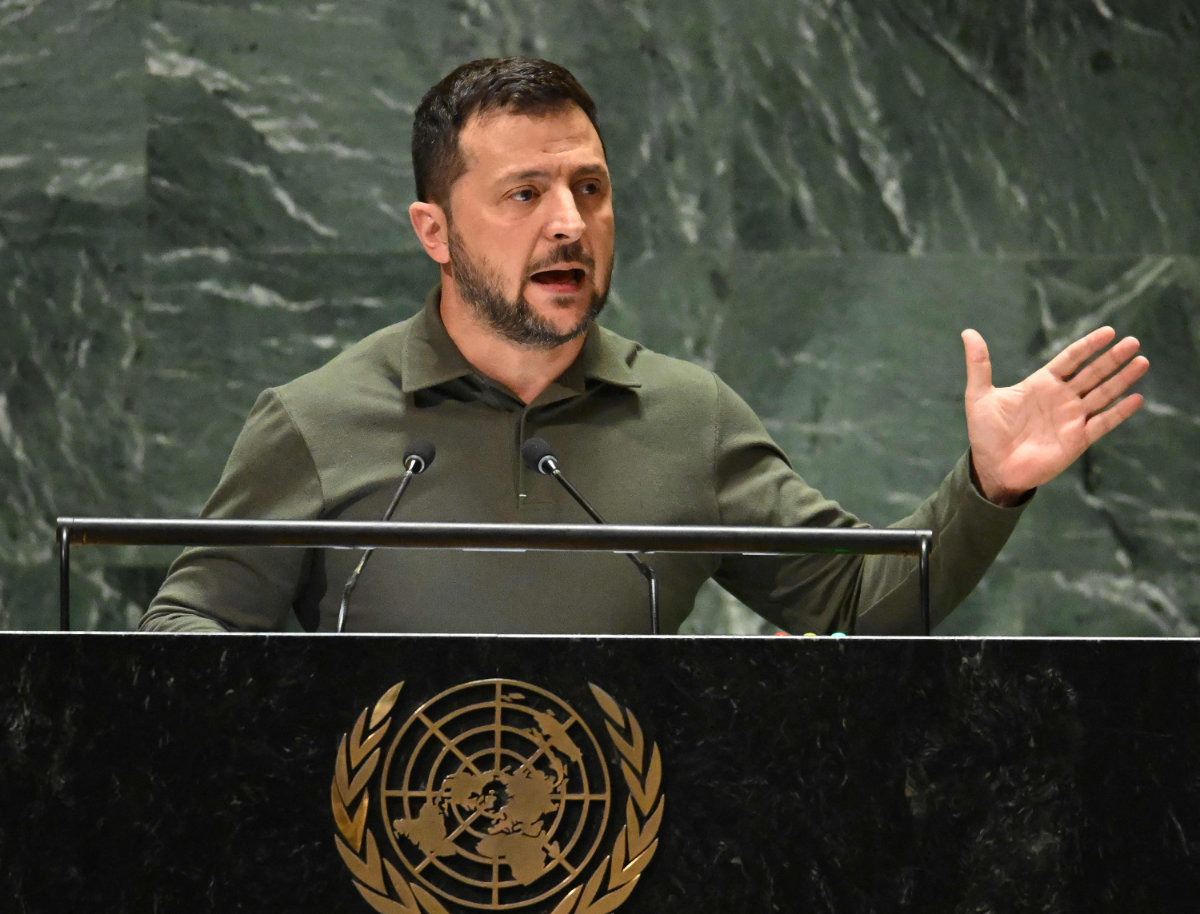
Ukrainian President Volodymyr Zelensky addresses the 78th United Nations General Assembly at UN headquarters in New York City on September 19, 2023. (AFP)
Zelensky was the next speaker, sitting behind the Ukraine plaque at the Security Council’s horseshoe-shaped table and wearing his traditional fatigues.
He called the invasion “a criminal and unprovoked aggression by Russia” that was “aimed at Ukraine’s territory and resources.”
“But it’s not just that,” he said. “The terrorist state is willing, through its aggression, to undermine all the grounds of international norms meant to protect the world from the wars.”
Ukraine has long accused Russia of being an illegal successor to the former Soviet Union, which collapsed in the early 1990s, and Zelensky went after Russia again for claiming the Soviet Union’s Security Council seat “through backstage manipulations.”
The Ukrainian leader accused Russia of “mass atrocities” of human rights and said action should be taken to prevent Moscow from using its veto at the Security Council. The UN’s most powerful body is charged with ensuring international peace and security, but it has been blocked from taking any action on Ukraine because of Russia’s virtually certain veto.
Zelensky called for reforms to allow the 193 members of the UN General Assembly, where there are no vetoes, to suspend or strip the veto power of one of the five permanent members of the Security Council for egregious violations of the UN charter.
The assembly has condemned Russia’s invasion and demanded the withdrawal of its forces and a reversal of its annexation of Ukrainian territory, but its resolutions are not legally binding.
Ukraine has come under pressure from some council members, including China, to engage in talks to end the war, which has claimed tens of thousands of lives on both sides.
Zelensky laid out two key concrete steps to ensure Ukraine’s future security: a complete withdrawal of all Russian troops, mercenaries and military and paramilitary “formations,” and ships, from Ukraine’s internationally recognized territory and its Black Sea waters. That step would be followed by “full restoration” of Ukrainian control “over the entire state border and exclusive economic zone.”
“Only the implementation of these two points will result in an honest, reliable and complete cessation of hostilities,” he said.
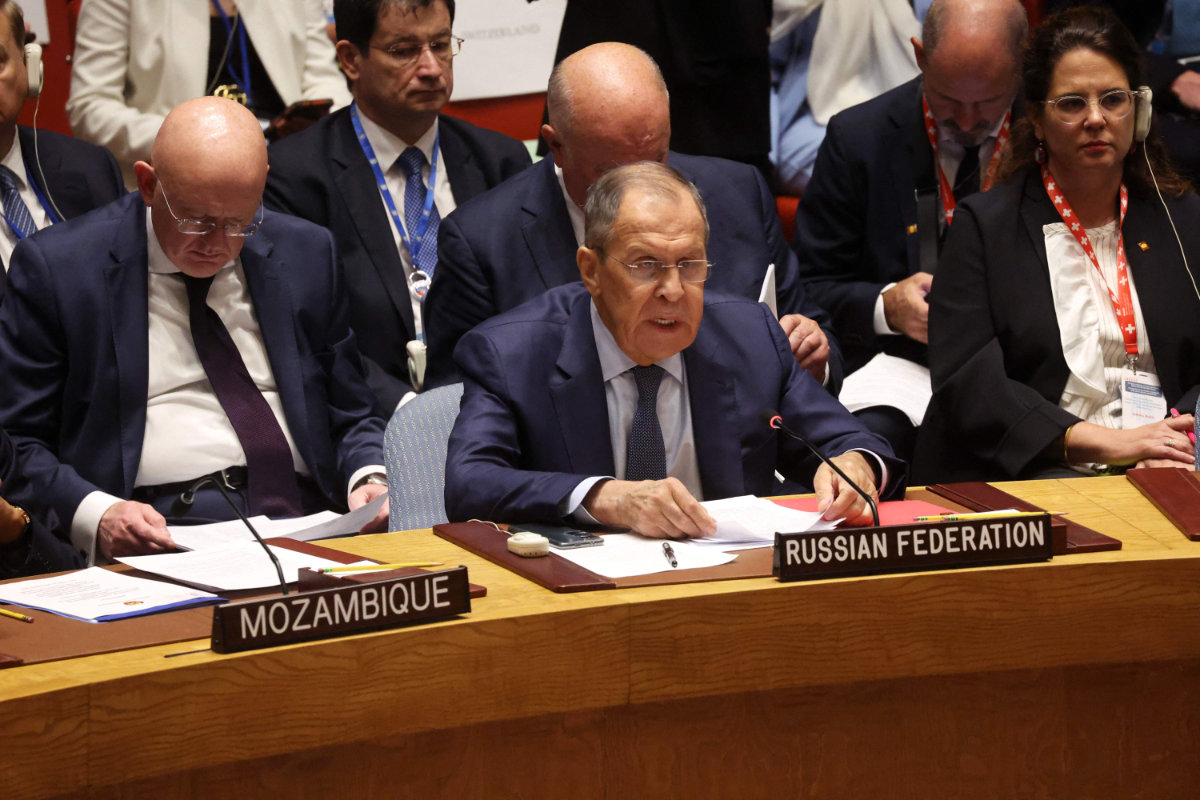
Russian Foreign Minister Sergey Lavrov speaks at a UN Security Council meeting during the United Nations General Assembly on September 20, 2023 in New York City. (Getty Images/AFP)
In a high-profile speech Tuesday to the General Assembly during its annual meeting of world leaders, the Ukrainian president accused Russia of using food, energy and even children as weapons in the war — and he warned other leaders that “when hatred is weaponized against one nation, it never stops there.”
US Secretary of State Antony Blinken told the council that Russia “has shredded the major tenets of the UN charter, the Universal Declaration of Human Rights and international humanitarian law — and flouted one Security Council resolution after another.”
The invasion violates the charter’s “central pillar” of respecting every country’s sovereignty and territorial integrity, he said.
“Russia is committing war crimes and crimes against humanity on a daily basis.” he said.
Blinken said Russian President Vladimir Putin declared from the outset that the Kremlin’s aim is to erase Ukraine from the map and restore Russia’s lost empire.
Lavrov blamed the West for “a shaking of global stability as well as the exacerbation and the fomenting of new hotbeds of tension.” He said “the US and its satellites have egregiously and openly interfered in the domestic affairs of Ukraine,” heightening the risks of global conflict.
He insisted that Russia has “fully” respected the provisions of the UN charter “in an interconnected way.”


