

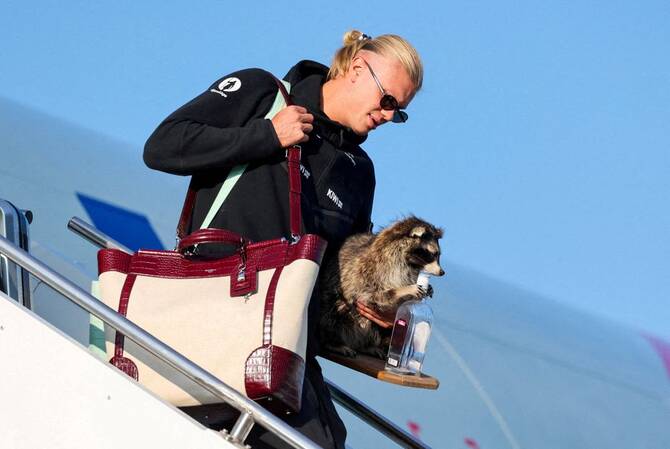

BEIRUT: Erling Braut Haaland, the 25-year-old Norwegian football star, returned home from the US with seven World Cup goals, a stuffed raccoon, two stuffed squirrels, a cowboy hat and even more global fame, earned through his phenomenal scoring ability, immense physical strength and exceptional speed, despite Norway’s failure to England in the quarterfinal.
His rapid rise in the game has made him one of football’s biggest names, with some help from the Middle East. Haaland was only 19 when he first met his Lebanese coach John Haddad online.
“Haaland had a minor issue that I won’t disclose and he overcame it using the treatment method I developed, which differs from the approaches used by most sports medicine specialists. I specialize in biomechanics and movement therapy,” Haddad told Arab News.
The Manchester City striker, considered by many to be the greatest player in Norway’s history, began his professional career at the academy of his hometown club, Bryne, before moving to Red Bull Salzburg in 2019, where he won the Austrian Bundesliga and Austrian Cup titles. In 2020, he joined Borussia Dortmund in Germany.
The world was under Covid lockdowns, and the only means of communication was online.
“That’s when we started training and therapy. I didn’t see him again until years later. He was in Germany when we started online training sessions, and this type of online training made up 80 percent of our sessions,” Haddad said.
“I can say that Haaland was an exceptionally committed person who prioritized his professionalism and training needs and worked resolutely to improve himself.”
Haddad described the Norwegian as “extremely fast, with a disciplined and determined mindset.”
“Even on his days off, he trained. He was committed every single day. That’s simply who he is” he said.
Haaland burst onto the international stage by winning the Golden Boot at the 2019 FIFA U-20 World Cup, where he set a record with nine goals in a single match.
Since making his senior debut for Norway that same year, he has racked up 60 goals in 53 international appearances to become his country’s all-time top scorer. He also became just the sixth player in history to reach 50 international goals in only 46 games.
The striker’s athletic gifts showed early and not only on the pitch. As a boy he dabbled in handball, golf, and athletics. At the age of 5 he set an world record for his age group in the standing long jump, leaping 1.63 meters.
At 195 cm tall and clocking speeds of up to 36.7 kph, Haaland leaves little to chance in his training.
“He works tirelessly on strength, flexibility and quick recovery, blending traditional football drills with high-intensity interval training and functional movements, while treating sleep and nutrition as top priorities,” Haddad said.
For Haddad, genetics tell only part of the story. Haaland’s athletic pedigree runs deep — his father, Alfie, played for Leeds United and his mother, Gre-Marita Braut, was Norway’s national heptathlon champion in the 1990s. But Haddad credits much of the striker’s appeal to a magnetic, down-to-earth personality that has endeared him to fans.
Haddad declined to comment on the claims circulating on social media about Haaland’s supposed superhuman abilities. One such claim was that “he consumes 6,000 calories a day.”
The Norwegian striker took social media by storm within weeks, becoming both a sports icon and a social phenomenon. People sought to emulate him, eager to discover the secret behind his strength and gain insight into his daily routine, while fans tried to imitate his natural spontaneity.
But how does a star like Haaland cope with defeat?
“This is a very important question,” Haddad said.
“No one likes to lose. His strong personality may help him come to terms with defeat, even though he had high hopes of achieving unexpected results. At the end of the day, this is a united team. It is still too early to predict how it will respond to this setback and rise to the challenges ahead.”
Haddad refrained from comparing his client Haaland with other clients “to avoid causing embarrassment or drawing comparisons given my line of work.”
Even so, he acknowledged what millions of Haaland’s fans already believe: “There is no one quite like him.”


