

Oscar-nominated filmmaker Farah Nablusi discusses feature debut ‘The Teacher’ 

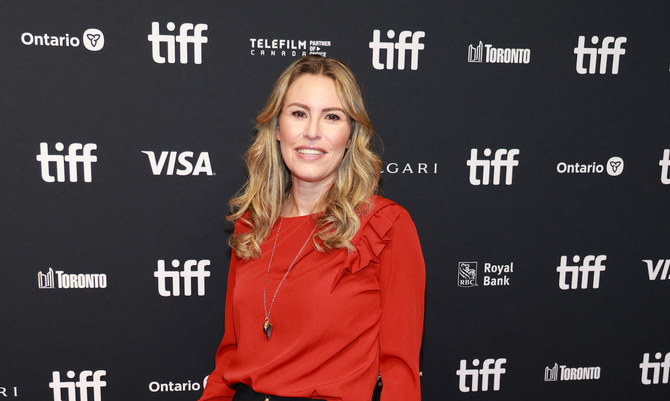
Farah Nabulsi is the director of “The Teacher.” (AFP)
Short Url
Updated 20 September 2023
Follow

Oscar-nominated filmmaker Farah Nablusi discusses feature debut ‘The Teacher’ 

TORONTO: Palestinian director Farah Nabulsi’s feature debut “The Teacher” wowed audiences at the recent Toronto International Film Festival.   

The story revolves around the parallel struggles of a Palestinian schoolteacher grieving the loss of his son and an American couple fighting to reclaim their son from kidnappers.  

“This is a story about characters that represent a severely marginalized and underrepresented people,” Oscar-nominated and BAFTA-winning Nablusi told Arab News.  

“It’s a story that challenges stereotypes and lends some kind of insight into the lives and struggles of those people whose voices are often excluded or misrepresented,” she added.  

“The Teacher” stars renowned Palestinian actor Saleh Bakri, who starred in the Oscar-nominated short “The Present,” also directed by Nabulsi.  

Bakri plays the role of a teacher struggling to reconcile his life-threatening commitment to political resistance with his emotional support for one of his students, Adam.  

“I think Saleh Bakri is one of the best actors in the Arab world,” Nabulsi said. “I think he’s the Daniel Day-Lewis of the Arab world. He has an intensity; he has an emotional intelligence that is fantastic. Whereas Mohamed Abdel Rahman, who’s our Adam, who’s a wonderful newcomer that I will say I’ve discovered, I feel like I have … it’s just that raw talent that you rarely come across.” 

Shot with difficulty in the occupied Palestinian West Bank, the film is based on a true story that offers a tragic yet hopeful insight on the struggles that Palestinians face. 

“The story of ‘The Teacher’ is the sort of amalgamation of all these different real-life events that I’ve come across during my travels and trips to Palestine, where I have been talking with numerous Palestinians about so many real-life events that they have experienced firsthand, that take place and inspired the screenplay,” Nabulsi said.  

“There’s always this thing, this reluctance, this idea that if a film is to do with Palestine that maybe, maybe it won’t sit well so well with Western audiences, for example. And on the contrary, the audience seemed to have loved the film,” she added. “I’ve had a lot of reactions and feedback. Some of the critics have written some wonderful stuff.” 


Sale of Saudi artist Safeya Binzagr’s work sets record at Sotheby’s auction in Riyadh

Updated 01 February 2026
Follow

Sale of Saudi artist Safeya Binzagr’s work sets record at Sotheby’s auction in Riyadh

RIYADH: A painting by Saudi artist Safeya Binzagr sold for $2.1 million at Sotheby’s “Origins II” auction in Riyadh on Saturday, emerging as the top lot of the evening and setting a new auction record for a Saudi artist.

The work, “Coffee Shop in Madina Road” (1968), sold for $1.65 million before the buyer’s premium, the additional fee paid by the purchaser to the auction house on top of the hammer price.

The result nearly doubled the previous auction record for a Saudi artist and became the most valuable artwork ever sold at auction in the Kingdom. It also ranks as the third-highest price achieved for an Arab artist at auction.

It was presented as part of “Origins II,” Sotheby’s second auction staged in Saudi Arabia, comprising 62 modern and contemporary lots and bringing together Saudi artists alongside regional and international names.

Collectors from more than 40 countries participated in the auction, with around one-third of the lots sold to buyers within Saudi Arabia.

The sale totaled $19.6 million, exceeding its pre-sale estimate and bringing the combined value of works offered across “Origins” and “Origins II” to over $32 million.

Saudi artists were central to the evening’s results. All nine Saudi works offered found buyers, achieving a combined total of $4.3 million, well above pre‑sale expectations.

Ashkan Baghestani, Sotheby’s head of contemporary art for the Middle East, told Arab News at the auction that “Safeya made more than any other artist tonight, which is incredible.”

He said the results demonstrated Sotheby’s broader objective in the Kingdom.

“The results tonight show exactly what we’re trying to do here. Bring international collectors to Saudi Arabia and give them exposure to Saudi artists, especially the pioneers.”

All nine works by Saudi artists offered in the sale found buyers, generating a combined $4.3 million. Additional auction records were set for Egyptian artist Ahmed Morsi and Sudanese artist Abdel Badie Abdel Hay.

An untitled work from 1989 by Mohammed Al-Saleem sold for a triple estimate of $756,000, while a second work by the artist, “Flow” from 1987, achieved $630,000.

The sale opened with the auction debut of Mohamed Siam, whose “Untitled (Camel Race)” sold for $94,500. Also making his first auction appearance, Dia Aziz Dia’s prize-winning “La Palma (The Palma)” achieved $226,800.

The sale coincided with the opening week of the Contemporary Art Biennale in Riyadh, reinforcing the city’s growing role as a focal point for both cultural institutions and the art market.

Baghestani added that Saudi modern artists are now receiving long‑overdue recognition in the market.

“There’s so much interest and so much demand, and the price is where it should be,” he said.

International highlights included works by Pablo Picasso, Roy Lichtenstein, Andy Warhol and Anish Kapoor, underscoring Saudi Arabia’s growing role as a destination for major global art events and collectors.

Picasso’s “Paysage,” painted during the final decade of the artist’s life, sold for $1,600,000, becoming the second most valuable artwork sold at auction in Saudi Arabia.

Seven works by Lichtenstein from the personal collection of the artist and his wife, including collages, prints, works on paper and sculptures, all found buyers. Warhol was represented in the sale with two works: “Disquieting Muses (After de Chirico),” which sold for $1,033,200, and a complete set of four screenprints of “Muhammad Ali,” which achieved $352,000.

Baghestani said the strength of the results was closely tied to the material’s freshness. “These were not works from the trade. Some of them had not been seen since the 1970s,” he said.