

Saudi military chief of staff visits Pakistan’s naval headquarters, discusses regional security

In this screengrab, taken from a video released by Pakistan Navy's Director General Public Relations, Pakistan's Chief of Staff Vice Admiral Naveed Ashraf (left) shakes hands with Chief of the General Staff Saudi Armed Forces General Fayyadh bhi Hameed as he arrives at the Naval Headquarters, Islamabad on September 20, 2023. (AN Photo/Screengrab)
Short Url
Updated 20 September 2023
Follow

Saudi military chief of staff visits Pakistan’s naval headquarters, discusses regional security

  • Pakistan and Saudi navy forces earlier this month participated in joint naval exercise near Al Jubail
  • Saudi military chief of staff’s visit to ehnahce bilateral defense cooperation, says Pakistan Navy

ISLAMABAD: General Fayyadh bin Hamed Al-Ruwaili, chief of general staff of the Saudi Armed Forces, visited Pakistan’s Naval Headquarters in Islamabad on Wednesday to discuss regional security and bilateral cooperation with a senior Pakistan Navy official, the navy said in a statement. 
The armed forces of Pakistan and Saudi Arabia enjoy close collaboration and defense ties which results in joint exercises between the two countries on a regular basis. Earlier this month, Pakistan and Saudi Arabia started a joint naval exercise near the Kingdom’s Al Jubail city to strengthen bilateral ties and foster interoperability among their navies and special operation forces.
During Wednesday’s visit, Pakistan Navy said Al-Ruwaili called on Pakistan Navy’s Chief of Staff Vice Admiral Naveed Ashraf.
“During the meeting, matters of mutual interest including bilateral collaboration and regional security were discussed,” the statement said. “The visiting dignitary appreciated and acknowledged Pakistan Navy’s efforts and commitments in support of collaborative maritime security in the region.”
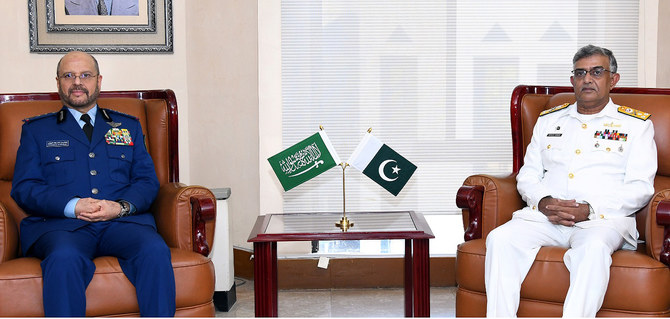


In this handout photograph, taken on September 20, 2023 and released by Pakistan Navy's Director General Public Relations, Pakistan's Chief of Staff Vice Admiral Naveed Ashraf gestures with Chief of the General Staff Saudi Armed Forces General Fayyadh bhi Hameed during a meeting at the Naval Headquarters, Islamabad. (Photo courtesy: Pakistan Navy)

Pakistan Navy said both representatives appreciated the successful conduct of the mutual naval exercise in Al-Jubail and “reaffirmed the resolve to further enhance bilateral defense ties.”
“The visit of Chief of the General Staff Saudi Arabian Armed Forces will further enhance bilateral defense collaboration between the two countries,” the statement added.
Pakistan and Saudi Arabia have long-standing and historic fraternal relations, rooted deep in common faith, shared history and mutual support. The Kingdom is also home to over 2.5 million Pakistanis, serving as the South Asian nation’s top source of remittances.
Riyadh and Islamabad enjoy close cooperation in defense and other sectors, including trade, economy, culture, information and investment. In June, Pakistan set up a hybrid civil-military investment council to attract foreign investment in various sectors including mines, minerals and agriculture.
Earlier this month, Pakistan’s Caretaker Prime Minister Anwaar-ul-Haq Kakar said Riyadh had agreed to invest $25 billion in projects that are part of the investment council for a period of three to five years.


EU, Pakistan sign €60 million loan agreement for clean drinking water in Karachi

Updated 17 December 2025
Follow

EU, Pakistan sign €60 million loan agreement for clean drinking water in Karachi

  • Project will finance rehabilitation, construction of water treatment facilities in Karachi city, says European Investment Bank
  • As per a report in 2023, 90 percent of water samples collected from various places in city was deemed unfit for drinking

ISLAMABAD: The European Investment Bank (EIB) and Pakistan’s government on Wednesday signed a €60 million loan agreement, the first between the two sides in a decade, to support the delivery of clean drinking water in Karachi, the EU said in a statement. 

The Karachi Water Infrastructure Framework, approved in August this year by the EIB, will finance the rehabilitation and construction of water treatment facilities in Pakistan’s most populous city of Karachi to increase safe water supply and improve water security. 

The agreement was signed between the two sides at the sidelines of the 15th Pak-EU Joint Commission in Brussels, state broadcaster Radio Pakistan reported. 

“Today, the @EIB signed its first loan agreement with Pakistan in a decade: a €60 million loan supporting the delivery of clean drinking water for #Karachi,” the EU said on social media platform X. 

Radio Pakistan said the agreement reflects Pakistan’s commitment to modernize essential urban services and promote climate-resilient infrastructure.

“The declaration demonstrates the continued momentum in Pakistan-EU cooperation and highlights shared priorities in sustainable development, public service delivery, and climate and environmental resilience,” it said. 

Karachi has a chronic clean drinking water problem. As per a Karachi Water and Sewerage Corporation (KWSC) study conducted in 2023, 90 percent of water from samples collected from various places in the city was deemed unsafe for drinking purposes, contaminated with E. coli, coliform bacteria, and other harmful pathogens. 

The problem has forced most residents of the city to get their water through drilled motor-operated wells (known as ‘bores’), even as groundwater in the coastal city tends to be salty and unfit for human consumption.

Other options for residents include either buying unfiltered water from private water tanker operators, who fill up at a network of legal and illegal water hydrants across the city, or buying it from reverse osmosis plants that they visit to fill up bottles or have delivered to their homes.

The EU provides Pakistan about €100 million annually in grants for development and cooperation. This includes efforts to achieve green inclusive growth, increase education and employment skills, promote good governance, human rights, rule of law and ensure sustainable management of natural resources.