

Saudi Arabia, Pakistan launch joint naval exercise to boost bilateral ties, interoperability

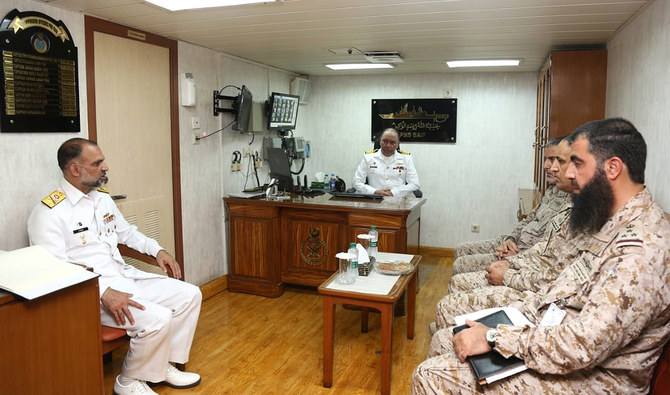
Officials from Royal Saudi Naval Forces meet Mission Commander and Commanding Officer onboard PNS SAIF during Joint Naval Exercise AL Bahr XIV in Saudi Arabia on September 9, 2023. (Photo courtesy: Pakistan Navy)
Short Url
Updated 09 September 2023
Follow

Saudi Arabia, Pakistan launch joint naval exercise to boost bilateral ties, interoperability

  • The exercise will not only involve naval ships but also special operations forces and marines from both countries
  • Maritime drills will encompass a spectrum of naval operations, spanning traditional and non-traditional warfare domains

ISLAMABAD: Saudi Arabia and Pakistan have commenced a joint naval exercise near the kingdom’s Al Jubail city to strengthen bilateral ties and foster interoperability among their navies and special operation forces, the Pakistan Navy said in a statement on Saturday.

Naval exercises are planned military training activities conducted by naval forces belonging to different countries. They serve several purposes, including training and readiness of naval personnel, stronger coordination among different navies, testing of equipment, and experimenting with new tactics.

These exercises also deter potential adversaries and prepare the participants for any crisis response.

“A major joint naval exercise Naseem Al Bahr-XIV and Deraa Al Sahil between Pakistan Navy (PN) and Royal Saudi Naval Forces (RSNF) has commenced at Al Jubail, Saudi Arabia,” the Pakistan Navy announced in the statement.

It added that the maritime drills would encompass a wide spectrum of naval operations, spanning both traditional and non-traditional warfare domains.

“For participation in the exercise, the PN Flotilla, comprising Pakistan Navy Ships Saif, Himmat, Dehshat, and Muhafiz, reached Al Jubail port of Saudi Arabia, where they were warmly welcomed by senior RSNF officials and Pakistan’s diplomatic staff in [the kingdom],” the statement said.

The exercises involve not only naval ships, but also special operations forces and marines from both naval forces, complemented by the participation of helicopters and aircraft from the RSNF.

During the harbor phase, both sides exchanged views on professional topics and completed preparations for the upcoming sea exercises. The activities during that phase encompassed workshops focusing on tactical procedures, informative seminars, simulator training sessions, reciprocal visits, and coordination meetings, all crucial preludes to the execution of sea exercises.

Exercise Naseem Al Bahr is conducted biennially and has evolved over three decades into an expression of strategic partnership between Saudi Arabia and Pakistan, highlighting their shared determination to strengthen collaboration in the naval sphere, with a united effort to address maritime challenges effectively.


Pakistan president meets UAE counterpart, explores trade, investment opportunities

Updated 27 January 2026
Follow

Pakistan president meets UAE counterpart, explores trade, investment opportunities

  • Asif Ali Zardari is in UAE on four-day visit to strengthen bilateral ties, review bilateral cooperation
  • Both sides discuss regional, international developments, reaffirm commitment to promote peace

ISLAMABAD: President Asif Ali Zardari met his UAE counterpart Sheikh Mohammed bin Zayed Al-Nahyan in Abu Dhabi on Tuesday during which both sides explored new opportunities in trade, investment, energy and other sectors, Zardari's office said. 

Zardari arrived in Abu Dhabi on Monday evening with a high-level delegation on a four-day official visit to the UAE to review trade, economic and security cooperation. 

"The leaders discussed ways to further deepen the longstanding and brotherly relations between Pakistan and the UAE," a statement from Zardari's office said about his meeting with the UAE president. 

"They reviewed the full spectrum of bilateral cooperation and explored new opportunities in trade, investment, energy, infrastructure, technology, and people-to-people exchanges, highlighting the significant potential for expanding economic and strategic partnership.

Zardari highlighted the significance of Al-Nayhan's visit to Pakistan last month, the statement said, expressing appreciation for the UAE's continued support for strengthening bilateral ties.

It said both sides also exchanged views on a range of regional and international developments, reaffirming their commitment to promoting peace, stability and sustainable development.

The meeting was also attended by Pakistan's First Lady Aseefa Bhutto-Zardari, the Pakistani president's son Bilawal Bhutto-Zardari, who is also the chairman of the Pakistan Peoples Party, Interior Minister Mohsin Naqvi and Pakistan's ambassador to the UAE. 

ZARDARI MEETS AD PORTS CEO

Zardari earlier met AD Ports Group CEO Captain Mohamed Juma Al-Shamisi to discuss the group's investment initiatives in Karachi. 

"Both sides agreed that the expansion and modernization of port infrastructure would strengthen trade flows and support Pakistan’s broader economic development and country’s seaborne trade," the President's Secretariat said in a statement.

It added that Zardari described the AD Ports Group's long-term investment and expanding role in Pakistan's maritime and logistics sector as a key pillar of Pakistan–UAE economic cooperation.

Pakistan and the UAE maintain close political and economic relations, with Abu Dhabi playing a pivotal role in supporting Islamabad during periods of financial stress through deposits, oil facilities and investment commitments. 

The UAE is Pakistan's third-largest trading partner, after China and the United States, and a key destination for Pakistani exports, particularly food, textiles and construction services.

The Gulf state is also home to more than 1.5 million Pakistani expatriates, one of the largest overseas Pakistani communities in the world, who contribute billions of dollars annually in remittances, a crucial source of foreign exchange for Pakistan’s economy.

Beyond trade and labor ties, Pakistan and the UAE have steadily expanded defense and security cooperation over the years, including military training, joint exercises and collaboration in counter-terrorism and regional security matters.