ISLAMABAD: Responding to Canadian accusations that India may have been involved in the killing of a Sikh separatist leader in suburban Vancouver, Pakistan said on Wednesday the charges called into question New Delhi’s reliability as a credible international partner and showed that its “network of extra-territorial killings” had gone global.
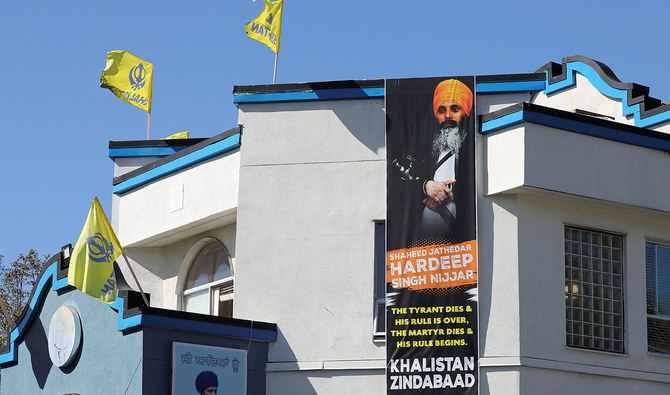
On Monday, Canadian Prime Minister Justin Trudeau said there were “credible allegations” of Indian involvement in the slaying of Hardeep Singh Nijjar, a 45-year-old Sikh leader who was killed by masked gunmen in June in Surrey, outside Vancouver. For years, India has said Nijjar, a Canadian citizen born in India, has links to terrorism, an allegation Nijjar denied.
Prime Minister Narendra Modi’s government has rejected outright Canada’s suspicions that New Delhi’s agents had links to the murder.
“India’s assassination of a Canadian national on Canadian soil is a clear violation of international law and the UN principle of state sovereignty,” the foreign ministry for Pakistan, India’s arch-rival and neighbor, said. “It is also a reckless and irresponsible act that calls into question India’s reliability as a credible international partner and its claims for enhanced global responsibilities.”
The foreign office said the news of Indian involvement in Nijjar’s killing showed that “India’s network of extra-territorial killings has now gone global.”
“For decades, Indian intelligence agency RAW has been actively involved in abductions and assassinations in South Asia,” the foreign office said, saying Pakistan had itself been a target of espionage and target killings by RAW.
In December 2022, Pakistan released a dossier accusing Indian intelligence of being behind an attack in Lahore in June 2021. In 2016, Pakistan arrested former Indian naval officer Kulbhushan Jadhav and convicted him of planning espionage and sabotage and sentenced him to death. Jadhav is still in a Pakistani prison and India says he is innocent.
Speaking to journalists in New York on Tuesday on the sidelines of the 78th session of the United Nations General Assembly (UNGA), Pakistani Foreign Secretary said Islamabad was “not surprised” by Canada’s allegations against the Indian government.
“We have captured one of [India’s] serving naval intelligence officers [Jadhav] on our soil, who is in our custody at the moment, and he has admitted that he had arrived here to create instability and all types of mischief,” Qazi said.
“The situation is developing, so let’s see, but according to our experience, we are not surprised.”


![]()

‘Reckless and irresponsible’: Pakistan hits out at India over link to killing of Sikh separatist leader
Short Url
https://arab.news/wjdhh
‘Reckless and irresponsible’: Pakistan hits out at India over link to killing of Sikh separatist leader
- Canadian PM Trudeau has said there was “credible allegations” of Indian involvement in slaying of Hardeep Singh Nijjar
- Pakistani foreign office says Pakistan had for years been a target of espionage and target killings by Indian intelligence
Latest updates



© 2026 SAUDI RESEARCH & PUBLISHING COMPANY, All Rights Reserved And subject to Terms of Use Agreement.