

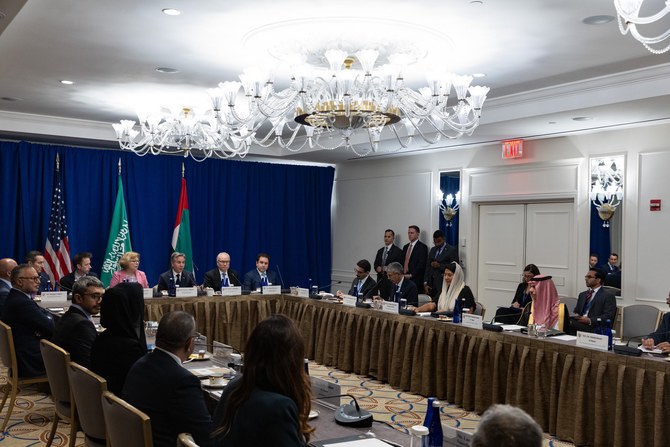

RIYADH: Gulf states and the US said they welcomed the diplomatic engagement with Iran and are seeking to stop any escalation in the region, a joint statement issued by the minister said.
“Ministers welcomed diplomatic engagement by Saudi Arabia and other GCC states with Iran to pursue regional de-escalation and emphasized the importance of adherence to international law, including the UN Charter, by states of the region,” it read.
Ministers renewed their commitment to ensuring the freedom of navigation in the region and maritime security. They renewed their “determination to deter illegal actions at sea or elsewhere that might threaten shipping lanes, international trade, and oil installations in the GCC states.”
The meeting took place on the sidelines of the 78th UN General Assembly in New York and was attended by Saudi Foreign Minister Prince Faisal bin Farhan and his US and GCC counterparts.
The ministers also called on “Iran to cease its proliferation of unmanned aerial vehicles and other dangerous weapons that pose a grave security threat to the region.”
In a separate meeting involving the US, KSA and UAE, US Secretary of State Antony Blinken welcomed Saudi Arabia hosting a delegation from Sanaa in Riyadh. The discussions are aimed at finding a roadmap to the conflict that has rage since 2014 through “a Yemeni-led political process under UN auspices, as well as Saudi Arabia’s commitment to provide $1.2 billion in economic support for the Yemen Government,” the US State Department said.
Saudi Defense Minister Prince Khalid bin Salman met with the delegation on Monday and the Kingdom welcomed positive results of discussions with the group.
On the Israeli-Palestinian conflict, ministers highlighted their commitment to the Arab Peace Initiative and finding a “comprehensive peace in the Middle East in accordance with the two-state solution.”
On the issue of three UAE islands at the heart of a dispute between the Emirates and Iran, the statement said: “The Ministers reiterated their support for the United Arab Emirates’ call to reach a peaceful solution to the dispute over the three islands, Greater Tunb, Lesser Tunb, and Abu Musa, through bilateral negotiations or the International Court of Justice, in accordance with the rules of international law including the UN Charter.”
As for the demarcation of the Kuwait-Iraq border they stressed the “importance of Iraq’s commitment to Kuwait’s sovereignty and territorial integrity and respect for international conventions and UN resolutions, especially UNSC Resolution 833 regarding the demarcation of the Kuwait-Iraq boundary,” the joint statement said.


