

UN alarm over child deaths in Sudan

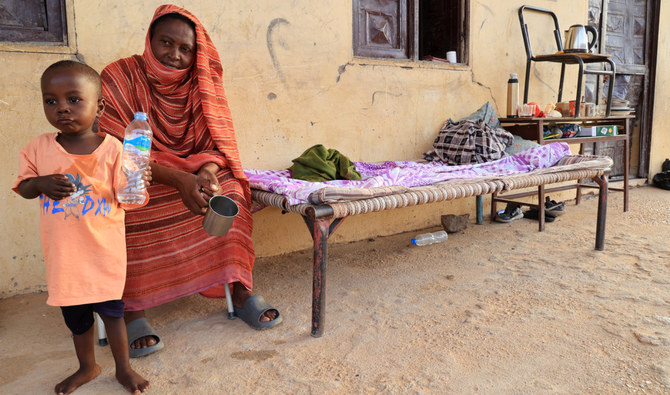
A woman and a child sit outside a classroom at a school that has been transformed into a shelter for people displaced by conflict in Sudan’s northern border town of Wadi Halfa near Egypt on September 11, 2023. (AFP)
Short Url
Updated 20 September 2023
Follow

UN alarm over child deaths in Sudan

  • UNHCR says over 1,200 children from Ethiopia and South Sudan under the age of five died in nine camps since May

GENEVA: More than 1,200 children have died of suspected measles and malnutrition in Sudan refugee camps, while many thousands more, including newborns, are at risk of death before year-end, UN agencies said on Tuesday.

More than five months into a conflict between Sudan’s army and paramilitary group, Rapid Support Forces, the country’s healthcare sector is on its knees due to direct attacks from the warring parties as well as shortages of staff and medicines, they said.

Dr. Allen Maina, chief of public health at the UN refugee agency UNHCR, told a UN briefing in Geneva that since May more than 1,200 children from Ethiopia and South Sudan under the age of five had died in nine camps in White Nile state, home to one of Sudan’s larger refugee populations.


SPOTLIGHT

Plight of Sudanese people ‘right at the top of our agenda,’ UK’s permanent representative to the UN tells Arab News


“Unfortunately we fear numbers will continue rising because of strained resources,” he added, adding that partners were struggling to vaccinate refugees, stoking the risk of epidemics.

Separately, some 3,100 suspected measles cases and 500 cholera cases have been reported across the country in the same period, along with outbreaks of dengue and malaria, he added.

A World Health Organization official told the same briefing that there have been 56 verified attacks so far on healthcare in Sudan since the war began and about 70 percent to 80 percent of hospitals in conflict states are now out of service.

“They and their mothers need skilled delivery care. However in a country where millions are either trapped in war zones or displaced, and where there are grave shortages of medical supplies, such care is becoming less likely by the day,” UNICEF spokesperson James Elder told the same briefing.


Lebanese show strong trust in military, little confidence in parliament, poll finds

Updated 6 sec ago
Follow

Lebanese show strong trust in military, little confidence in parliament, poll finds

  • Public security institutions viewed favorably as survey reveals low faith in state authorities

BEIRUT: Lebanese place strong trust in their military and security forces, a recent opinion poll conducted by the Arab Center for Research and Policy Studies, as part of the ninth Arab Index, has found.

However, the survey, which included Lebanon and 14 other Arab countries, found that confidence in the state’s judicial, executive and legislative authorities remains low, peaking at just 41 percent.

Parliament emerged as the least trusted institution, garnering only 36 percent of respondents’ support.

Nasser Yassin, the center’s director, told Arab News that the survey is the largest in the Arab region by sample size, participating countries and range of topics.

Conducted from 2011 to last year, it enables analysis of shifts in Arab public opinion across 15 countries, including Lebanon.

At a press conference in Beirut, Mohammed Al-Masri, the center’s executive director and coordinator of the Arab Index program, presented Lebanon-specific survey results to academics and researchers.

The survey included 2,400 participants, he said.

Lebanese participants identified Israel as the primary threat to Lebanon’s security (56 percent), followed by the US (20 percent) and Iran (17 percent).

Regarding Lebanese citizens’ engagement in civil organizations and political parties, the survey found that “Lebanese involvement in these organizations is low, not exceeding 2 percent.”

Only 10 percent of participants reported political party membership.

Additionally, 62 percent do not trust political parties, while 36 percent do.

Fifty-one percent of Lebanese citizens plan to take part in the forthcoming parliamentary elections, tentatively scheduled for May, while 40 percent do not intend to take part.

The Arab Index asked about perceptions of the Lebanese army after the last Israeli war in Lebanon.

Fifty-six percent reported a more positive view, while 40 percent said their opinion remained unchanged.

Sixty-six percent of Lebanese respondents said their view of Hezbollah had not changed, while 13 percent viewed it more positively and 19 percent more negatively.

A majority of Lebanese considered the war a defeat (59 percent), while 38 percent viewed it as a victory.

Eighty-nine percent of respondents opposed Lebanon recognizing Israel, while 9 percent supported it.

Half of those in favor conditioned recognition on the creation of an independent Palestinian state.

Most opponents cited Israel’s colonial, racist and expansionist policies, with few referencing cultural or religious reasons.

Ninety-one percent of Lebanese viewed US policy on Palestine unfavorably.

Additionally, 58 percent perceived Iranian policies, and 40 percent perceived Russian policies, as threats to regional security and stability.

Thirty-six percent cited media outlets as their main source of information about the US, while 21 percent relied on the internet, particularly social media.

The index shows that public opinion has become more negative over the past decade. More than 70 percent of Lebanese believe the US seeks to impose its policies globally, control Arab countries, exacerbate divisions and favor non-democratic governments.

Fifty-six percent of respondents disagreed that the US protects human rights.

Thirty-seven percent said that changes in US policy toward Palestine, such as protecting Palestinians and ending support to Israel, would improve their perception of the US.

Fifty-eight percent of Lebanese citizens believe the country is heading in the wrong direction, while 39 percent disagree.

Most who believe Lebanon is on the wrong track attribute this to economic issues, political turmoil and the political system’s failure to meet its responsibilities.

They also cite “poor governance, flawed public policies and the lack of stability in general.”

Ninety-seven percent of those who believe Lebanon is on the right track attribute this to “the end of war, the election of a new president and the formation of a new government.”

Only 14 percent of respondents rated Lebanon’s security as “good” or “very good,” while 85 percent rated it as “bad” or “very bad.” Additionally, 86 percent rated the economic situation as “bad” or “very bad.”

Eighty-five percent of respondents provided a meaningful definition of “democracy,” which the Arab Opinion Index said is notably high.

However, only 51 percent support a political system in which the military holds power.

The percentage of respondents who support a political party’s accession to power through elections, even if they disagree with its principles, dropped from 50 percent before 2018 to 38 percent afterward.

The survey also revealed “near-unanimous agreement among Lebanese citizens that financial and administrative corruption is widespread,” adding that “this figure has not changed significantly since the survey began in 2011.”

Sixty-seven percent of respondents expressed some interest in political affairs.

Forty-four percent now rely on the internet for political news, the highest level since 2011 and a more than tenfold increase. Reliance on television has declined over the same period.