

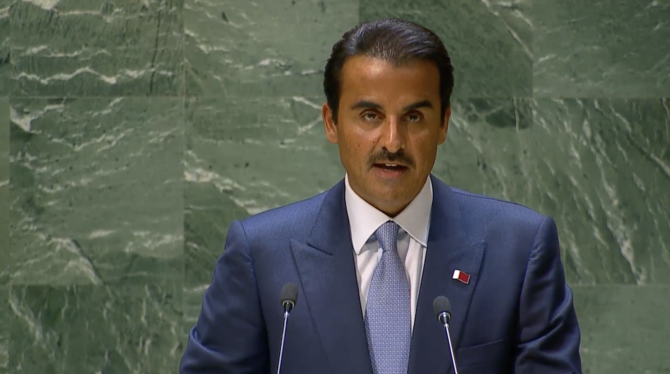

LONDON: Qatar’s emir on Tuesday branded Israel’s treatment of Palestinians as tantamount to a “21st-century apartheid system in broad daylight.”
Speaking at the UN General Assembly, Sheikh Tamim bin Hamad Al-Thani said it was “unacceptable” that the Palestinian people continued “to languish under the yoke and intransigence of Israeli occupation.”
During a general debate on the issue, he noted that concern was growing even among traditional supporters of Israel over its policies.
And he pointed out that the failure of the international community to act against the Israeli occupation had provided, and continued to provide, an opportunity for Israel to undermine the foundations of a two-state solution.
However, Sheikh Tamim welcomed improvements in relations between several countries in the Middle East and highlighted the restoration of ties between Saudi Arabia and Iran as well as the rapprochement between Egypt and Turkiye.
But he added that more needed to be done to resolve the crises in Syria, Yemen, Lebanon, and Libya.
He said it was “not permissible to accept the grave injustice befalling the brotherly Syrian people as if it were fate,” adding that Qatar supported efforts to bring about a peaceful solution in Libya and that the Yemeni conflict should be resolved through relevant regional and international resolutions, including from the Security Council.
“In brotherly Lebanon, where state institutions are in danger, we stress the necessity of finding a sustainable solution to the political vacuum and finding mechanisms to prevent it from recurring and forming a government capable of meeting the aspirations of the Lebanese people,” Sheikh Tamim said.
He also condemned the “crimes committed against civilians in Khartoum and in the Darfur region,” and called for the perpetrators of the violence in Sudan to be held accountable.
In addition, the Qatari leader called out “racism and campaigns of incitement,” and warned that the Muslim world should not be distracted by “an imbecile or biased person provoking us by burning the Holy Qur’an,” in reference to recent such incidents in Denmark and Sweden.
In his address, Sheikh Tamim noted the powerful role sport could play in uniting different peoples and cultures around the world, citing Qatar’s hosting last year of the FIFA World Cup.
“During the 2022 World Cup in Qatar, there was an opportunity for interaction between peoples, and it was an opportunity for the world to see our people as they are and to learn about our culture and values,” he said.
He described Qatar as a “global destination and nexus between East and West.”
And he added: “We emphasized the role that sports could play in building bridges of communication and rapprochement between peoples and cultures.
“I hope we had contributed through this tournament to breaking the stereotypes and presenting a new, exciting, and safe tournament to the world.”


