

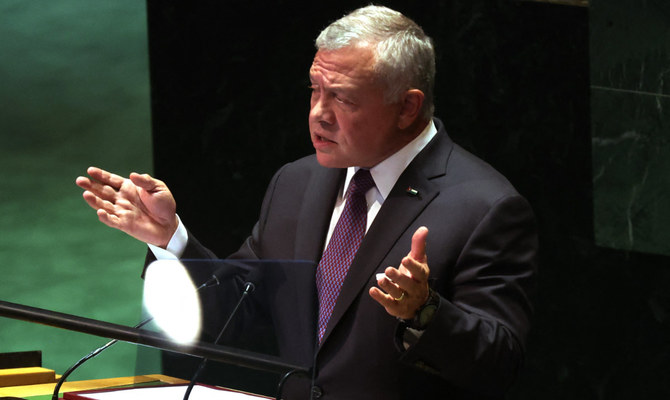

LONDON: The world must not abandon Palestinian refugees to the forces of despair, Jordan’s King Abdullah II told the UN General Assembly in New York on Tuesday.
Sustainable funding is urgently needed by UNRWA, the UN agency that provides vital relief, education and health services to millions of Palestinian refugees, he added.
The funding is essential to protect Palestinian families, keep communities stable, and prepare young people for productive lives, he said.
“We must protect young Palestinians from extremists who prey on their frustrations and hopelessness by making sure they continue to learn at the schools under the blue flag of the United Nations, as the alternative will be the black flags of terror, hate and extremism,” the king warned.
As the custodian of Islamic and Christian holy sites in Jerusalem, Jordan remains committed to safeguarding the city’s identity by preserving it as the city of faith and peace for Islam, Christianity and Judaism, he said.
The king drew attention to the plight of 5 million Palestinians living under occupation with no civil rights, no freedom of mobility, and no say in their lives despite “every UN resolution since the beginning of this conflict recognizing the equal rights of the Palestinian people to a future of peace, dignity and hope.”
He said the only path to a comprehensive and lasting peace to the Palestinian-Israeli conflict is a two-state solution.
“We can see the Israeli people actively defending and engaging in the expression of their national identity, yet the Palestinian people are deprived of that same right to express and fulfil their own national identity.”
He said the basic requirement for that Palestinian right is the “establishment of their own independent and viable state on the June 4, 1967 lines with East Jerusalem as its capital, living alongside Israel in peace, security and prosperity.”
The king added that delaying justice and peace has bought endless cycles of violence, and 2023 has been the deadliest for the Palestinian people in the past 15 years.
“How can people trust in global justice while settlement building, land confiscations and home demolitions continued? Where is the global solidarity to make UN resolutions believable by people in need of our help?” he asked.
King Abdullah also highlighted the effects that a severe shortfall in international funds has had on multiple UN agencies providing vital services to refugees in need.
“In Jordan, where refugees make up over a third of our 11 million population, cuts have already thrown the lives of hundreds of thousands of refugees into uncertainty. The impact of such humanitarian shortfalls is never limited to a country or region,” he said.
The king added that fear and want often bring on sharp increases in the number of refugees in the Middle East fleeing to Europe and beyond, on journeys that often end in tragedy.
“Jordanians are serious about our duty to those in need. We’ve done everything we can to secure a dignified life for refugees,” he said.
“Nearly half of the almost 1.4 million Syrians we host are under 18 years of age. For many of them, Jordan is the only place they’ve ever known. Over 230,000 Syrian children have been born in Jordan since 2011.”
He said Jordan is sharing precious resources to help Syrian refugees meet basic needs such as food, energy and water, despite being among the most water-poor countries in the world and facing climate change that is causing destructive heat waves, drought and flooding.
“To meet the refugee burden, we’ve been carefully managing to combine our limited resources with essential support from the international community because the responsibility to act falls on everybody’s shoulders, because the world can’t afford to walk away and leave a lost generation behind,” the king said.
He added that Jordan will not have the ability or the resources to host and care for more Syrian refugees, whose “future is in their country, not in host countries. But until they’re able to return, we must all do right by them.
“And the fact is, refugees are far from returning. On the country, more Syrians are likely to leave their country as the crisis persists.”


