

Closing bell: Saudi main index rebounds to close at 11,070
Closing bell: Saudi main index rebounds to close at 11,070/node/2376566/business-economy
Closing bell: Saudi main index rebounds to close at 11,070
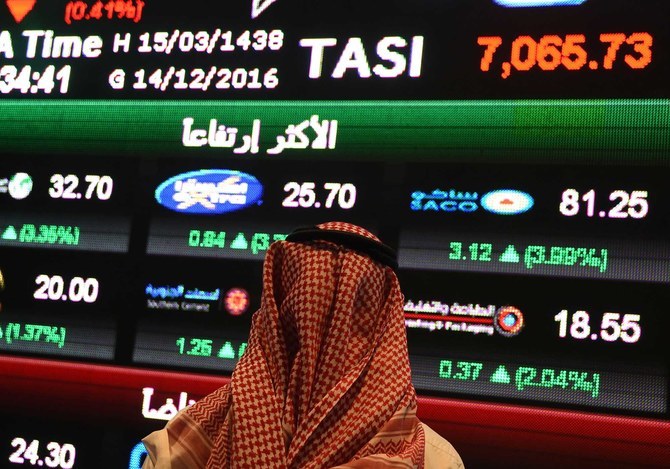
Saudi Arabia’s Tadawul All Share Index closed at 11,070.77 with a total trading turnover recorded at SR5.86 billion ($1.56 billion) as 117 of the stocks advanced, while 94 declined. File
Closing bell: Saudi main index rebounds to close at 11,070
Updated 19 September 2023
Arab News
RIYADH: Rebounding after two days of decline, Saudi stocks closed higher on Tuesday with the benchmark index climbing 34.73 points or 0.31 percent.
Saudi Arabia’s Tadawul All Share Index closed at 11,070.77 with a total trading turnover recorded at SR5.86 billion ($1.56 billion) as 117 of the stocks advanced, while 94 declined.
Nomu, the Kingdom’s parallel market, edged up by 119.67 points to 22,409.39 and the MSCI Tadawul Index also went up by 0.52 percent to close at 1,426.45.
Thimar Development Holding Co. emerged as the best-performing stock on the main market, as its share price soared by 9.92 percent to SR28.25.
The share price of Filing and Packing Materials Manufacturing Co. hit a 52-week high of SR54.40. The company closed the day’s trading at SR54, up 7.09 percent compared to the opening value.
Al-Baha Investment and Development Co. performed poorly with its share price retreating by 6.25 percent to SR0.15.
The best-performing stock on Nomu was Molan Steel Co with its share price soaring by 8.72 percent to SR5.11.
On the announcements front, Saudi Arabia’s Capital Markets Authority on Monday said that it has approved the request from Arabian Shield Cooperative Insurance Co. to increase its capital from SR638.52 million to SR798.15 million by issuing 15.96 million ordinary shares.
According to a statement issued by the regulator, the capital hike is aimed at merging Alinma Tokio Marine Co. with Arabian Shield Cooperative Insurance Co.
The deal will also see the transfer of all the assets of Alinma Tokio Marine Co. and liabilities to Arabian Shield Cooperative Insurance Co. through a share swap.
Meanwhile, Professional Medical Expertise Co., listed on the Kingdom’s parallel market said that it has renewed and raised its existing credit facility with Banque Saudi Fransi.
According to a Tadawul statement, both parties agreed to renew the SR40 million credit facilities of 2022 and signed a deal to increase the contract by SR10 million, thus bringing the overall credit facility to SR50 million.
GCC chambers plan Gulf Guarantee project to boost intra-regional trade
Updated 14 sec ago
Abdulaziz Al-Faki - ALEQTISADIAH
DAMMAM: The Federation of GCC Chambers, in cooperation with the Customs Union Authority, intends to launch the Gulf Guarantee Project to provide a unified mechanism for exports and trade transactions and to enhance the efficiency of intra-GCC trade, which reached about $146 billion by the end of 2024, Saleh Al-Sharqi, Secretary-General of the federation, told Al-Eqtisadiah.
Al-Sharqi said, on the sidelines of his meeting with media representatives at the federation’s headquarters in Dammam, that the initiative represents a qualitative leap in supporting intra-GCC trade by facilitating transit movement through a single point, contributing to cost reduction, accelerating the flow of goods, and enhancing the reliability of trade operations among Gulf markets.
Saleh Al-Sharqi, Secretary-General of the Federation of GCC Chambers. Al-Eqtisadiah
He explained that the federation recently launched a package of strategic initiatives, including the Tawasul initiative aimed at strengthening communication among Gulf business owners and supporting the building of trade and investment partnerships, in addition to the Gulf Business Facilitation initiative, which seeks to address challenges facing Gulf investors and traders, simplify procedures, and improve the business environment across member states.
He noted that these initiatives fall within an integrated vision to address obstacles hindering investment and intra-regional trade flows by developing regulatory frameworks, activating communication channels between the public and private sectors, and supporting Gulf economic integration in line with the objectives of the Gulf Common Market.
In a related context, the Secretary-General affirmed the direction of GCC countries to leverage artificial intelligence technologies to support trade and investment flows, stressing the importance of establishing a unified Gulf committee for artificial intelligence to coordinate efforts and exchange expertise among member states. He said the federation will support this direction in the coming phase, drawing on leading international experiences, particularly the Chinese experience in this field.
Regarding the recently announced electric railway project between Riyadh and Doha, Al-Sharqi revealed that technical and advisory committees are working to complete the necessary studies for the project, confirming that it will positively impact passenger and freight movement between the two countries, enhance Gulf logistical integration, and support regional supply chains.
On investment opportunities available to Gulf nationals in the Syrian market, he said the federation is coordinating with private sector representatives in Syria to overcome obstacles that may face the flow of Gulf investments, in addition to working to provide adequate guarantees to protect these investments and ensure a stable and attractive investment environment.
In response to a question from Al-Eqtisadiah about the impact of tariffs imposed by the US on imports of iron, steel, and aluminum, he said that economic and technical committees in GCC countries are continuously monitoring the repercussions of these tariffs on the Gulf private sector, assessing their effects, and taking the necessary measures to protect it from any potential negative impacts.
Al-Sharqi also pointed to the launch of two specialized committees in the transport and logistics sectors and in real estate activities, given their pivotal role and active contribution to Gulf gross domestic product, stressing that developing these two sectors is a fundamental pillar for enhancing economic diversification and increasing the competitiveness of GCC economies.
He added that during the past year the federation held more than 40 meetings and official engagements with Gulf and international entities, participated in nine regional and international events to strengthen the presence of the Gulf private sector on the global stage, and signed 12 agreements and memoranda of understanding with Gulf, regional, and international entities to open new horizons for economic and investment cooperation.
During the same year, the federation launched four digital platforms to support the Gulf private sector, bringing the total number of its digital platforms to eight serving the business community across member states.
The Secretary-General affirmed that the federation will continue working with relevant economic entities to unify procedures and regulations, reduce non-tariff barriers, and accelerate mutual recognition of products and standard specifications, in a way that enhances the competitiveness of the Gulf economy and supports the growth of intra-GCC trade.