

Fears of new war in the Caucasus as Azerbaijan launches offensive

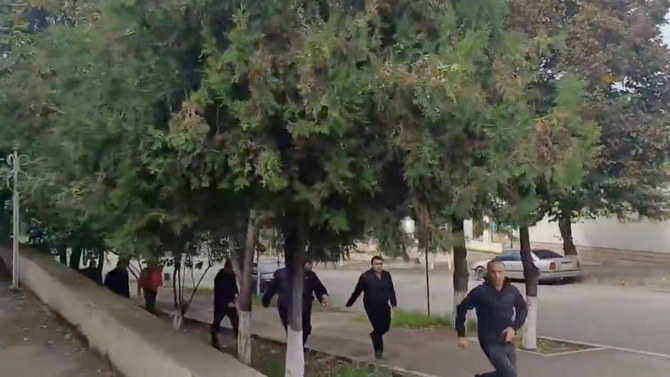
People run as gunfire and explosions are heard in Stepanakert, called Khankendi by Azerbaijan, in the Nagorno-Karabakh region, on Sept. 19, 2023, in this screengrab obtained from a handout video. (Reuters)
Short Url
Updated 20 September 2023
Follow

Fears of new war in the Caucasus as Azerbaijan launches offensive

  • 25 dead in attack on disputed Nagorno-Karabakh * Russia and Turkiye urge talks to end fighting

JEDDAH: Azerbaijan on Tuesday launched a new military offensive in the disputed Nagorno-Karabakh region, raising fears of another war in the Caucasus.

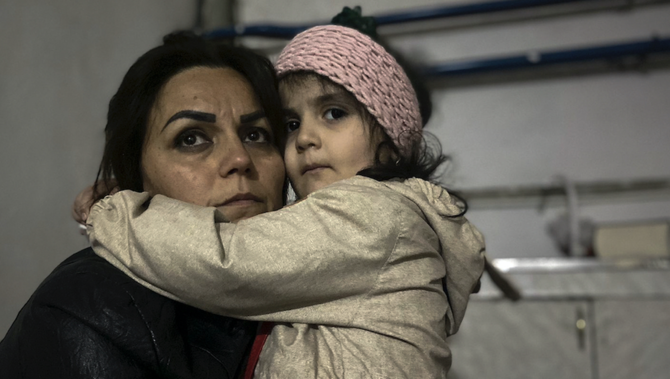
Armenian separatists in the region said Azerbaijan was using artillery, combat aircraft and attack drones, and 25 people including some civilians had been killed and 80 wounded. They accused Azerbaijani forces of “trying to advance” into Karabakh. “Fighting continues along the entire line of contact,” they said.
Azerbaijan’s Defense Ministry said it was using “high precision weapons on the front line and in depth.” Baku’s presidency said: “Localised anti-terrorist measures have been launched in the region.” It urged Karabakh separatists to lay down their arms and offered talks in the town of Yevlakh.
“Illegal Armenian armed forces must raise the white flag,” it said. “Otherwise, the anti-terrorist measures will continue until the end.”
Armenia’s Foreign Ministry condemned the offensive. “Azerbaijan unleashed another large-scale aggression against the people of Nagorno-Karabakh, aiming to complete its policy of ethnic cleansing,” it said, and Russian peacekeepers in the region should “take clear and unequivocal steps to stop Azerbaijan’s aggression.”

The former Soviet Caucasus rivals have been locked in a decades-long dispute over Karabakh, and foughttwo wars over the mountainous territory in the 1990s and in 2020.
Regional power brokers Russia and Turkiye, who oversee a fragile peacekeeping mission in Nagorno-Karabakh, had been informed about Azerbaijan’s military activities in Karabakh, Baku said.
Turkey called the operation “necessary” and urged “comprehensive negotiations” to end the fighting. “As a result of its rightful and legitimate concerns about the situation on the ground that it voiced repeatedly not being alleviated in nearly three years since the end of the Second Karabakh War, Azerbaijan was forced to take measures it deems necessary on its sovereign territory,” the Foreign Ministry said.

Russian peacekeepers patrolling the region called for an immediate ceasefire, and said they had organized civilian evacuations. Kremlin spokesman Dmitry Peskov said Russia was concerned over the sharp escalation in Karabakh and was working to get the two countries to negotiate.

Protesters in Armenia’s capital Yerevan called on Prime Minister Nikol Pashinyan to resign after he denounced calls for a “coup” over Azerbaijan’s offensive.
Hundreds of people gathered in Republic Square outside Pashinyan’s offices to protest against  his handling of the Karabakh crisis, shouting “Nikol traitor” and “Nikol resign.” Some tried to break through a police cordon.
Armenia’s opposition has accused Pashinyan of being weak on Karabakh, a breakaway region of Azerbaijanpopulated mainly by ethnic Armenians. “It’s impossible to have a leader who is losing our territories,” said one protester, Gevorg Gevorgyan, a military veteran.


Russia to free two Hungarian-Ukrainian POWs, Putin says

Updated 3 sec ago
Follow

Russia to free two Hungarian-Ukrainian POWs, Putin says

  • Ukraine accused the two countries of having “manipulated the sensitive issue of prisoners of war“
  • “You will be able to take them with you on the plane you arrived on and the plane you will return to Budapest on,” Putin told Szijjarto

MOSCOW: Russia will free two Ukrainian-Hungarian nationals captured while fighting for Ukraine, President Vladimir Putin said Wednesday, after Hungarian Prime Minister Viktor Orban appealed for their release in a phone call.
Ukraine accused the two countries of having “manipulated the sensitive issue of prisoners of war” and of staging the release as a PR stunt ahead of parliamentary elections in Hungary in April.
In a meeting with Hungarian Foreign Minister Peter Szijjarto in Moscow, Putin said the two soldiers were “forcibly conscripted” by Ukraine and that he personally made the decision to release them.
“As the prime minister requested, you will be able to take them with you on the plane you arrived on and the plane you will return to Budapest on,” Putin told Szijjarto.
Hungary is one of the few European countries to maintain close ties with Russia amid its Ukraine offensive and has consistently opposed military aid for Kyiv.
Ukraine is home to a large Hungarian minority, most of whom live in the western Zakarpattia region and hold dual citizenship.
The Russian defense ministry published a video last week purporting to show a dual Hungarian-Ukrainian citizen prisoner of war, alleging he had been forced to enlist in the Ukrainian army.
During their meeting, Szijjarto also urged Moscow not to raise energy prices, after fighting in the Middle East spurred by joint US-Israeli strikes on Iran sent markets into turmoil.
“I came here... to be assured and obtain a guarantee that even in the midst of the current crisis, the quantities of natural gas and crude oil necessary for Hungary’s energy security will be available, and that they will be delivered to Hungary from Russia at the same price,” Szijjarto said.
Putin said Russia was happy to discuss the issue of energy.
“Not everything depends on us, but, I repeat, we have always been reliable suppliers,” Putin told Szijjarto.
Hungary is the European Union’s biggest importer of Russian fossil fuels, having maintained purchases and secured exemptions from sanctions despite pressure from Brussels amid the Ukraine war.
Budapest was already facing disruption from the closure of the Druzhba pipeline, which transports Russian oil to Hungary and which Ukraine says was damaged in a Russian strike in January.
Both Hungary and Slovakia, as well as the Kremlin, accuse Kyiv of deliberately stalling its reopening. Kyiv says the threat of another attack is holding up repairs.