

Italy passes tougher measures to deter migrant arrivals 

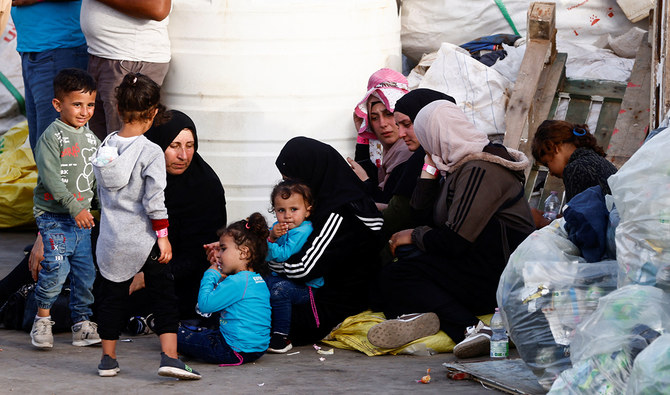
Migrants rescued at sea wait, after disembarking from a vessel, on the Sicilian island of Lampedusa, Italy, September 18, 2023. (Reuters)
Short Url
Updated 18 September 2023
Follow

Italy passes tougher measures to deter migrant arrivals 

  • Move came after almost 10,000 migrants reached southern Italian island of Lampedusa last week
  • New measures lengthen time of detainment, ensure repatriation of people with no legal right to stay 

ROME: The Italian government, struggling with a surge in arriving migrants, on Monday passed measures to lengthen the time they can be detained and ensure more people who have no legal right to stay are repatriated, government officials said. 

The move came after almost 10,000 migrants reached the southern Italian island of Lampedusa last week, dealing a blow to the credibility of right-wing Prime Minister Giorgia Meloni, who won office last year vowing to curb illegal immigration. 

Meloni said at the start of a cabinet meeting on the situation that migrants awaiting repatriation should be detained for an initial six months, extendable to up to 18, up from three months now. 

“That will be all the time needed not only to make the necessary assessments, but also to proceed with the repatriation of those who do not qualify for international protection,” Meloni said in her introductory speech. 

Government sources said the cabinet approved that measure shortly afterwards, as well as the creation of more detention centers in remote areas. Meloni said Italy needed to increase the capacity of such facilities as they had been weakened by “years of immigrationist policies.” 

Under Italian law, migrants facing repatriation can be held if they cannot be immediately expelled. Officials say a majority of migrants head to Italy for economic reasons and are therefore not eligible for asylum. 

Past efforts to hold migrants have largely failed, with those detained repeatedly breaking out of centers and often heading straight to wealthier northern European countries. 

MEASURES CONDEMNED 

Meloni visited Lampedusa on Sunday with European Commission President Ursula von der Leyen, who promised a 10-point EU action plan, but the measures resembled previous initiatives that have failed to make much impact. 

An agreement struck in July between the EU and Tunisia, from where many of the migrants set sail, has yet to take effect. 

Almost 130,000 migrants have arrived in Italy so far this year, according to government data, nearly double the figure for the same period of 2022. The migrants have come from countries including Guinea, Ivory Coast, Tunisia, Egypt, Burkina Faso, Bangladesh and Pakistan. 

The government’s latest move to stem the migrant flow was condemned by the opposition and rights groups. 

The Italian Coalition for Civil Rights and Liberties (CILD) described the detention centers as “black holes” where serious violations of fundamental rights take place, adding that they are expensive and inefficient. 

In April, the Italian parliament approved measures to create new migrant centers for people waiting to hear the outcome of asylum applications, as well as more detention facilities for those facing expulsion. 

As part of the package, it set aside around 20 million euros ($21.3 million) to fund it over a two-year period. ($1 = 0.9379 euros) 


Saudi ambassador becomes first foreign envoy to meet Bangladesh’s new PM

Updated 4 sec ago
Follow

Saudi ambassador becomes first foreign envoy to meet Bangladesh’s new PM

  • Tarique Rahman took oath as PM last week after landslide election win
  • Ambassador Abdullah bin Abiyah also meets Bangladesh’s new FM

Dhaka: Saudi Arabia’s ambassador to Dhaka became on Sunday the first foreign envoy to meet Bangladesh’s new Prime Minister Tarique Rahman since he assumed the country’s top office.

Rahman’s Bangladesh Nationalist Party made a landslide win in the Feb. 12 election, securing an absolute majority with 209 seats in the 300-seat parliament.

The son of former Prime Minister Khaleda Zia and former President and BNP founder Ziaur Rahman, he was sworn in as the prime minister last week.

The Saudi government congratulated Rahman on the day he took the oath of office, and the Kingdom’s Ambassador Abdullah bin Abiyah was received by the premier in the Bangladesh Secretariat, where he also met Bangladesh’s new foreign minister.

“Among the ambassadors stationed in Dhaka, this is the first ambassadorial visit with Prime Minister Tarique Rahman since he assumed office,” Saleh Shibli, the prime minister’s press secretary, told Arab News.

“The ambassador conveyed greetings and best wishes to Bangladesh’s prime minister from the king and crown prince of Saudi Arabia … They discussed bilateral matters and ways to strengthen the ties among Muslim countries.”

Rahman’s administration succeeded an interim government that oversaw preparations for the next election following the 2024 student-led uprising, which toppled former leader Sheikh Hasina and ended her Awami League party’s 15-year rule.

New Cabinet members were sworn in during the same ceremony as the prime minister last week.

Foreign Minister Khalilur Rahman is a former UN official who served as Bangladesh’s national security adviser during the interim government’s term.

He received Saudi Arabia’s ambassador after the envoy’s meeting with the prime minister.

“The foreign minister expressed appreciation for the Saudi leadership’s role in promoting peace and stability in the Middle East and across the Muslim Ummah. He also conveyed gratitude for hosting a large number of Bangladeshi workers in the Kingdom and underscored the significant potential for expanding cooperation across trade, investment, energy, and other priority sectors, leveraging the geostrategic positions of both countries,” the ministry said in a statement.

“The Saudi ambassador expressed his support to the present government and his intention to work with the government to enhance the current bilateral relationship to a comprehensive relationship.”

Around 3.5 million Bangladeshis live and work in Saudi Arabia. They have been joining the Saudi labor market since 1976, when work migration to the Kingdom was established during the rule of the new prime minister’s father.

Bangladeshis are the largest expat group in the Kingdom and the largest Bangladeshi community outside Bangladesh and send home more than $5 billion in remittances every year.