

Red Sea Global’s giga-projects looking to involve Japanese companies

1 / 3
The Red Sea Project aims to be completed by 2030 and to be powered 100 percent by renewable energy. (ANJ)
2 / 3
The Red Sea Project aims to be completed by 2030 and to be powered 100 percent by renewable energy. (ANJ)
3 / 3
The Red Sea Project aims to be completed by 2030 and to be powered 100 percent by renewable energy. (ANJ)
Short Url
Updated 18 September 2023
Follow

Red Sea Global’s giga-projects looking to involve Japanese companies

TOKYO: Red Sea Global outlined its giga-projects and opportunities in Saudi Arabia for Japanese companies interested in being part of the development of tourist destinations along the Red Sea.

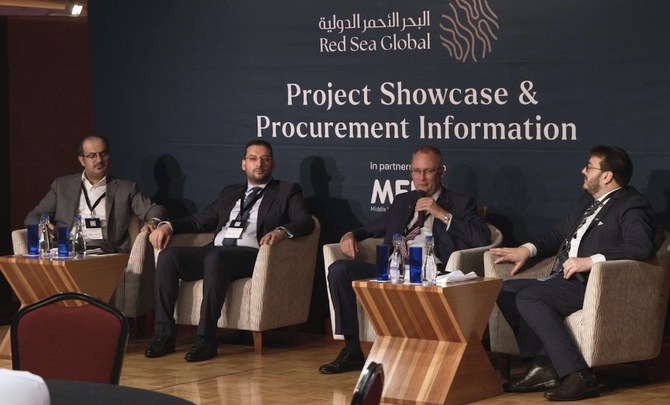
The event was hosted by developer Red Sea Global with participants including the MEED information group and construction company BEC Arabia.

RSG is facilitating an ambitious sustainable tourism industry in Saudi Arabia, which is keen to diversify its economy under its Vision 2030 plan, particularly in the field of tourism. So far, RSG has been involved in the awarding of more than $7.2 billion worth of contracts on the Red Sea project and $3.5 billion on the Amaala project. In 2023, it plans to procure more than $8 billion in contracts.

Ed James of MEED/GlobalData outlined the many opportunities that Saudi Arabia offers as its economy moves away from oil and into other fields, pointing out that nearly half of the contracts awarded in the last two decades have gone to international companies from South Korea, Japan, China and Italy.

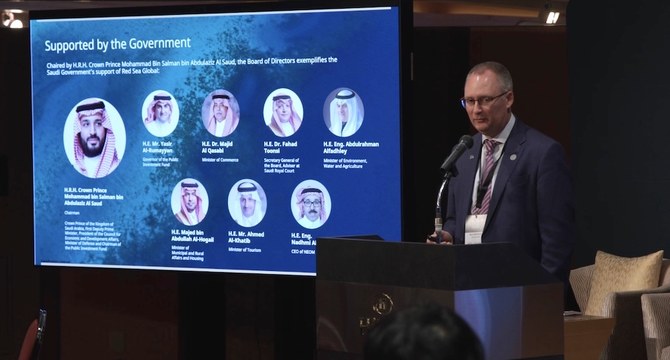
RSG’s Ben Edwards gave an insight into the scale of existing and future projects, which also cover other developments in places such as Qatar and Egypt. He also explained potential costs, material and supply requirements and how companies can be part of the new projects.

“We are the developers behind regenerative tourist destinations on the Red Sea coast in Saudi Arabia, and Phase 1 involves the construction of 16 very luxurious hotels, which are a mixture of inland hotels, some individual island hotels and one large island that has 11 hotels,” he explained. “Add to that Red Sea International Airport and all of the associated backup housing infrastructure of a big tourism resort. A little further up the coast, we have the Amaala project and Phase 1 there consists of eight hotels and a Marina Yacht Club area.

“The opportunities for the Japanese market are very broad as we are not only the designers and constructors of these hotels, we are the operators of them. So, we are procuring the full range of goods and services not only for the design and construction of the resorts and assets but also the operational work streams such as security, catering, air services, ground transportation, even landscaping. So, there are many wide and varied opportunities for Japanese companies, and we are excited to develop the relationships.”

The presentation in Japan aimed to attract the involvement of Japanese companies to the projects, as RSG’S Procurement Executive Director Mohammed Al-Fardan explained: “We are here today in Japan to show the opportunities we have in Red Sea Global and also the projects we have in the pipeline — nine or 10 projects that we have in the master planning phase. Here at Red Sea Global, and also as Saudis, we believe in the Japanese contractors’ and suppliers’ quality and capabilities. We have had a good experience with them at Red Sea Global. We invite all Japanese contractors and suppliers to participate and to join us in our journey.”

Shigeru Nakajima, a senior general manager for Mitsubishi Heavy Industries, told Arab News Japan that his company has had good experiences working in the Kingdom.

“We have long been involved in the Kingdom’s projects in the 1990s and at the beginning of the 2000s. So far, we could not join this project, but we heard that contract conditions had eased, and payment conditions had been worked out, so we really wanted to get involved in Saudi projects again,” he said.

The Red Sea project was launched in 2017 and this year will see the opening of three resorts and Red Sea International Airport, currently for domestic flights only but with international flights to be added next year. The Red Sea project aims to be completed by 2030 and to be entirely powered by renewable energy.

This article originally appeared on Arab News Japan


Saudi Arabia sets global benchmark in AI modernization

Updated 15 January 2026
Follow

Saudi Arabia sets global benchmark in AI modernization

  • Executives hail the Kingdom’s robust infrastructure and strategic workforce programs

RIYADH: Saudi Arabia is emerging as a global leader in artificial intelligence, according to executives from OpenText, one of the world’s largest enterprise information management companies. 

With 22 years of international AI experience, Harald Adams, OpenText’s senior vice president of sales for international markets, said the Kingdom’s modernization efforts are now setting a global standard.

“From my perspective, Saudi Arabia is not only leading the modernization towards artificial intelligence in the Middle East, I think it is even not leading it only in the MENA region. I think it is leading it globally,” Adams told Arab News.

In an interview, Adams and George Schembri, vice president and general manager for the Middle East at OpenText, discussed the Kingdom’s significant investments in AI during the inauguration of OpenText’s new regional headquarters in Riyadh.

“So for us (OpenText), from our perspective, it was a strategic decision to move our MENA headquarters to Saudi Arabia because we believe that we will see here a lot of innovation coming out of the country, we can replicate not only to the MENA region, maybe even further to the global level,” Adams said.

The new headquarters, located in the King Abdullah Financial District, will serve as a central hub for OpenText customers and partners across the Middle East. Its opening reflects a broader trend of tech giants relocating to Riyadh, signaling the Kingdom’s rise as a hub for global AI innovation.

Adams attributed Saudi Arabia’s lead in AI modernization to a combination of substantial financial backing, a unified national strategy, and a remarkable pace of execution.

“I mean, a couple of things, because the ingredients in Saudi Arabia are of course, quite interesting. On the one hand side, Saudi Arabia has deep pockets and great ambitions. And they are, I mean, and they are executing fast, yeah,” he said.
“So from that perspective, at the moment, what we see is that there are, especially on the government side, I can’t see any other government organizations globally moving faster into that direction than it is happening in Saudi Arabia. Not in the region, not even on a global level, they are leading the game,” he underlined.

Schembri added, “Saudi’s AI vision is one of the most ambitious in the world, and AI on a national scale is not good without trusted, secured, and governed, and this is where OpenText helps to enable the Saudi organizations to be able to deliver on the 2030 Vision.”

“The Kingdom’s focus on AI and digital transformation creates a powerful opportunity for organizations to unlock value from their information,” Schembri stated.
“With OpenText on the ground in Riyadh, our customers gain direct access to trusted global expertise combined with local insight — enabling them to manage information securely, scale AI with confidence, and compete on a global stage,” he added.

DID YOU KNOW?

• Saudi Arabia ranks 5th globally and 1st in the region for AI growth under the 2025 Global AI Index.

• The Kingdom is also 3rd globally in advanced AI model development, trailing only the US and China.

• AI is projected to contribute $235.2 billion — or 12.4 percent — to Saudi Arabia’s GDP by 2030.

The inauguration of OpenText’s new regional headquarters was attended by Canada’s Minister of International Trade and Economic Development, Maninder Sidhu, and Jean-Philippe Linteau, Canada’s ambassador to Saudi Arabia. 

Sidhu emphasized the alignment of Saudi Vision 2030 with Canada’s economic and innovation goals.

“His Highness (Crown Prince Mohammed bin Salman) and Vision 2030, there is a lot of alignment with Canada, as you know, with the economic collaboration, with his vision around mining, around education, tourism, healthcare, you look at AI and tech, there’s a lot of alignment here at OpenText Grand opening their regional headquarters,” Sidhu told Arab News.

Saudi Arabia’s AI ambitions are projected to contribute $235.2 billion — or 12.4 percent — to its GDP by 2030, according to PwC. The Saudi Data and AI Authority, established by a royal decree in 2019, drives the Kingdom’s national data and AI strategy.

One flagship initiative, Humain, chaired by Crown Prince Mohammed bin Salman, was launched in May 2025 under the Public Investment Fund. It aims to build a full AI stack — from data centers and cloud infrastructure to models and applications — positioning Saudi Arabia as a globally competitive AI hub. The project plans to establish a data center capacity of 1.8 GW by 2030 and 100 GW of AI compute capacity by 2026.

Saudi Arabia is also expanding international partnerships. In May 2025, Humain signed a $5 billion agreement with Amazon Web Services to accelerate AI adoption domestically and globally, focusing on infrastructure, services, and talent development.

The Kingdom ranked fifth globally and first in the Arab region for AI sector growth under the 2025 Global AI Index, and third worldwide in advanced AI model development, behind only the US and China, according to the Stanford University AI Index 2025.

Education is another pillar of Saudi AI strategy. Starting in the 2025-26 academic year, AI will be taught as a core subject across all public school grades, reaching roughly 6.7 million students. The curriculum will cover algorithmic thinking, data literacy, and AI ethics.

OpenText executives emphasized their commitment to supporting Vision 2030 and the national AI strategy through workforce development.

“OpenText has put a lot of investment in the Kingdom, right. We brought cloud to the Kingdom, we’ve opened our headquarters in the Kingdom, we’ve basically hiring Saudis in the Kingdom, We basically building, if you like, an ecosystem to support the Kingdom. And on top of that, what we’re doing is we’re putting a plan together, if you like, a program to look at how we can educate, if you like, the students at universities,” Schembri said.
“So this is something that we are looking into, we are basically investigating and to see how we can support the Saudi nationals when they come into the workplace. And I’m really excited. I have Harry who is, our leadership who’s supporting this program.”
“It’s something that we are putting together. It’ll take some effort. So it’s still in play because we want to make sure what we put it basically delivers on what we're trying to achieve based on the vision of Saudi,” he added.

“The younger generation is sooner or later either working for us or maybe for a partner or for maybe for a customer. So that’s why we are to 100 percent committed to enable all of that,” Adams said.