

Red Sea Global inks deal with EDF, Masdar to make AMAALA sustainable 

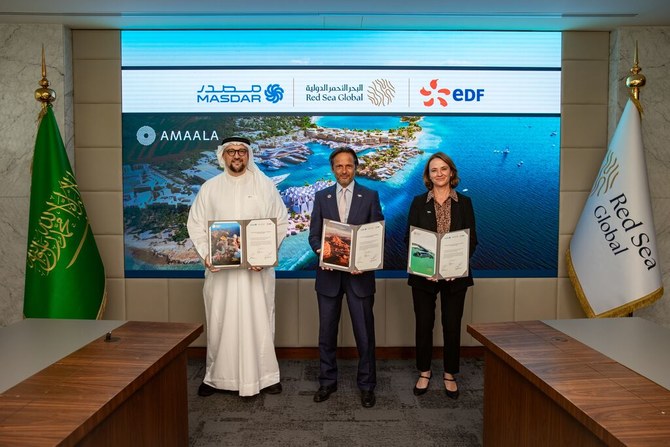
The agreement, a 25-year concession, focuses on a multi-utility infrastructure facility to serve the tourist destination, according to a press release. Photo/Supplied
Short Url
Updated 11 September 2023
Follow

Red Sea Global inks deal with EDF, Masdar to make AMAALA sustainable 

RIYADH: Ultra-luxury resort destination AMAALA is on track to become fully powered by solar energy following a partnership between developer Red Sea Global and French utility company EDF, along with the UAE's clean energy major, Masdar.  

The agreement, a 25-year concession, focuses on a multi-utility infrastructure facility to serve the tourist destination, according to a press release. 

The newly established facility has an optimized off-grid renewable energy system that generates energy through photovoltaic technology. This setup also includes a battery energy storage solution, ensuring a sustainable 24/7 power supply for the desalination and wastewater treatment plants. 

“Sustainability is a cornerstone of AMAALA, and our new partnership with EDF and Masdar will drive us toward achieving a zero-carbon footprint once fully operational,” said RSG Group CEO John Pagano in a press statement. 

According to RSG’s statement, AMAALA’s renewable supply system has the capacity to generate up to 410,000 megawatt hour per annum, which is enough to power 10,000 households for an entire year.   

The system includes a 700 MWh battery storage facility, which ensures AMAALA will be powered by renewables, day and night. There will also be a water desalination plant that uses reverse osmosis technology and has a capacity of 37 million liters of water per day.   

The contract was structured as an independent public-private partnership, encompassing the design, construction, and operation of utility systems, along with the accompanying networks and infrastructure. 

“With more than 90 percent of its electricity production decarbonized, the EDF group is pursuing its ambition to contribute to reach carbon neutrality by 2050. Our objective is to continue to be a key player in the development of innovative, fully resilient, and net-zero electrical systems,” Béatrice Buffon, group executive vice president in charge of EDF’s international division said.  

He added that this project will set new standards of execution and operation for EDF and the Kingdom.   

For his part, Mohamed Jameel Al-Ramahi, CEO of Masdar, said: “For this fully integrated utility project in partnership with Red Sea Global and EDF, we have brought together a suite of innovative solutions and technologies including solar, battery storage and desalination.”     

He added that this is a unique project that will help drive sustainable economic development to the “beautiful tourism destination” of AMAALA.   

RSG stated that its utility concession agreement with EDF and Masdar has an initial 25-year term with the option to extend. The agreement covers financing, engineering, development, construction, operation, maintenance, and transfer of a multi-utility infrastructure facility. 

Furthermore, while this deal helps AMAALA achieve its net-zero ambitions, the destination will go beyond sustainability to have a regenerative impact on the environment. The goal is to deliver a 30 percent net conservation benefit to local ecosystems by 2040. 

“This will be achieved by enhancing biologically diverse habitats including mangroves, seagrass, corals and land vegetation that help biodiversity to flourish while contributing to carbon sequestration efforts too,” RSG further added. 


Jordan’s industry fuels 39% of Q2 GDP growth

Updated 31 December 2025
Follow

Jordan’s industry fuels 39% of Q2 GDP growth

JEDDAH: Jordan’s industrial sector emerged as a major contributor to economic performance in 2025, accounting for 39 percent of gross domestic product growth in the second quarter and 92 percent of national exports.

Manufactured exports increased 8.9 percent year on year during the first nine months of 2025, reaching 6.4 billion Jordanian dinars ($9 billion), driven by stronger external demand. The expansion aligns with the country’s Economic Modernization Vision, which aims to position the country as a regional hub for high-value industrial exports, the Jordan News Agency, known as Petra, quoted the Jordan Chamber of Industry President Fathi Jaghbir as saying.

Export growth was broad-based, with eight of 10 industrial subsectors posting gains. Food manufacturing, construction materials, packaging, and engineering industries led performance, supported by expanded market access across Europe, Arab countries, and Africa.

In 2025, Jordanian industrial products reached more than 144 export destinations, including emerging Asian and African markets such as Ethiopia, Djibouti, Thailand, the Philippines, and Pakistan. Arab countries accounted for 42 percent of industrial exports, with Saudi Arabia remaining the largest market at 955 million dinars.

Exports to Syria rose sharply to nearly 174 million dinars, while shipments to Iraq and Lebanon totaled approximately 745 million dinars. Demand from advanced markets also strengthened, with exports to India reaching 859 million dinars and Italy about 141 million dinars.

Industrial output also showed steady improvement. The industrial production index rose 1.47 percent during the first nine months of 2025, led by construction industries at 2.7 percent, packaging at 2.3 percent, and food and livestock-related industries at 1.7 percent.

Employment gains accompanied the sector’s expansion, with more than 6,000 net new manufacturing jobs created during the period, lifting total industrial employment to approximately 270,000 workers. Nearly half of the new jobs were generated in food manufacturing, reflecting export-driven growth.

Jaghbir said industrial exports remain among the economy’s highest value-added activities, noting that every dinar invested generates an estimated 2.17 dinars through employment, logistics, finance, and supply-chain linkages. The sector also plays a critical role in narrowing the trade deficit and supporting macroeconomic stability.

Investment activity accelerated across several subsectors in 2025, including food processing, chemicals, pharmaceuticals, mining, textiles, and leather, as manufacturers expanded capacity and upgraded production lines to meet rising demand.

Jaghbir attributed part of the sector’s momentum to government measures aimed at strengthening competitiveness and improving the business environment. Key steps included freezing reductions in customs duties for selected industries, maintaining exemptions for production inputs, reinstating tariffs on goods with local alternatives, and imposing a 16 percent customs duty on postal parcels to support domestic producers.

Additional incentives in industrial cities and broader structural reforms were also cited as improving the investment climate, reducing operational burdens, and balancing consumer needs with protection of local industries.