Pakistan’s finance minister highlights early signs of economic recovery amid continuing challenges

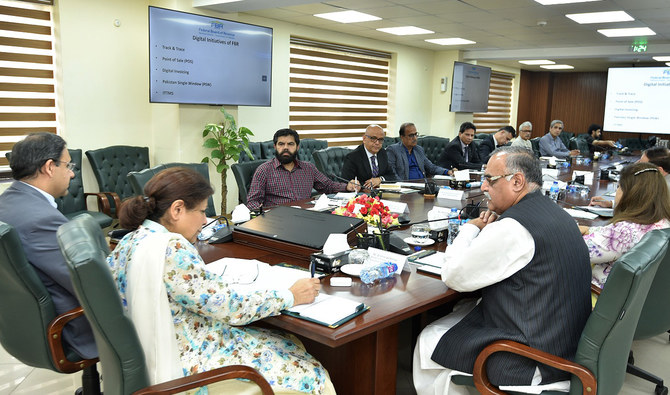
Pakistan's interim finance minister Dr. Shamshad Akhtar holds a meeting of the Federal Board of Revenue at FBR headquarters in Islamabad on Spetember 15, 2023. (Photo courtesy: Ministry of Finance)
Short Url
Updated 15 September 2023
Follow

Pakistan’s finance minister highlights early signs of economic recovery amid continuing challenges

  • Dr. Shamshad Akhtar says inflationary pressure is down and business activity taking off in industrial and service sectors
  • She says the central bank’s decision not to increase key interest rate will help the industrial sector prosper in the future

ISLAMABAD: Dr. Shamshad Akhtar, Pakistan’s caretaker finance minister, mentioned encouraging signs of economic recovery during a news conference on Friday, citing a reduction in inflationary pressures and increased activity in the agricultural, industrial and service sectors.

Akhtar’s statement comes just months after Pakistan averted a sovereign debt default by securing a short-term $3 billion loan from the International Monetary Fund (IMF) amid declining foreign exchange reserves and a rapidly depreciating national currency.

The country’s caretaker administration, led by Prime Minister Anwaar-ul-Haq Kakar, launched a massive crackdown on individuals involved in smuggling and hoarding essential commodities upon assuming power in August, which led to a reduction in their prices in the market.

The declining trend of the Pakistani rupee against the US dollar was also curtailed after the government targeted the currency black market within the country.

“The caretaker government has inherited plenty of challenges, but we are not afraid of them and making efforts to tackle with them one after another,” she told a media briefing in the federal capital.

“There are some signs of economic recovery, even if it is just starting,” she continued. “On the inflation side, the CPI is in on a decline from May figures of over 38 percent to 27.2 percent now. This is a very important indicator that shows we have come out of certain difficulties, and we hope that price stability will improve as we go forward.”

The minister noted the country’s productive sectors, such as agriculture, had also gained pace, adding that economic figures also indicated recovery in the cement and other industries.

She said the macroeconomic indicators of the economy were showing improvement while describing the service sector as “vibrant.”

“We are trying to control the expenditures and enhance our revenues,” she added. “It is only through this that we can bring betterment in the situation.”

Akhtar noted the central bank had not increased the interest rate during its recent monetary policy announcement while hoping the decision would make the industrial sector prosper.

She also pointed out that Pakistan’s reserves were stable and the government was not focusing on bringing remittances through official banking channels.

“The government has rolled up its sleeves and is actually working,” she said.


Pakistan seeks operationalization of World Bank’s $20 billion framework to advance reform priorities

Updated 5 sec ago
Follow

Pakistan seeks operationalization of World Bank’s $20 billion framework to advance reform priorities

  • Pakistan’s finance chief meets World Bank Country Director Bolormaa Amgaabazar in the capital
  • The Bank’s 10-year Country Partnership Agreement for Pakistan was approved in January last year

ISLAMABAD: Pakistan’s Finance Minister Muhammad Aurangzeb on Wednesday called for the operationalization of the World Bank Country Partnership Framework (CPF) to advance the government’s key reform priorities during a meeting with the Bank’s country director, according to a statement.

The Bank’s Board of Directors approved a 10-year CPF deal with Pakistan, indicating $20 billion in financing for Pakistan under the framework. The amount will include public and private financing from the World Bank Group, with roughly half expected to come from private-sector operations led by the International Finance Corporation (IFC).

“The Finance Minister emphasized the importance of effective operationalization of the CPF, particularly in priority areas such as population management and climate change,” the finance ministry said in a statement after Aurangzeb’s meeting with the Bank’s Country Director Bolormaa Amgaabazar.

“He underscored the need for strong coordination between federal and provincial governments to ensure coherence in policy design and implementation.”

Discussions focused on population, human capital development, climate resilience, agricultural reform and energy sector sustainability, it added.

The ministry said both sides exchanged views on enhancing institutional coordination, improving transparency in project design and strengthening monitoring mechanisms to deliver intended outcomes. It highlighted that the World Bank expressed readiness to continue supporting agricultural transformation efforts in collaboration with the IFC.

“Both sides agreed to continue technical-level engagements to explore feasible solutions in line with Pakistan’s reform agenda and fiscal framework,” the finance ministry added.

Climate resilience and population control are major concerns for policymakers in Pakistan, a country whose population exceeds 241 million, making it the world’s sixth-most populous country. Limited infrastructure, health care, and educational opportunities place added strain on public services, contributing to unemployment and poverty.

The South Asian nation is also among the countries most affected by climate change. Unusually heavy monsoon rains in 2022 killed more than 1,700 people and caused over $30 billion in damages. Torrential rains and floods since late June last year have claimed more than 1,000 lives, as authorities continue surveys to assess the full extent of the destruction.