NASA joins the still controversial search for UFOs 

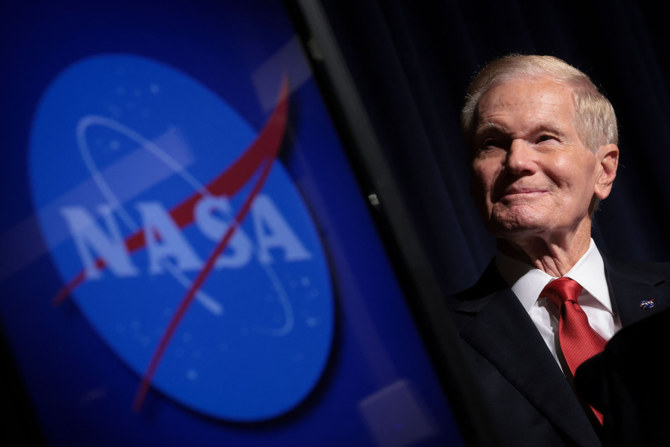
NASA Administrator Bill Nelson attends a press conference at NASA headquarters on September 14, 2023 in Washington, DC.(Getty Images/AFP)
Short Url
Updated 15 September 2023
Follow

NASA joins the still controversial search for UFOs 

  • NASA says it is well positioned to investigate what it calls “unidentified anomalous phenomena,” or UAP
  • “We want to shift the conversation about UAP from sensationalism to science,” says agency chief Bill Nelson

WASHINGTON: NASA on Thursday officially joined the search for UFOs — but reflecting the stigma attached to the field, the US space agency kept secret for hours the identity of the person heading a new program tracking mystery flying objects.
The official’s appointment is the result of a year-long NASA fact-finding report into what it calls “unidentified anomalous phenomena,” or UAP.
“At NASA, it’s in our DNA to explore — and to ask why things are the way they are,” agency chief Bill Nelson said.
An independent team of 16 researchers concluded in the report that the search for UAPs “demands a rigorous, evidence-based approach.”
NASA is well positioned to play a prominent role, thanks to its satellite capabilities and other technical assets. But the agency stressed in its report that any findings of possible extraterrestrial origin “must be the hypothesis of last resort — the answer we turn to only after ruling out all other possibilities.”
“We want to shift the conversation about UAP from sensationalism to science,” Nelson said.
While initially withholding the program leader’s name, NASA ultimately relented Thursday evening, saying in an updated press release it had appointed Mark McInerney as director of UAP research.
In government positions since 1996, McInerney has served as NASA’s liaison to the Pentagon on UAP issues.
Even if NASA has long explored the heavens, hunting for the origin, identity and purpose of a growing number of unexplained flying objects over planet Earth is bringing unprecedented challenges.
Military and civilian pilots keep offering a multitude of reports on strange sightings. But decades of movies and sci-fi books about aliens mean the entire topic is mostly laughed off by the public as the territory of cranks.
That atmosphere explained the unusual decision by NASA to initially withhold the lead UAP official’s identity.
“We need to ensure that the scientific process and methods are free,” said Daniel Evans, who worked on NASA’s report leading to the announcement.
“Some of the threats and the harassment have been beyond the pale, quite frankly,” Evans said.

There have been more than 800 “events” collected over 27 years, of which two to five percent are thought to be possibly anomalous, the report’s authors said in May.
These are defined as “anything that is not readily understandable by the operator or the sensor,” or “something that is doing something weird,” said team member Nadia Drake.
The US government has begun taking UAP issues more seriously in recent years, in part due to concerns that they are related to foreign surveillance.
One example of a still-unexplained phenomenon was a flying metallic orb spotted by an MQ-9 drone at an undisclosed location in the Middle East. Footage of the UAP was shown to Congress in April.
NASA’s work, which relies on unclassified material, is separate from a parallel Pentagon investigation, though the two are coordinating on how to apply scientific tools and methods.
In July, a former US intelligence officer made headlines when he told a congressional committee he “absolutely” believes the government is in possession of unidentified anomalous phenomena — as well as remains of their alien operators.
“My testimony is based on information I’ve been given by individuals with a longstanding track record of legitimacy and service to this country — many of whom also shared compelling evidence in the form of photography, official documentation and classified oral testimony,” David Grusch told lawmakers.
Earlier this week, the alleged bodies of two “non-human” beings were presented during a congressional hearing in Mexico, generating a mixture of surprise, disbelief and ridicule on social media.
The purported mummified remains, which had a grayish color and a human-like body form, were brought by Jaime Maussan, a controversial Mexican journalist and researcher who reported finding them in Peru in 2017.


Youth voters take center stage in Bangladesh election after student-led regime change

Updated 38 min 40 sec ago
Follow

Youth voters take center stage in Bangladesh election after student-led regime change

  • About 45% of Bangladeshis eligible to vote in Thursday’s election are aged 18-33
  • Election follows 18 months of reforms after the end of Sheikh Hasina’s 15-year rule

DHAKA: When he goes to the polls on Thursday, Atikur Rahman Toha will vote for the first time, believing that this election can bring democratic change to Bangladesh.

A philosophy student at Dhaka University, Toha was already eligible to vote in the 2024 poll but, like many others, he opted out.

“I didn’t feel motivated to even go to vote,” he said. “That was a truly one-sided election. The election system was fully corrupted. That’s why I felt demotivated. But this time I am truly excited to exercise my voting rights for the first time.”

The January 2024 vote was widely criticized by both domestic and international observers and marred by a crackdown on the opposition and allegations of voter fraud.

But the victory of the Awami League of ex-Prime Minister Sheikh Hasina was short-lived, as a few months later the government was ousted by a student-led uprising, which ended the 15-year rule of Bangladesh’s longest-serving leader.

The interim administration, led by Nobel laureate Muhammad Yunus, took control in August 2024 and prepared a series of reforms to restructure the country’s political and institutional framework and organize the upcoming vote.

About 127.7 million Bangladeshis are eligible to cast their ballots, according to Election Commission data, with nearly a third of them, or 40.4 million, aged 18-29. Another 16.9 million are 30-33, making it a youth–dominated poll, with the voters hopeful the outcome will help continue the momentum of the 2024 student-led uprising.

“We haven’t yet fully transitioned into a democratic process. And there is no fully stable situation in the country,” Toha said. “After the election we truly hope that the situation will change.”

For Rawnak Jahan Rakamoni, also a Dhaka University student, who is graduating in information science, voting this time meant that her voice would count.

“We are feeling that we are heard, we will be heard, our opinion will matter,” she said.

“I think it is a very important moment for our country, because after many years of controversial elections, people are finally getting a chance to exercise their voting rights and people are hoping that this election will be more meaningful and credible. This should be a fair election.”

But despite the much wider representation than before, the upcoming vote will not be entirely inclusive in the absence of the Awami League, which still retains a significant foothold.

The Election Commission last year barred Hasina’s party from contesting the next national elections, after the government banned Awami League’s activities citing national security threats and a war crimes investigation against the party’s top leadership.

The UN Human Rights Office has estimated that between July 15 and Aug. 5, 2024 the former government and its security and intelligence apparatus, together with “violent elements” linked to the Awami League, “engaged systematically in serious human rights violations and abuses in a coordinated effort to suppress the protest movement.”

It estimated that at least 1,400 people were killed during the protests, with the majority shot dead from military rifles.

Rezwan Ahmed Rifat, a law student, wanted the new government to “ensure justice for the victims of the July (uprising), enforced disappearances, and other forms of torture” carried out by the previous regime.

The two main parties out of the 51 contesting Thursday’s vote are the Bangladesh Nationalist Party and Jamaat-e-Islami. Jamaat, which in 2013 was banned from political participation by Hasina’s government, heads an 11-party alliance, including the National Citizen Party formed by student leaders from the 2024 movement.

“I see this election as a turning point of our country’s democratic journey … It’s not just a normal election,” said Falguni Ahmed, a psychology student who will head to the polls convinced that no matter who wins, it will result in the “democratic accountability” of the next government.

Ahmed added: “People are not voting only for their leaders; they are also voting for the restoration of democratic credibility. That’s why this election is very different.”