

‘Worst enemy’: Morocco quake brings new hardships for farmers

1 / 2
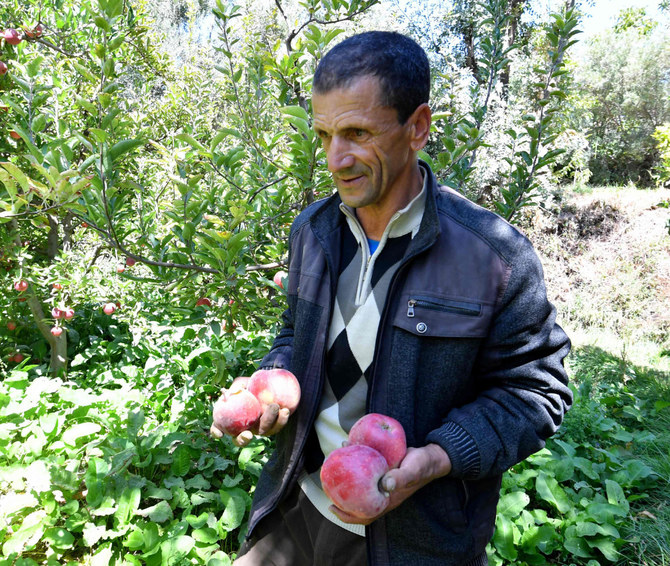
armer Mohammed Al-Moutawak shows apples that fell prematurely from his trees in the village of Ineghede in the High Atlas mountains of central Morocco. (AFP)
2 / 2
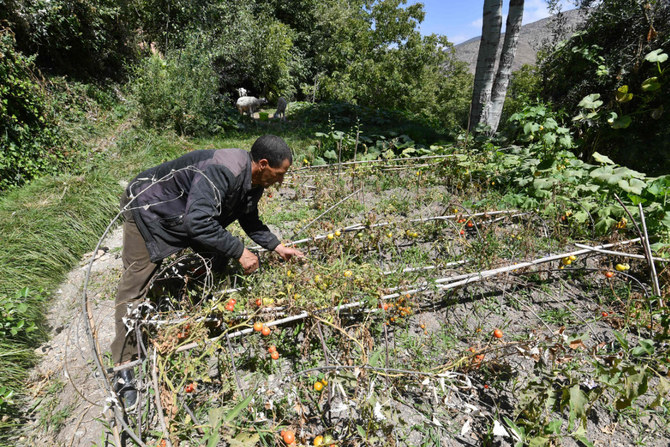
Farmer Mohammed Al Moutawak checks his damaged tomato plants in the village of Ineghede in the High Atlas mountains of central Morocco on September 13, 2023. (Fethi Belaid/AFP)
Short Url
Updated 15 September 2023
Follow

‘Worst enemy’: Morocco quake brings new hardships for farmers

  • Quake aggravates impact of drought and extreme weather that have long taken a toll on the North African kingdom’s growers
  • Access to water is now one of the biggest looming problems as almost all the pipes in the farming region had been destroyed

INEGHEDE, Morocco: Mohammed Al Moutawak’s village was destroyed by Morocco’s powerful earthquake and his apple harvest ruined, but he refuses to leave the land that is vital to small farmers like him.
Drought and extreme weather have long taken a toll on the North African kingdom’s growers, but the quake spells new challenges that are just beginning to come into focus.
“We thought hail was our worst enemy, but now we’ve got another,” said the 56-year-old farmer from the mountain village of Ineghede in the worst-hit Al-Haouz region south of Marrakech.
“The earthquake, it has destroyed everything.”
Days after the quake that killed more than 2,900 people, he was looking sadly at his apple and walnut trees growing on terraces carved into the Atlas Mountains.
With dust-covered hands, he pointed to the trees his family has cultivated for generations and which still stand, unlike the stone and wood houses of his village.
The September 8 disaster killed 11 of the hamlet’s 200 inhabitants and left survivors living in yellow aid tents.
The Golden and Gala apples Moutawak had expected to harvest now laid in the grass, their scent mingling with the stench of a decomposing donkey buried under the rubble.
Because the fruit had not yet ripened, his harvest is lost, along with the profits he had hoped to use to settle his debts.

In the village, the search for survivors is over.
All bodies have been recovered and everyone else is accounted for, unlike in other towns where rescue workers were still searching for signs of life, six days after the quake.
Women were sorting through blankets and clothes delivered by civilians while men were digging through the rubble for the basics of daily life: glasses, pots and water cans.
As elsewhere in these mountains, small-scale farming, along with herding goats, cows and other livestock, is an essential source of food and income.
“We work hard to raise a little money by harvesting apples, so that we can prepare for the start of the new school year and help our families a little,” said another resident, Jamel Ait Bouyahia, 42.
In recent years, the Moroccan government and donors have pushed ahead with aid programs, some aimed at boosting resilience in the face of climate change.
Other development initiatives have more specifically aimed to break through the isolation of village life and provide more autonomy to women.
There have also been programs to reuse treated wastewater in agriculture, and to promote water-saving drip-irrigation.

Access to water is now one of the biggest looming problems.
“The sector most seriously affected by the earthquake is irrigation,” said Bouyahia, who added that almost all the pipes had been destroyed.
There is still water in the wells, but stones that shifted during the quake have blocked the flow from springs, said Moutawak.
Moroccan authorities say the problem is widespread in the region, with water networks also impacted in areas including Amizmiz, Moulay Brahim and Talat Nyacoub.
The upcoming reconstruction efforts will serve as “a wake-up call for development workers,” said Hlima Razkaoui, director of the group Care Maroc, which has worked extensively in the region.
She said the effort will have to help people rebuild in a resilient way, with improved access to water, voicing hope that this will give communities “an opportunity to bounce back.”


Israel confirms ban on 37 NGOs in Gaza

A Palestinian woman carries wood for fire in the Nuseirat refugee camp in the central Gaza Strip on December 31, 2025. (AFP)
Updated 3 sec ago
Follow

Israel confirms ban on 37 NGOs in Gaza

JERUSALEM: Israel on Thursday said 37 humanitarian agencies supplying aid in Gaza had not met a deadline to meet “security and transparency standards,” and would be banned from the territory, despite an international outcry.
The international NGOs, which had been ordered to disclose detailed information on their Palestinian staff, will now be required to cease operations by March 1.
The United Nations has warned that this will exacerbate the humanitarian crisis in the war-ravaged Palestinian territory.
“Organizations that have failed to meet required security and transparency standards will have their licenses suspended,” Israel’s Ministry of Diaspora Affairs and Combating Antisemitism said in a statement.
Several NGOS have said the requirements contravene international humanitarian law or endanger their independence.
Israel says the new regulation aims to prevent bodies it accuses of supporting terrorism from operating in the Palestinian territories.
Prominent humanitarian organizations hit by the ban include Doctors Without Borders (MSF), the Norwegian Refugee Council (NRC), World Vision International and Oxfam, according to a ministry list.
In MSF’s case, Israel accused it of having two employees who were members of Palestinian militant groups Islamic Jihad and Hamas.
MSF said this week the request to share a list of its staff “may be in violation of Israel’s obligations under international humanitarian law” and said it “would never knowingly employ people engaging in military activity.”
‘Critical requirement’ 
NRC spokesperson Shaina Low told AFP its local staff are “exhausted” and international staff “bring them an extra layer of help and security. Their presence is a protection.”
Submitting the names of local staff is “not negotiable,” she said. “We offered alternatives, they refused,” hse said, of the Israeli regulators.
The ministry said Thursday: “The primary failure identified was the refusal to provide complete and verifiable information regarding their employees, a critical requirement designed to prevent the infiltration of terrorist operatives into humanitarian structures.”
In March, Israel gave NGOs 10 months to comply with the new rules, which demand the “full disclosure of personnel, funding sources, and operational structures.”
The deadline expired on Wednesday.
The 37 NGOs “were formally notified that their licenses would be revoked as of January 1, 2026, and that they must complete the cessation of their activities by March 1, 2026,” the ministry said Thursday.
A ministry spokesperson told AFP that following the revocation of their licenses, aid groups could no longer bring assistance into Gaza from Thursday.
However, they could have their licenses reinstated if they submitted the required documents before March 1.
Minister of Diaspora Affairs and Combating Antisemitism Amichai Chikli said “the message is clear: humanitarian assistance is welcome — the exploitation of humanitarian frameworks for terrorism is not.”
‘Weaponization of bureaucracy’
On Thursday, 18 Israel-based left-wing NGOs denounced the decision to ban their international peers, saying “the new registration framework violates core humanitarian principles of independence and neutrality.”
“This weaponization of bureaucracy institutionalizes barriers to aid and forces vital organizations to suspend operations,” they said.
UN Palestinian refugee agency chief Philippe Lazzarini had said the move sets a “dangerous precedent.”
“Failing to push back against attempts to control the work of aid organizations will further undermine the basic humanitarian principles of neutrality, independence, impartiality and humanity underpinning aid work across the world,” he said on X.
On Tuesday, the foreign ministers of 10 countries, including France and Britain, urged Israel to “guarantee access” to aid in the Gaza Strip, where they said the humanitarian situation remains “catastrophic.”
A fragile ceasefire has been in place since October, following a deadly war waged by Israel in response to Hamas’s unprecedented October 7, 2023 attack on Israel.
Nearly 80 percent of buildings in Gaza have been destroyed or damaged by the war, according to UN data.
About 1.5 million of Gaza’s more than two million residents have lost their homes, said Amjad Al-Shawa, director of the Palestinian NGO Network in Gaza.