

Britain, France and Germany say they will keep their nuclear and missiles sanctions on Iran

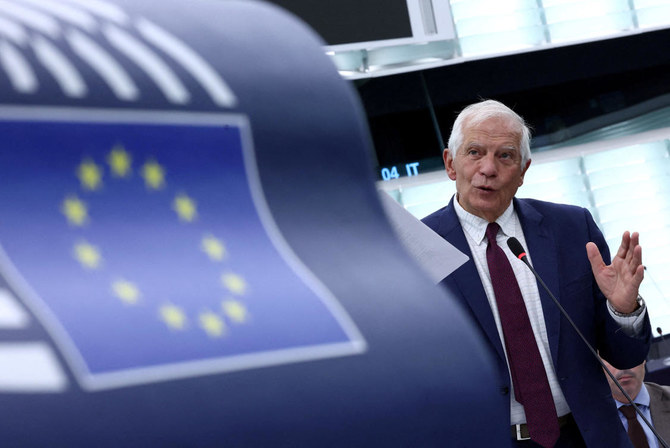
High Representative of the European Union for Foreign Affairs and Security Policy Josep Borrell addresses the European Parliament in Strasbourg on Sept. 12, 2023. (Reuters)
Short Url
Updated 15 September 2023
Follow

Britain, France and Germany say they will keep their nuclear and missiles sanctions on Iran

  • The three European allies said they would retain their sanctions in a “direct response to Iran’s consistent and severe non-compliance” with the accord
  • The measures bar anyone from buying, selling or transferring drones and missiles to and from Iran

VIENNA: Britain, France and Germany announced Thursday they will keep their sanctions on Iran related to the Mideast country’s atomic program and development of ballistic missiles.
The measures were to expire in October under a timetable spelled out in the now defunct nuclear deal between Tehran and world powers.
In a joint statement, the three European allies known as E3 that had helped negotiate the nuclear deal, said they would retain their sanctions in a “direct response to Iran’s consistent and severe non-compliance” with the accord, also known by its official name as Joint Comprehensive Plan of Action or JCPOA.
The measures ban Iran from developing ballistic missiles capable of delivering nuclear weapons and bar anyone from buying, selling or transferring drones and missiles to and from Iran. They also include an asset freeze for several Iranian individuals and entities involved in the nuclear and ballistic missile program.
Iran has violated the sanctions by developing and testing ballistic missiles and sending drones to Russia for its war on Ukraine.

BACKGROUND

A November resolution ordered Iran to cooperate urgently with the International Atomic Energy Agency’s investigation into the presence of uranium particles at three undeclared sites, since narrowed down to two.

The sanctions will remain in place until Tehran “is fully compliant” with the deal, the E3 said. The sanctions, according to the accord from eight years ago, were to expire on Oct. 18.
The 2015 nuclear deal meant to ensure that Iran could not develop atomic weapons. Under the accord, Tehran agreed to limit enrichment of uranium to levels necessary for nuclear power in exchange for the lifting of economic sanctions.
In 2018, then-President Donald Trump unilaterally pulled the United States out of the accord, saying he would negotiate a stronger deal, but that did not happen. Iran began breaking the terms a year later and is now enriching uranium to nearly weapons-grade levels, according to a report by the United Nations’ nuclear watchdog.
Formal talks to try to find a roadmap to restart the deal collapsed in August 2022.
The E3 have informed the European Union’s foreign policy chief, Josep Borrell, about their decision, the statement said. Borrell, in turn, said he had forwarded the E3 letter to other signatories of the 2015 deal — China, Russia and Iran.
The development comes at a delicate moment as the United States is preparing to finalize a prisoner swap with Iran that would include the unfreezing of Iranian assets held in South Korean banks worth $6 billion.
Iran’s mission to the United Nations did not immediately respond to a request for comment.
US State Department spokesman Matthew Miller told reporters that Washington was in touch with the European allies over “the appropriate next steps.”
“We are working closely with our European allies, including members, of course, of the E3, to address the continued threat that Iran poses including on missiles and arms transfers with the extensive range of unilateral and multilateral tools that are at our disposal,” he said.
Iran has long denied ever seeking nuclear weapons and continues to insist that its program is entirely for peaceful purposes, though Rafael Mariano Grossi of the International Atomic Energy Agency, the UN nuclear watchdog, has warned that Tehran has enough enriched uranium for “several” nuclear bombs if it chose to build them.
Under the terms of the nuclear deal, a UN arms embargo against Tehran will expire on Oct. 18, after which countries that do not adopt similar sanctions on their own as the E3 — likely Russia and perhaps also China — will no longer be bound by the UN restrictions on Iran.
However, Iran has lately slowed the pace at which it is enriching uranium, according to a report by the IAEA that was seen by The Associated Press earlier this month. That could be a sign Tehran is trying to ease tensions after years of strain between it and the US
“The decision makes sense,” Henry Rome, an analyst with the Washington Institute for Near East Policy, said of the European decision. “The real question is how Iran will react. Given the broader de-escalation efforts underway, I would expect Iran not to act rashly, but we never know.”


Egyptian woman faces death threats for filming alleged harasser

Updated 6 sec ago
Follow

Egyptian woman faces death threats for filming alleged harasser

  • Case revives longstanding national debate in Egypt over harassment and violence against women
  • A 2013 UN study found that 99.3 percent of Egyptian women reported experiencing harassment
CAIRO: A young Egyptian woman is facing death threats after posting a video showing the face of a man she says repeatedly harassed her, reviving debate over how victims are treated in the country.
Mariam Shawky, an actress in her twenties, filmed the man aboard a crowded Cairo bus earlier this week, accusing him of stalking and harassing her near her workplace on multiple occasions.
“This time, he followed me on the bus,” Shawky, who has been dubbed “the bus girl” by local media, said in a clip posted on TikTok.
“He kept harassing me,” added the woman, who did not respond to an AFP request for comment.
Hoping other passengers would intervene, Shawky instead found herself isolated. The video shows several men at the back of the bus staring at her coldly as she confronts her alleged harasser.
The man mocks her appearance, calls her “trash,” questions her clothing and moves toward her in what appears to be a threatening manner.
No one steps in to help. One male passenger, holding prayer beads, orders her to sit down and be quiet, while another gently restrains the man but does not defend Shawky.
Death threats
As the video spread across social media, the woman received a brief flurry of support, but it was quickly overwhelmed by a torrent of abuse.
Some high-profile public figures fueled the backlash.
Singer Hassan Shakosh suggested she had provoked the situation by wearing a piercing, saying it was “obvious what she was looking for.”
Online, the comments were more extreme. “I’ll be the first to kill you,” one user wrote. “If you were killed, no one would mourn you,” said another.
The case has revived a longstanding national debate in Egypt over harassment and violence against women.
A 2013 UN study found that 99.3 percent of Egyptian women reported experiencing harassment, with more than 80 percent saying they faced it regularly on public transport.
That same year, widespread protests against sexual violence rocked the Egyptian capital.
In 2014, a law criminalizing street harassment was passed. However, progress since then has been limited. Enforcement remains inconsistent and authorities have never released figures on the number of convictions.
Public concern spiked after previous high-profile incidents, including the 2022 killing of university student Nayera Ashraf, stabbed to death by a man whose advances she had rejected.
The perpetrator was executed, yet at the time “some asked for his release,” said prominent Egyptian feminist activist Nadeen Ashraf, whose social-media campaigning helped spark Egypt’s MeToo movement in 2020.
Denials
In the latest case, the authorities moved to act even though the bus company denied any incident had taken place in a statement later reissued by the Ministry of Transport.
The Interior Ministry said that the man seen in the video had been “identified and arrested” the day after the clip went viral.
Confronted with the footage, he denied both the harassment and ever having met the woman before, according to the ministry.
Local media reported he was later released on bail of 1,000 Egyptian pounds (around $20), before being detained again over a pre-existing loan case.
His lawyer has called for a psychiatric evaluation of Shawky, accusing her of damaging Egypt’s reputation.
These images tell “the whole world that there are harassers in Egypt and that Egyptian men encourage harassment, defend it and remain silent,” said lawyer Ali Fayez on Facebook.
Ashraf told AFP that the case revealed above all “a systemic and structural problem.”
She said such incidents were “never taken seriously” and that blame was almost always shifted onto women’s appearance.
“If the woman is veiled, they’ll say her clothes are tight. And if her hair is uncovered, they’ll look at her hair. And even if she wears a niqab, they’ll say she’s wearing makeup.”
“There will always be something.”