MANILA: Philippine and US military officials said on Thursday they may look to further expand areas covered in their joint defense agreement, which could give Washington more access to bases in the Philippines at a time when tensions are simmering in the South China Sea.
Manila granted the US entry to four more bases in strategic areas of the Philippines earlier this year, a move that riled Beijing as it gives Washington access to a total of nine military sites in the country under their 2014 Enhanced Defense Cooperation Agreement.
The four new bases are situated in strategic locations, with three of the sites facing north toward Taiwan and one near an island in the disputed South China Sea.
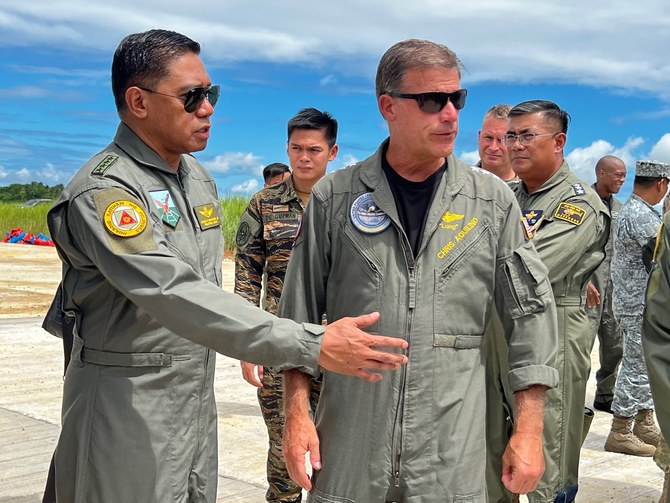
US Indo-Pacific Command head Adm. John Aquilino said he and the Philippines’ military chief Lt. Gen. Romeo Brawner Jr. have discussed the possibility of expanding the number of bases US forces could access.
“Gen. Brawner and I may make recommendations to our senior leaders for the consideration of additional sites, but there’s still work to do there before we get to that answer,” Aquilino told reporters after their meeting on Thursday. “We are in discussions.”
Ranking military officials led by Aquilino and Brawner were inspecting two of the four new EDCA sites on Wednesday, where various work is underway, including building a pier and repairing an airstrip.
The US has allocated over $100 million to develop sites in the Philippines, with over 90 projects having already been approved in the new locations.
“We are just opening this up for shared use with our counterpart, with our only ally the United States, because we believe that doing certain things together would bring more value,” Brawner said.
Some of the bases could be designed specifically for joint training, he said, while adding that locations of the sites agreed upon under EDCA have “nothing to do with other countries in the Indo-Pacific region.”
Brawner said: “What we are interested in really is to promote the interest of the Philippines. So the choices of the EDCA sites, for instance, are primarily because of considerations for humanitarian assistance and disaster response.”
The site visit this week “signifies our commitment to further strengthen our cooperation, ensuring that both militaries are prepared and well equipped to respond to evolving security challenges and humanitarian crises,” he added.
President Ferdinand Marcos Jr. has said that granting the US access to more military bases in his country was not intended for “any offensive action.”
The Philippines’ western command flagged concerns on Thursday over a “resurgence” of Chinese fishing vessels “swarming” in waters around the Spratly Islands inside Manila’s exclusive economic zone, following a series of similar encounters in the area in recent months.
The Chinese Ambassador to the Philippines Huang Xilian in April accused Manila of fueling geopolitical tension in the Asia-Pacific.


![]()

Philippines, US discuss expanding military base access
Short Url
https://arab.news/zunhk
Philippines, US discuss expanding military base access
- Manila gave Washington access to 4 new military bases earlier this year under joint defense pact
- Philippines’ military chief says location of bases was selected for disaster response, humanitarian crisis


Latest updates



© 2026 SAUDI RESEARCH & PUBLISHING COMPANY, All Rights Reserved And subject to Terms of Use Agreement.