

India, Japan discuss stronger cooperation to foster peace in Indo-Pacific region

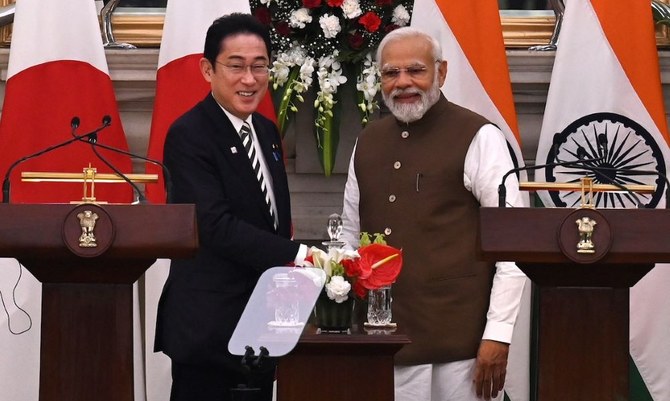
Japan’s Prime Minister Fumio Kishida, left, shakes hands with his Indian counterpart Narendra Modi after attending a joint media briefing at Hyderabad House in New Delhi on March 20, 2023. (AFP)
Short Url
Updated 20 March 2023
Follow

India, Japan discuss stronger cooperation to foster peace in Indo-Pacific region

  • New Delhi, Tokyo hold respective presidencies of G20, G7 groupings this year
  • India ‘indispensable partner’ to achieve Japan’s vision of free, open Indo-Pacific

NEW DELHI: Indian Prime Minister Narendra Modi and his Japanese counterpart Fumio Kishida met on Monday for wide-ranging bilateral talks and discussed ways to strengthen cooperation for peace in the Indo-Pacific region.

Kishida, who is on a two-day trip to India and this year chairs the Group of Seven industrialized nations, invited Modi to participate in the G7 Summit in May, which will be held in the western Japanese city of Hiroshima.

The two PMs addressed issues ranging from security to climate and energy during their meeting and discussed ways to converge priorities of India’s presidency of the Group of 20 biggest economies and Japan’s G7 leadership.

“The India-Japan special strategic and global partnership is based on our shared democratic values and international rule of law. To strengthen this cooperation is important not only for both countries but also this will enhance peace and prosperity in the Indo-Pacific region,” Modi said.

“One of the pillars of the G20 presidency is to give voice to the global south. We believe in carrying everyone together,” he added.

Modi said Kishida’s visit was important “to keep the momentum going” for India-Japan cooperation.

The Japanese premier noted that India was an “indispensable partner” to achieve its new plan of a free and open Indo-Pacific, as he pledged $75 billion to the region as part of the expansive new vision.

“I believe that Japan and India are in an extremely unique position in the current international relations and furthermore in the history of the world,” Kishida said at a lecture hosted by the Indian Council of World Affairs.

“Japan and India have a great responsibility for maintaining and strengthening a free and open international order based on the rule of law.”

The two nations, along with the US and Australia, make up the Indo-Pacific alliance known as the Quad that has sought to counter China’s rising influence in Asia.

“This year, as Japan holds the G7 presidency and India holds the G20 presidency, my hope is that through working together with ASEAN (Association of Southeast Asian Nations) and other many countries we will bring about peace and prosperity to the international community which faces a time of challenges.”

India is not a G7 member but has been participating at its summits as a partner country. Japan, on the other hand, is a member of the two major groupings.

The two Asian nations are strong economic partners with bilateral trade valued at around $20.6 billion in the fiscal year 2021 to 2022. Japan has been supporting infrastructure development in India, which includes a high-speed rail project, and Tokyo’s investment in the South Asian nation reached $32 billion between 2000 and 2019.

Harsh V. Pant, head of strategic studies at the New Delhi-based Observer Research Foundation, told Arab News that both countries were increasingly looking at the Indo-Pacific through similar lenses.

“Though the two nations are on different tracks when it comes to the Ukraine crisis, certainly both feel the G7 and G20 have to work together if the global governance agenda is to be changed,” Pant said.

India has not condemned Russia’s invasion of Ukraine, while Japan has imposed financial sanctions to isolate Russia.

“India is pivotal to Japan’s Indo-Pacific outlook and strategy,” he said.

“Japan wants G7 and India wants G20 to work for the developing world, to resolve global governance problems and to ensure that the leadership void that the world is feeling at the moment is filled with the leadership of countries like India and Japan.”

Hungry, wounded, orphaned: South Sudan’s children trapped in new conflict

Updated 6 sec ago
Follow

Hungry, wounded, orphaned: South Sudan’s children trapped in new conflict

  • The hospital in Akobo has only one surgeon, now overwhelmed
  • More than 40 young men were being treated for gunshot wounds during AFP’s visit

AKOBO, South Sudan: An 18-month-old boy lies motionless on a dirty hospital bed deep in the conflict zone of South Sudan, a bullet wound in his leg — another newly orphaned victim in the world’s newest country.
“When they arrived, they started shooting everyone in the area — elder, child, and mother,” Nyayual, his grandmother, told AFP at the hospital in the opposition-held town of Akobo, eastern Jonglei State.
The bullet that hit the little boy also killed his mother — Nyayual’s daughter. AFP is using only her first name for fear of reprisals.
She says it was government forces that attacked their village.
“We ran away... they were still shooting at us,” she said. “This failed government has no way to resolve things.”
South Sudan gained independence in 2011 but soon descended into civil war between two rival generals, Salva Kiir and Riek Machar.
A 2018 power-sharing deal brought relative peace, with Kiir as president and Machar his deputy, but the agreement has unraveled over the past year.
Fighting in Jonglei state between the army under Kiir and forces loyal to Machar has displaced some 280,000 people since December, according to the United Nations.
The hospital in Akobo — a ramshackle collection of buildings, most without doors or windows — has only one surgeon, now overwhelmed. More than 40 young men were being treated for gunshot wounds during AFP’s visit.
In one ward, an elderly woman lay, her face turned away from the family around her. She was shot by soldiers in both legs, they said. They carried her for days before finding a car that agreed to bring them to the hospital.
The military declined to comment to AFP on the claims. The Jonglei state government’s information minister, Nyamar Lony Thichot Ngundeng, said she did not have information about the incidents.
However, she added: “If you get injured during the crossfire, that is counted as a crossfire, it is not intentional.”

- ‘Disaster’ -

UNICEF says more than half the displaced are children, some fleeing for the second or third time. Around 825,000 are at risk of acute malnutrition across three of South Sudan’s states: Jonglei, Unity and Eastern Equatoria.
Akeer Amou, 33, fled Jonglei for an informal camp on the banks of the White Nile, where she gave birth to her fifth child.
Not on any maps, the place is known only as Yolakot, meaning riverside, but hundreds of women and children now live under the shade of its trees, waiting for help. AFP saw at least three other newborns among them.
Amou named her child Riak, meaning “disaster.”
She does not know why the conflict is happening, but she knows her son will bear the brunt.
“Breast milk can come if there is something to eat, but now there is nothing,” she said, gently rocking Riak under the scant protection of a cotton sheet.
The mothers spend the days foraging for fruit, nuts, and water lily seeds, while children splash in the river’s murky waters.
Most are desperately hungry. A local official told AFP there were roughly 6,700 people waiting for food, but there was no sign of any aid.

- Out of supplies -

In Jonglei’s state capital Bor, doctors try to serve the massive influx of displaced people with rapidly dwindling supplies.
David Tor, acting director of the town’s hospital, introduced AFP to a mother who had been forced to deliver in nearby swamp land. He had managed to reduce the newborn’s fever, a rare bit of good news.
The mother fled Fangak, a town to the north, where last May the only health care facility for more than 100,000 people — run by international NGO Doctors Without Borders (MSF) — was attacked by helicopter gunships and drones, which completely destroyed its pharmacy and all its medical supplies.
“Because of the increase in the number of people who need services, we have run out of almost everything,” said Tor. “At a certain point we may lose patients.”
Jonglei information minister Ngundeng told AFP the hospital would receive supplies.
“I would say it’s enough until the hospital or the ministry of health says otherwise,” she said.

- Trapped -

South Sudan is ranked the most corrupt country in the world by monitoring group Transparency International.
Billions in oil revenue have been stolen by the elite, according to the UN, and the country relies on international donors for 80-90 percent of its health care needs.
Fresh conflict is creating another generation of children with few prospects for a better life. The World Bank estimates 70 percent are not in school.
In the displacement camp in Lake State, south of Bor, where some 35,000 people have recently arrived, mothers queued to sign up their children for an emergency education and psycho-social program run by the Norwegian Refugee Council. It has already registered 2,000 children.
Some of those in the queue may never escape this life.
Nyanhiar Malneth, 28, grew up in an earlier conflict in the country. Her schooling ended when she was eight and she has spent years in displacement camps with her five children.
“I want them to go to school for knowledge,” she said.
But first there are more urgent concerns: “We need something to eat.”