
NAIROBI/LONDON: North Africa suffered two disasters in three days when a devastating earthquake struck Morocco on Friday, followed by catastrophic flooding in Libya on Sunday, leaving thousands dead and many more missing, sparking a global aid response.
On Friday night, a powerful earthquake, measuring 6.8 in magnitude, struck high in the Atlas Mountains about 70 km south of Marrakech, flattening whole villages, killing at least 2,900 people and leaving thousands more homeless.
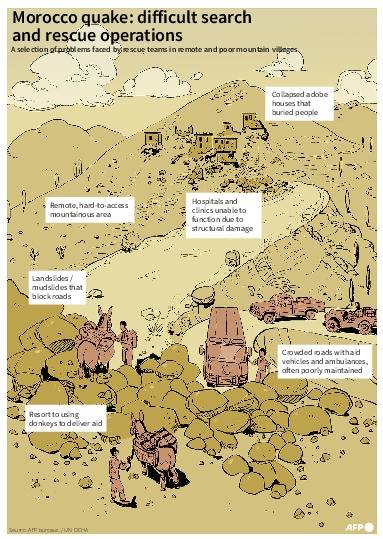
The graphic depicts difficulties faced by rescue teams in remote mountain villages in Morocco. (AFP)
In Morocco’s Al-Haouz province, isolated farming communities have been left cut off, with many fending entirely for themselves. It was the North African country’s deadliest earthquake since 1960 and its most powerful in more than a century.
Just as aid agencies and donor nations were rolling out their response to this catastrophe, another disaster was unfolding to the east in crisis-torn Libya, where Storm Daniel caused two river dams to burst on Sunday afternoon.
The enormous surge of water released by the dams tore through the Mediterranean coastal city of Derna, sweeping buildings, vehicles and people into the sea. The confirmed death toll surpassed 5,000 on Wednesday, with thousands more still unaccounted for.
“Libya’s situation is a roller coaster. We’ve been through so much — conflicts, political ups and downs, and now these floods adding to the chaos,” Mohammed Thabit, a Tripoli-based citizen journalist, told Arab News.
“But remember, we’re a resilient bunch. We’ve faced worse and we’ll keep pushing for a brighter tomorrow, no matter the challenges.”
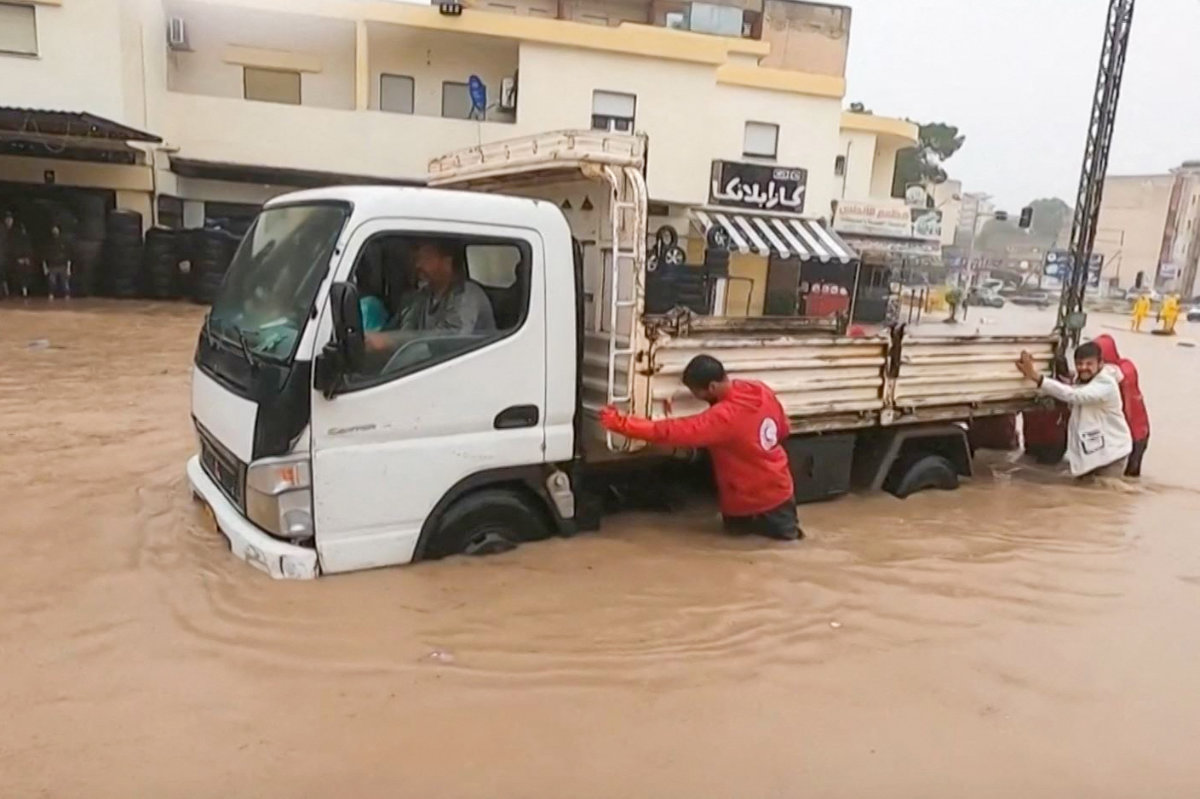
This grab from a video published on the Facebook account of the Libyan Red Crescent on September 11, 2023, shows members of their team assisting drivers whose cars are engulfed in floods in al-Bayda town in eastern Libya. (Basma Badran, Libyan Red Crescent via AFP)
The city of Derna, 300 km east of Benghazi, is ringed by hills and bisected by what is normally a dry riverbed in summer, which became a raging torrent of mud-brown water that also swept away several major bridges.
Derna was home to about 100,000 people and many of its multistory buildings on the banks of the riverbed collapsed, with people, their homes and cars vanishing into the raging waters.
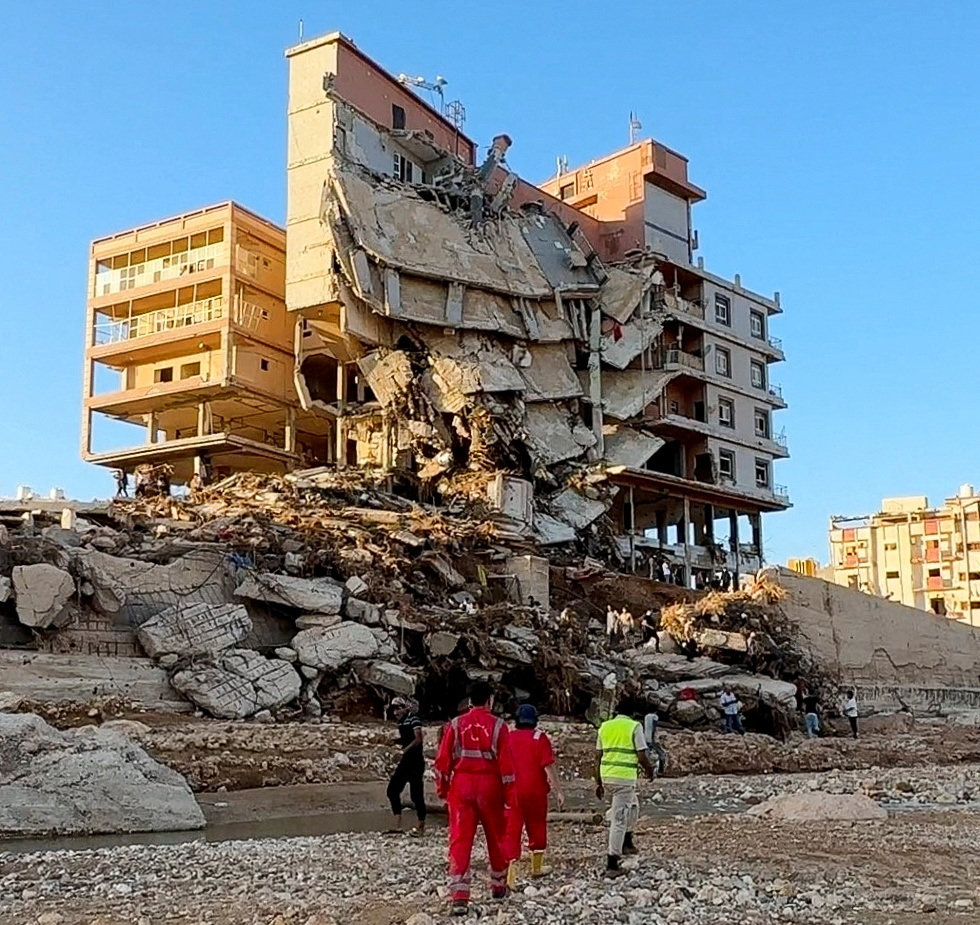
Emergency members work near a building destroyed when a powerful storm and heavy rainfall hit the city of Derna in Libya on September 12, 2023. (Screen grab from social media video by Ali M. Bomhadi/via REUTERS)
“In the face of these devastating floods in Libya, it’s a heartbreaker,” Thabit said. “Our dams got some funding, but it seems some folks ran off with the money instead of fixing things. Tough times, but we’re tougher.”
The Libyan Presidential Council has declared the cities of Derna, Shahat and Al-Bayda in Cyrenaica disaster zones and requested international support to confront the effects of the floods caused by the storm.
Libya is in effect under the control of two rival administrations: the internationally recognized government in Tripoli and authorities based along with the parliament in the east.
“The humanitarian needs are huge and far beyond the abilities of the Libyan Red Crescent and even beyond the abilities of the government,” Tamar Ramadan, head of the International Federation of Red Cross and Red Crescent Societies delegation in Libya, said in a statement to the UN.
“That’s why the government in the east has issued an international appeal for support.”
Margaret Harris, spokesperson for the World Health Organization, said the flooding was of “epic” proportions.
“There’s not been a storm like this in the region in living memory, so it’s a great shock,” she said.
There is also concern for the hundreds of thousands of migrants and refugees from more than 40 countries who use Libya as a jumping-off point to reach Europe and who have likely been caught up in the floods.
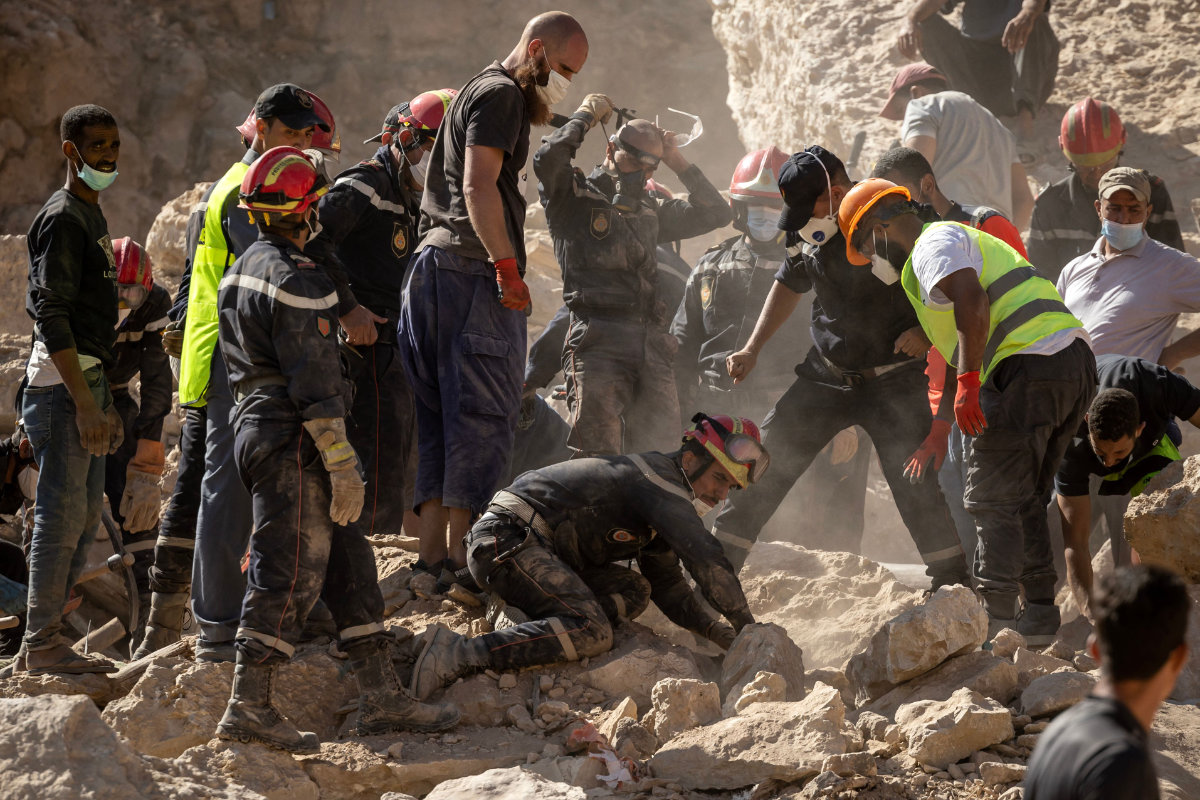
Rescue search through the rubble of an earthquake-damaged house in Imi N'Tala village near Amizmiz in Morocco on September 13, 2023. (AFP)
With global concern spreading about both disasters, several nations have offered aid and deployed rescue teams to Derna and isolated villages across Morocco to help survivors and retrieve the bodies of their loved ones from the rubble.
Offers of assistance came from Saudi Arabia, the UAE, Egypt, Algeria, Jordan, Iraq, Kuwait, Tunisia and Turkiye. Saudi Arabia on Tuesday expressed solidarity with “Libya and its brotherly people, and the victims of the floods.”
King Salman and Crown Prince Mohammed bin Salman earlier ordered aid flights to Morocco, and the crown prince called King Mohammed VI to affirm the Kingdom’s solidarity with the Moroccan people.
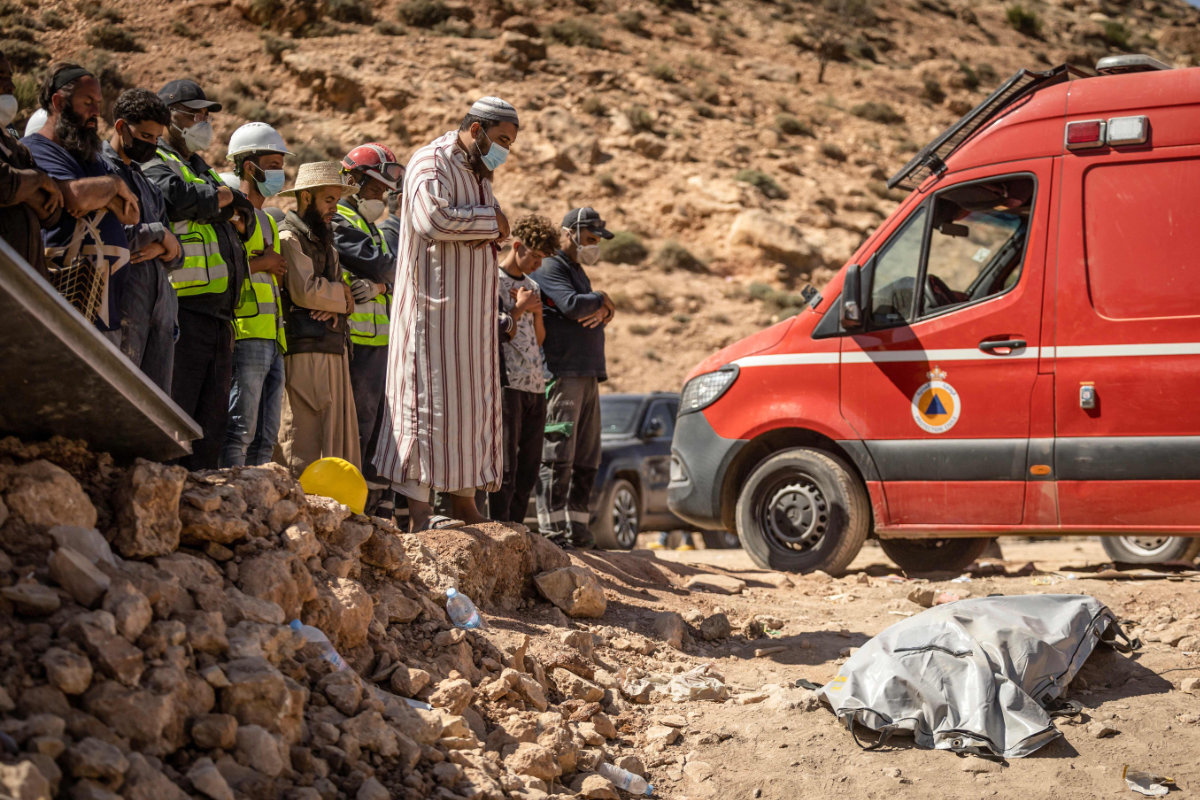
Villagers and rescuers recite a prayer in front of the body of an earthquake in the village of Imi N'Tala near Amizmiz on September 13, 2023. AFP)
Egypt’s President Abdel Fattah El-Sisi has declared a three-day mourning period and directed military personnel to provide humanitarian aid, including relief teams, rescue equipment and shelter camps for Libya and Morocco.
Sheikh Mohammed bin Zayed Al-Nahyan, president of the UAE, ordered the dispatch of urgent relief and search and rescue teams to Libya, deploying two aid planes carrying 150 tons of food, relief and medical supplies.
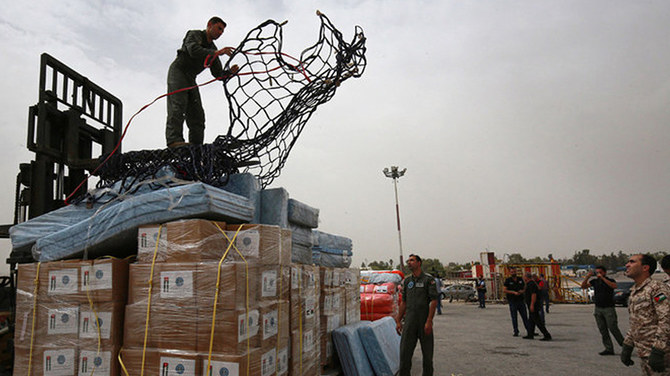
A Kuwaiti flight took off on Wednesday with 40 tons of supplies for Libya, while Jordan sent a military plane loaded with food parcels, tents, blankets and mattresses.
None of this has detracted from the Moroccan earthquake response. Rescuers from Spain, the UK and Qatar are helping local search teams to find survivors.
Many villagers in Morocco have had no power or telephone network since the earthquake struck and have had to rescue loved ones and pull dead bodies from under their crushed homes without any assistance.
The UN estimated that more than 300,000 people had been affected, a third of them children, by the powerful seismic event that hit just after 11 p.m. when most families were asleep.
Moroccans have demonstrated remarkable resilience in the face of adversity, but as rescue teams race against the clock to locate survivors, experts say restoring a sense of normality should be the priority.
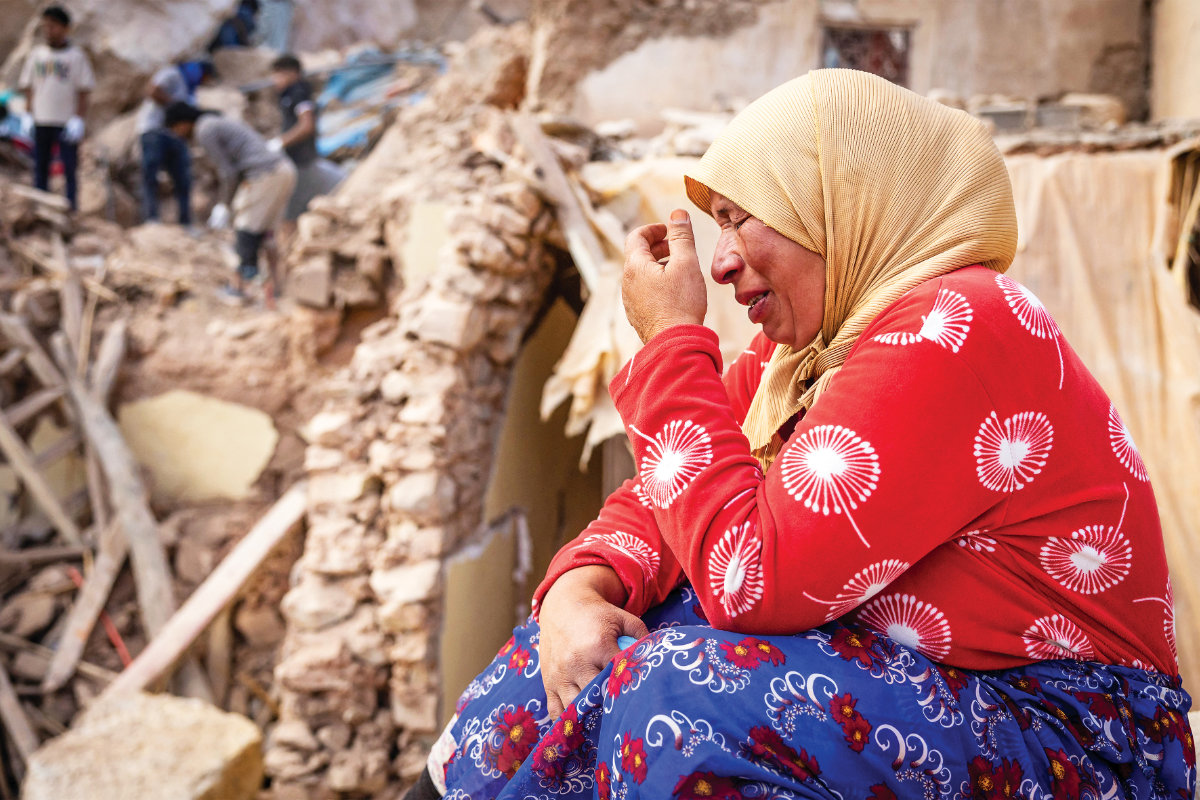
A woman reacts by the rubble of destroyed buildings in the aftermath of the deadly 6.8-magnitude September 8 earthquake in the village of Imi N'Tala near Amizmiz in central Morocco on September 10, 2023. (AFP)
“While buildings and towns can be rebuilt through reconstruction efforts,” it is the “going back to normal for the survivors which is the biggest challenge,” Karim Wafa Al-Hussaini, a historian with roots in Morocco, told Arab News.
“Instilling a renewed sense of normal among the population will be definitely one of the biggest challenges throughout and after the reconstruction projects.”
The earthquake has underscored the fragility of buildings in Morocco’s rural areas, constructed using traditional Amazigh building techniques. Climate change has also left its mark, rendering the structures more susceptible to devastation.
Fatima Ahouli, director of operations with the Morocco-based Imal Initiative for Climate and Development, believes these latest incidents underscore the need for investment in infrastructure designed to cope with natural disasters and extreme weather events.
“This entails the construction of robust infrastructure, such as educational institutions and healthcare facilities, capable of enduring the rigors of severe weather events, all while fostering sustainable resource management practices,” she said.
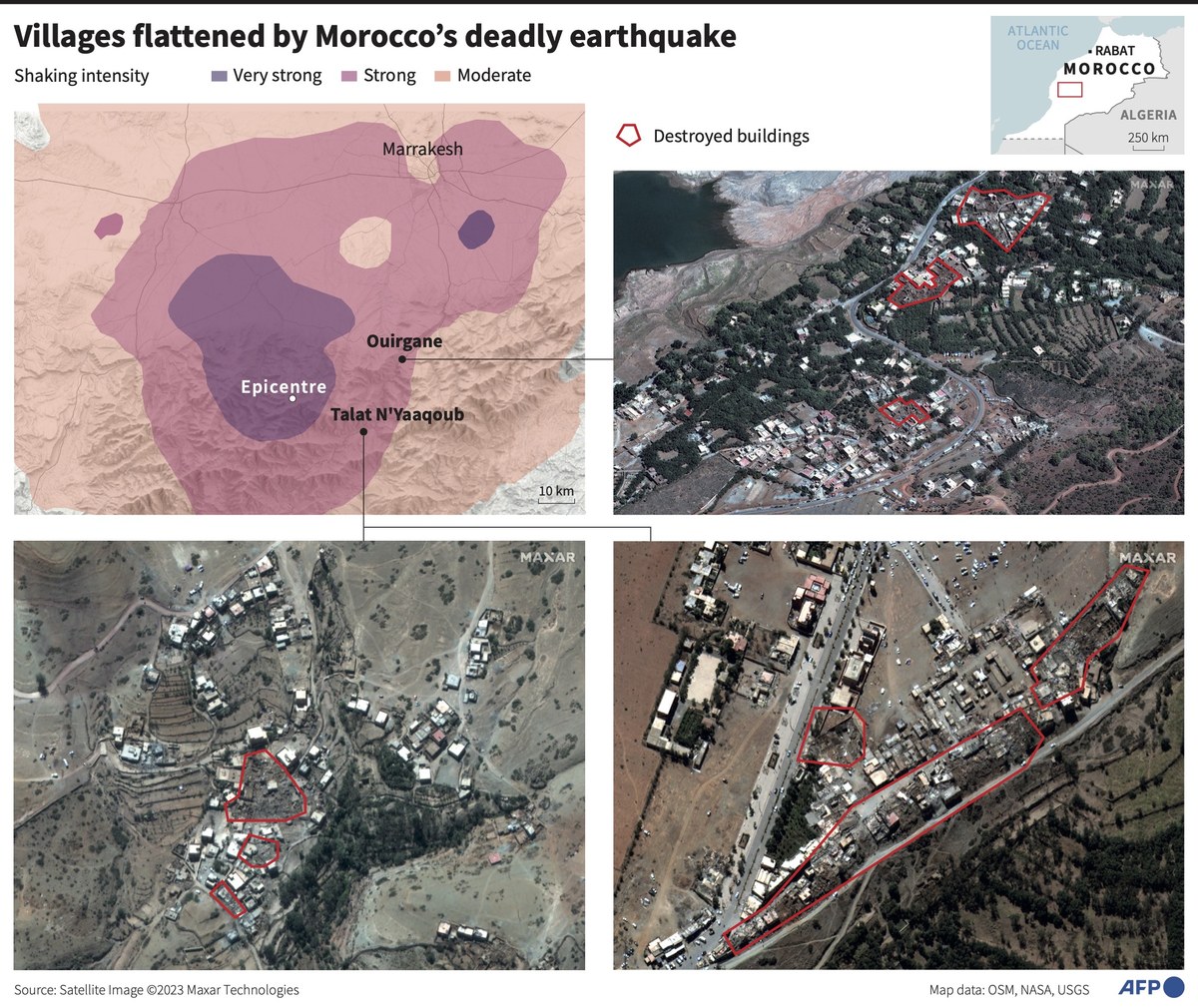
The collection of satellite images shows destruction caused by Morocco's deadly earthquake. (AFP)
Morocco’s King Mohammed has launched assessments to evaluate the structural damage and the feasibility of rebuilding the hardest-hit regions. Nevertheless, rescue operations have incurred criticism amid the rising death toll.
Meanwhile, in Marrakech, where state assistance for survivors has been most immediate, many modern buildings remained unscathed by the tremors. Several of the city’s famous historical sites, however, were not so fortunate.
“The earthquake’s fury primarily targeted ancient buildings, some dating back centuries, constructed using traditional clay methods once prevalent in Marrakech,” Yassine Soussi Temli, managing partner at the investment firm Maghreb Capital Advisers, told Arab News.
“The city’s distinctive architectural heritage has borne the brunt of the earthquake’s wrath.”