

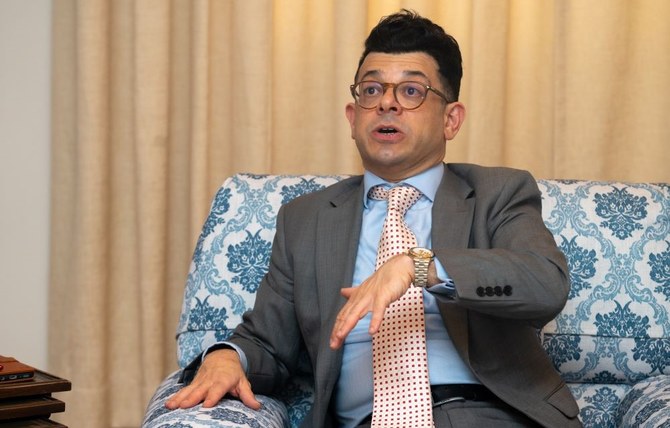
Malta ambassador to the Kingdom aims to re-strengthen ties

1 / 4
Ambassador of Malta to Saudi Arabia Dr. Clive Aquilina Spagnol. (AN Photo/Huda Bashatah)
2 / 4
Ambassador of Malta to Saudi Arabia Dr. Clive Aquilina Spagnol. (AN Photo/Huda Bashatah)
3 / 4
Ambassador of Malta to Saudi Arabia Dr. Clive Aquilina Spagnol. (AN Photo/Huda Bashatah)
4 / 4
Ambassador of Malta to Saudi Arabia Dr. Clive Aquilina Spagnol. (AN Photo/Huda Bashatah)
Short Url
Updated 14 September 2023
Follow

Malta ambassador to the Kingdom aims to re-strengthen ties

  • Dr. Clive Aquilina Spagnol: I went personally to the travel agents to promote Malta as a tourist destination
  • Spagnol: Hopefully we will have the University of Malta accredited here, so that Saudi students can go to Malta, study, come back and use their degree

RIYADH: Ambassador of Malta to Saudi Arabia Dr. Clive Aquilina Spagnol aims to use his tenure to strengthen Saudi-Maltese ties in tourism, education, trade and culture.

“The mission here is a very old mission, it goes back to 1985, it’s a very old mission ... the relationship between the Kingdom and Malta (has been) going on for quite a while,” Spagnol told Arab News.

Discussing the evolution of Saudi-Maltese relations the ambassador highlighted that there was a period where the two countries had experienced something of a slowdown.

“They (relations) were still good but they weren’t active. It didn’t mean they were going through a problematic phase, they just went into a sleeping mode,” he said.

The ambassador explained that in the 1990s Malta’s foreign policy was more focused on the European Union and becoming a member of the EU.

“Now that we are a fully fledged member of the EU and it’s been almost 20 years … we are tending to look outside the perimeter,” he said.

Spagnol added there has been an increase in Saudi diplomatic and business activity, too, in the last five years.

“We see a lot more engagement from KSA. (The Kingdom) is reaching out to the world, and that encourages us to engage with the Kingdom.”

Spagnol added that the increased areas of engagement between Saudi Arabia and Malta include tourism and education.

“The core value (of Malta) lies in the history and in the culture,” he stressed.

The ambassador explained that, as part of his efforts to strengthen Saudi-Malta cooperation, he personally visited travel agents in the Kingdom to highlight tourism opportunities “because no one knew about Malta and still today not a lot of people hear about Malta.

“I wanted to take Malta outside these walls and I went personally to the travel agents to promote Malta as a tourist destination.”

Spagnol added that Malta is a welcoming, family friendly country and safe for Muslim tourists to visit.

Another area that cooperation between the two countries extends to is education, which Spagnol called a major “wavelength” he is working to strengthen.

“Hopefully we will have the University of Malta accredited here, so that Saudi students can go to Malta, study, come back and use their degree,” he said, adding that he is working closely with the Saudi Ministry of Education to get the process finalized by the end of the year.

“Education and medical care in Malta is of (a) high standard,” the ambassador said.

Discussing the past colonization of Malta by Britain, the ambassador said: “You have to look at the positive side, every cloud has a silver lining.”

Touching upon the investment and social benefits, including healthcare, the British had brought to his island nation, Spagnol added: “Many people denounce colonialism but although we were colonized there was a lot of (benefits) out of colonialism.” 

The ambassador also touched upon the possibility for a growth in trade between Malta and Saudi Arabia.

“There is trade between Malta and Saudi without being so visible. Even on the shelves of the market you will find many ‘Made in Malta’ products in terms of food.”

Spagnol noted that the first Maltese hotel, called the Corinthia, will open in Saudi Arabia in Diriyah in 2026, adding that he wanted to see further examples of cultural exchange between the two countries, citing Malta’s strong cultural heritage.

“We would like to see more, for example, exhibits being shown here. Maltese in (Saudi Arabia) and Saudi exhibits in Malta,” he said.


Absher Hackathon finalists highlight scale of Saudi tech talent

Updated 50 min 5 sec ago
Follow

Absher Hackathon finalists highlight scale of Saudi tech talent

  • World’s largest hackathon underscores growing national enthusiasm for tech innovation

RIYADH: Saudi Arabia’s push to position itself as a global hub for digital innovation was on display this weekend as the Absher Tuwaiq Hackathon 2025 — billed as the world’s largest hackathon — concluded with the announcement of finalist teams competing for prizes totaling SR1 million ($266,000). 

The three-day hackathon, organized by the Ministry of Interior in partnership with Tuwaiq Academy, brought together innovators from across the Kingdom to develop digital solutions aligned with the ministry’s digital transformation goals. 

The finalist teams recognized for their projects were: Shadow, Wusool, Watheeq , Tanabbah, HRS, Ikhlaa, Amal, Mustabiq, Al‑Dahna, Inspire, Saqour Al‑Watan, Thaqib, Sawt Al‑Mustaqbal, Manee, and YS Advance International. 

The finalists were announced at the end of the three-day Absher Tuwaiq Hackathon organized by the Ministry of Interior in partnership with Tuwaiq Academy. (AN photo/Supplied)

In addition to cash prizes, the competition offered SR450,000 in support from the National Technology Development Program, along with incubation opportunities at Invi Lab to help teams turn prototypes into market-ready products.   

Tariq Al‑Hamid, official spokesperson for the Absher Conference, told Arab News that the hackathon has generated strong momentum nationwide.  

This year’s event included more than 4,000 participants from all regions of the Kingdom — “a reflection of the growing national enthusiasm for digital innovation,” he said. 

HIGHLIGHT

The Absher Tuwaiq Hackathon brought together innovators from across the Kingdom to develop digital solutions aligned with the ministry’s digital transformation goals. 

According to Al‑Hamid, the 2025 event was structured around four specialized tracks: digital identity and security applications; artificial intelligence for predictive and proactive security; Internet of Things applications supporting field operations; and innovations to enhance or expand services on the Absher Platform. 

Tariq Al-Hamid (center) said that the hackathon’s impact extends beyond prize money. (Supplied)

He added that this focused approach allowed participants “to present high‑quality ideas and advanced prototypes at levels comparable to international competitions.” 

Participants also took part in more than 80 training programs delivered by global partners including Google Cloud, Meta, NVIDIA, and Huawei, an experience Al-Hamid said significantly strengthened both the competition and participants’ skills. 

Al-Hamid said that the hackathon’s impact extends beyond prize money. “More important than the cash reward is the opportunity to turn creative ideas into real products that make an impact on citizens, residents, and visitors.” 

Standout participants often attract the attention of leading national technology companies seeking new talent, he added. 

Participation was open to individuals and teams from across Saudi Arabia, from high school students to industry professionals, highlighting the inclusivity of the event and the breadth of the Kingdom’s innovation ecosystem.  

The hackathon forms part of the wider Absher Tuwaiq initiative, a core pillar of the upcoming Absher Conference 2025, which will empower more than 100,000 participants across seven technical tracks in 16 cities, in partnership with 20 local and international organizations. 

The conference, organized by the Ministry of Interior and Tuwaiq Academy, sponsored by Elm Company and held in strategic partnership with the Saudi Data and Artificial Intelligence Authority, will take place in Riyadh from Dec. 17 -19. 

The event will showcase national digital innovations and reinforce Saudi Arabia’s role in global technology.