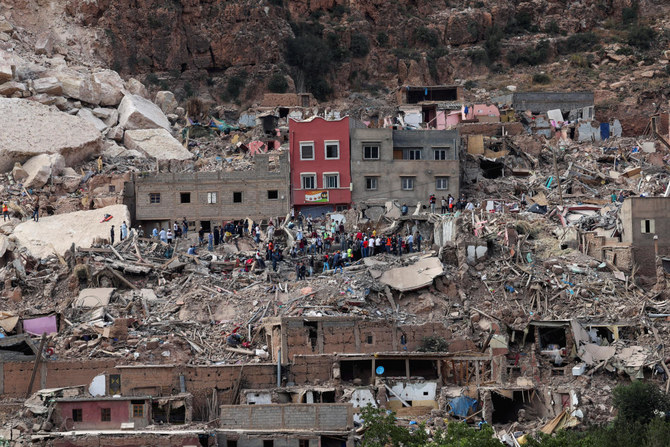
IMI N'TALA, Morocco: The stench of death wafted through the village of Imi N’Tala high up in Morocco’s Atlas Mountains four days after a deadly earthquake struck, slicing off a chunk of mountain, killing residents and razing the hamlet to the ground.
Bulldozers, rescue crews and Moroccan first responders work around the clock trying to dig through the wreckage to unearth the eight to ten corpses still underneath.
"The mountain was split in half and started falling. Houses were fully destroyed," Ait Ougadir Al Houcine said as rescuers worked on recovering bodies, including his sister's. “Some people lost all their cattle. We have nothing but the clothes we’re wearing. Everything is gone.”
The scene in Imi N'Tala, which mainly houses herders and famers and where 96 residents perished in Friday's earthquake, mirrors that of dozens of places situated along the treacherous mountain roads south of Marrakech: Men in donated djellabas neatly arrange rugs atop dust and rocks to pray after looking for open space and solid ground. Donkeys bray as they pass by people covering their noses to block the smell of decomposing bodies.
The death and injury counts continue to rise as more remote villages are reached, bodies get dug up and people sent to hospitals. Moroccan authorities reported 2,901 deaths as of Tuesday. The United Nations has estimated that 300,000 people were affected by Friday night’s magnitude 6.8 quake.
But things look different than in the hours and days immediately after the temblor.
About 38 miles (62 kilometers) north in Marrakech, King Mohammed VI is visiting a hospital and donating blood. And in Imi N'Tala — as well as in nearby Anougal, Imi N'Isli and Igourdane — aid has finally arrived. White and yellow tents line partially paved roads. Pyramids of water bottles and milk cartons are stacked nearby. Moroccans who've come to the region from the country's larger cities hand clay tagine pots and neatly packed bags full of food aid off of the backs of trucks.
Camera crews from France, Spain and Qatar's Al Jazeera set up as Moroccan emergency responders — along with crews from Qatar, Spain and international NGOs — jackhammer through rocks to recover a woman's body from under a crumbling house that looks like it could fall at any moment.
She's likely dead because — unlike the buildings that fell in Turkey and Syria's earthquake earlier this year — the mud bricks used to build homes in Imi N'Tala left little space for air needed to keep people alive, said Patrick Villadry of the French rescue crew, ULIS.
“When we dig, we look for someone alive. From there, we don’t ask ourselves questions. If they’re alive, great. If they’re dead, it’s a shame,” he said, noting that recovering the dead was important for Moroccan families.
Morocco has limited the amount of aid allowed into the country in response to the earthquake and green-lit crews from only four countries — Spain, the United Kingdom, the United Arab Emirates and Qatar — and non-governmental organizations. Villadry's five-person, four-dog crew from Nice was among the few French NGOs to have made it to the disaster site. It arrived Saturday, he said.
Though the government has cautioned that poorly coordinated aid “would be counterproductive," the explanation has prompted skepticism among Moroccans like Brahim Ait Blasri, who watched as they tried recovery attempts.
“It's not true. It's politics,” he said, referring to Morocco's decision not to accept aid from countries such as the United States and France. “We have to set aside our pride. This is too much.”


International crews in Morocco to recover bodies days after deadly 6.8 earthquake struck
https://arab.news/pqmwn
International crews in Morocco to recover bodies days after deadly 6.8 earthquake struck

- Bulldozers, rescue crews and Moroccan first responders work around the clock trying to dig through the wreckage to unearth the eight to ten corpses still underneath
- "The mountain was split in half and started falling. Houses were fully destroyed," Ait Ougadir Al Houcine said


Syrian government says it controls prison in Raqqa with Daesh-linked detainees
- Prison holds detainees linked to Daesh, and witnessed clashes in its vicinity between advancing Syrian government forces and Kurdish fighters
Syria’s Interior Ministry said on Friday it had taken over Al-Aktan prison in the city of Raqqa in northeastern Syria, a facility that was formerly under the control of Kurdish-led Syrian Democratic Forces (SDF).
The prison has been holding detainees linked to the militant group Daesh, and witnessed clashes in its vicinity this week between advancing Syrian government forces and the SDF.
It was not immediately clear how many Daesh detainees remain in Al-Aktan prison as the US military has started transferring up to 7,000 prisoners linked to the militant Islamist group from Syrian jails to neighboring Iraq. US officials say the detainees are citizens of many countries, including in Europe.
“Specialized teams were formed from the counter-terrorism department and other relevant authorities to take over the tasks of guarding and securing the prison and controlling the security situation inside it,” the Interior Ministry said in a statement.
Under a sweeping integration deal agreed on Sunday, responsibility for prisons housing Daesh detainees was meant to be transferred to the Syrian government.
The SDF said on Monday it was battling Syrian government forces near Al-Aktan and that the seizure of the prison by the government forces “could have serious security repercussions that threaten stability and pave the way for a return to chaos and terrorism.”
The US transfer of Daesh prisoners follows the rapid collapse of Kurdish-led forces in northeast Syria. Concerns over prison security intensified after the escape on Tuesday of roughly 200 low-level Daesh fighters from Syria’s Shaddadi prison. Syrian government forces later recaptured many of them.


