

Pakistan election dispute deepens as President Alvi says polls should be held on Nov. 6

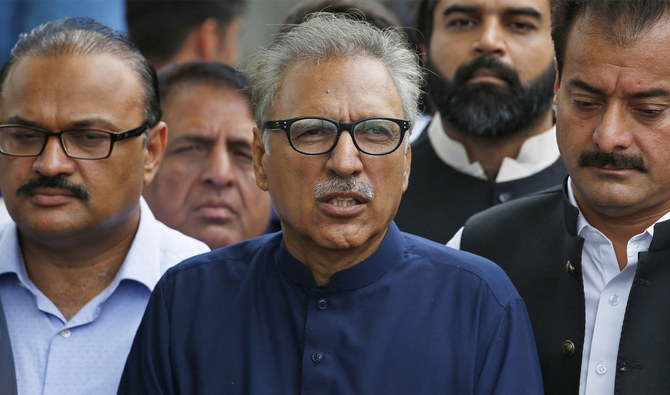
Pakistan's President Dr. Arif Alvi (C) walks back after submitting papers for the presidential election outside the high court building in Islamabad on August 27, 2018. (Photo courtesy: AFP/File)
Short Url
Updated 13 September 2023
Follow

Pakistan election dispute deepens as President Alvi says polls should be held on Nov. 6

  • In letter to chief election commissioner, president urges ECP to seek superior judiciary’s advice on fixing election date
  • Alvi says polls must be held on single day to promote unity among Pakistan’s provinces, avoid unnecessary expenses

ISLAMABAD: Pakistan’s President Dr. Arif Alvi wrote to the chief election commissioner on Wednesday, suggesting that polls in the country should be held on November 6 and urging Pakistan’s election regulator to seek the superior judiciary’s guidance on finalizing a single date for polls for the national and provincial assemblies, amid an election dispute that has cast doubts over when an elected government would take over the reins of the country. 

On August 23, Alvi invited Pakistan’s Chief Election Commissioner Sikander Sultan Raja to a meeting to fix a date for the impending elections. Raja snubbed the offer and pointed out that after amendments to the Elections Act in June by the outgoing government of Prime Minister Shehbaz Sharif, fixing a date for elections was the sole prerogative of Pakistan’s election regulator. Previously, the constitution mandated the president to consult the election commission before determining a date for polls. 

Alvi has maintained that as per Pakistan’s constitution, the president must fix a date for polls within 90 days of the dissolution of the National Assembly. However, a delay in elections beyond the 90-day constitutional limit is almost inevitable as the outgoing government of former prime minister Shehbaz Sharif approved the results of a new population census days before it dissolved the assemblies on Aug. 9 and handed over power to a caretaker administration.

 The Election Commission of Pakistan (ECP) is now bound to redraw hundreds of provincial and federal constituencies on the basis of the latest census results, an exercise the commission says will be finalized by December 14, effectively delaying elections beyond the 90-day limit.

“WHEREAS in terms of Article 48(5) the general election to the National Assembly should be held by the eighty-ninth day of the date of dissolution of the National Assembly, i.e. Monday, 6th Day of November 2023,” Alvi wrote in another letter he penned to Raja on Wednesday. 

He addressed the issue of determining a date for polls, adding that the Ministry of Law and Justice and Pakistan’s provincial governments agree that it is the ECP’s prerogative to announce the date for polls. Alvi said there is a consensus among the provincial governments that elections for the national and provincial assemblies must be held on the same day to promote unity and harmony among provinces, and to avoid “incurring of unnecessary expenses.”

Alvi wrote that there is a consensus in Pakistan that elections for the national and provincial assemblies must be held on the same day to promote unity and harmony among provinces and to avoid “incurring of unnecessary expenses.”

He advised Pakistan’s election regulator to seek guidance from the superior judiciary on the announcement of a single date for elections. 

“THEREFORE, taking into account all the above, the Election Commission of Pakistan in consultation with Provincial Governments and political parties under the relevant provisions of the Constitution and in view that some of these matters are already subjudice, may seek guidance from the Superior Judiciary for announcement of a single date for general election to the National and Provincial Assemblies,” Alvi wrote. 

Pakistan’s election regulator, meanwhile, has held consultations with major political parties, including former prime minister Imran Khan’s Pakistan Tehreek-e-Insaf (PTI) party and assured all stakeholders that polls would be held as soon as the delimitation exercise is concluded. 

However, independent analysts and political experts believe elections would be delayed to February and beyond. 


Pakistan says 41 suspected militants killed in operations in restive Balochistan province

Updated 10 sec ago
Follow

Pakistan says 41 suspected militants killed in operations in restive Balochistan province

  • Military says intelligence-based raids carried out in Harnai and Panjgur districts
  • Islamabad repeats claim militants backed by New Delhi, an allegation India denies

ISLAMABAD: Pakistani security forces killed 41 suspected militants in two separate intelligence-based operations in the southwestern province of Balochistan, the military said on Thursday, alleging the fighters were linked to India. 

The operations were carried out in the districts of Harnai and Panjgur in Balochistan, Pakistan’s largest but least developed province and home to a long running separatist insurgency that frequently targets security personnel, government infrastructure and non-local residents.

“On 29 January 2026, 41 terrorists belonging to Indian proxy, Fitna al Khwarij and Fitna al Hindustan, were killed in two separate operations in Balochistan,” the military’s media wing, Inter-Services Public Relations (ISPR), said in a statement.

According to the ISPR, 30 militants were killed in Harnai district following a “heavy exchange of fire,” during which security forces also destroyed a cache of recovered weapons and explosives.

In a separate intelligence-based operation in Panjgur district, the military said 11 additional suspected militants were killed after security forces raided a hideout.

“Besides weapons and ammunition, looted money from bank robbery in Panjgur on 15 December 2025 were also recovered from the killed terrorists,” the statement said.
“The terrorists were involved in numerous terrorist activities in the past.”

Pakistan’s military and government frequently use the terms “Fitna al Khwarij” and “Fitna al Hindustan” to describe militant groups it associates with the Pakistani Taliban and alleged Indian support.

The ISPR said follow-up “sanitization operations” were underway to eliminate any remaining militants in the area, describing them as “Indian-sponsored terrorists.”

Islamabad has repeatedly accused India of backing separatist groups in Balochistan to destabilize Pakistan, an allegation New Delhi denies.

Earlier this month, Pakistan’s counterterrorism police said they killed five militants planning attacks on security forces and an attempt to block the Quetta–Sibi highway, a key transport route. On Jan. 25, the military also reported killing three militants, including a local commander, in an intelligence-based operation in Panjgur.

Balochistan is strategically important due to its vast mineral resources and its role as a transit corridor for the China-Pakistan Economic Corridor (CPEC), a multibillion-dollar infrastructure initiative linking Pakistan with China.

Separatist groups such as the Balochistan Liberation Army (BLA) accuse Islamabad of exploiting the province’s natural resources without fair local benefit, a claim the government rejects.