

Taliban accepts first Chinese ambassador appointed to Kabul since takeover

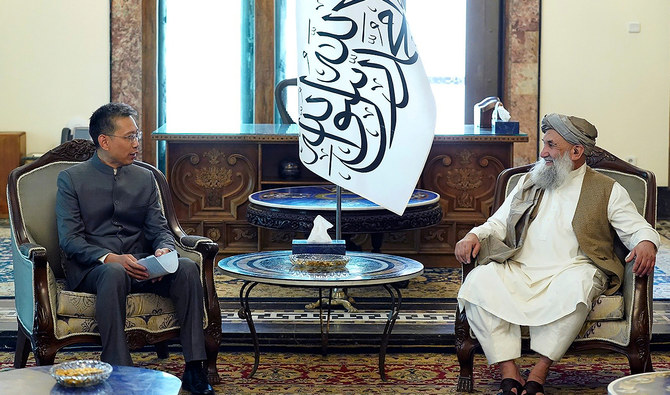
In this handout photo released by the Taliban Prime Minister Media Office, China's new ambassador to Afghanistan Zhao Sheng meets with Taliban Prime Minister Mohammad Hasan Akhund during the recognition ceremony at the Presidential Palace in Kabul, Afghanistan, Wednesday, Sept. 13, 2023. (Taliban Prime Minister Media Office via AP)
Short Url
Updated 13 September 2023
Follow

Taliban accepts first Chinese ambassador appointed to Kabul since takeover

  • Experts say appointment marks “important success” for Afghan Taliban
  • Taliban have not been officially recognized by any foreign government

KABUL: A newly appointed Chinese ambassador to Afghanistan presented his credentials to Taliban’s prime minister Mullah Hassan Akhund on Wednesday, Afghan authorities said, making China the first country to formally appoint an ambassador-level envoy since the new government took power in 2021.

The Taliban are not officially recognized by any foreign government, and it was not immediately clear whether Beijing has moved to a formal recognition of the Taliban with Wednesday’s appointment.

“Mohammad Hassan Akhund, the Prime Minister of the Islamic Emirate of Afghanistan, accepted the credentials of Mr.Zhao Xing, the new Chinese ambassador to Afghanistan, during a ceremony,” said Taliban’s chief spokesman Zabihullah Mujahid in a statement.

“Prime Minister of the Islamic Emirate thanked the leadership of China for appointing Mr. Zhao Xing as ambassador and expressed the hope that his appointment will lead to the promotion of diplomatic relations to a high level and the beginning of a new chapter between the two countries.”
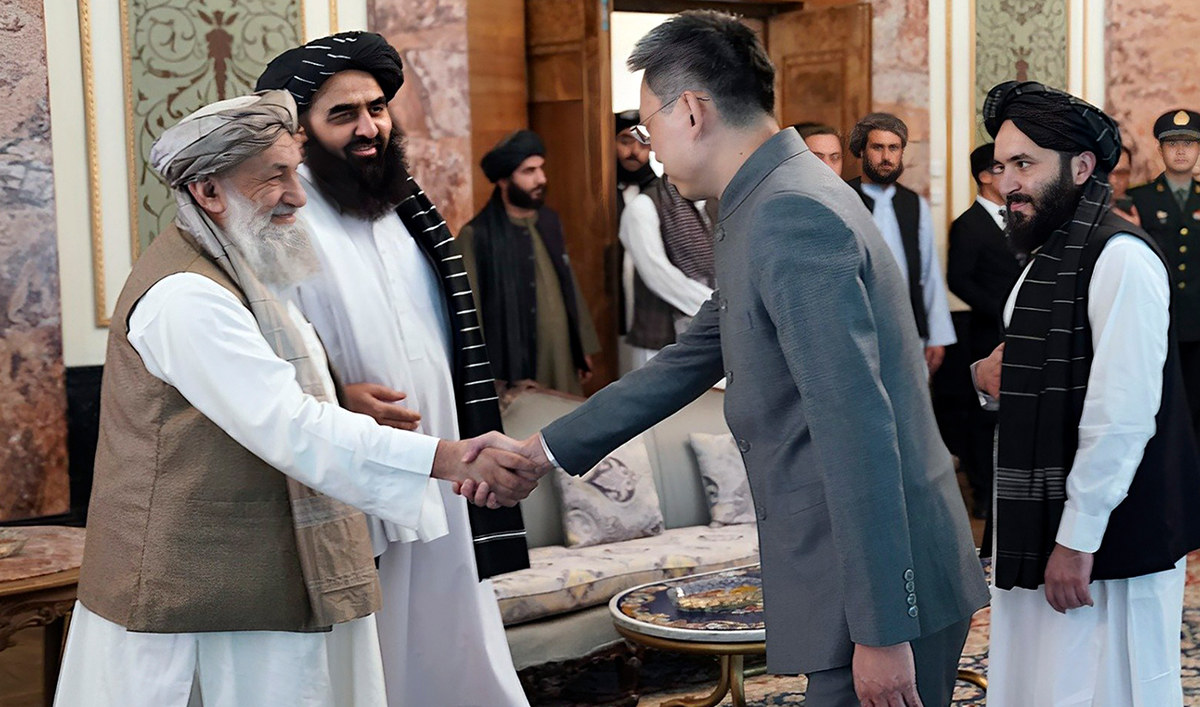


In this handout photo released by Taliban Prime Minister Media Office, China's new ambassador to Afghanistan Zhao Sheng shakes hand with Taliban Prime Minister Mohammad Hasan Akhund (left) during the recognition ceremony at the Presidential Palace, in Kabul on September 13, 2023. (Taliban Prime Minister Media Office via AP)

China has actively engaged the Taliban administration on various levels since they came to power, including through investment and infrastructure projects.

Afghan and Chinese railway authorities signed an accord with their counterparts from Uzbekistan and Kyrgyzstan last year to create a new economic corridor between their countries, which the Afghan government expects will boost trade and connectivity.

In January, the privately run oil company Xinjiang Central Asia Petroleum and Gas Co. signed a contract to extract oil from the Amu Darya basin. It was the first major extraction deal the Taliban signed with a foreign company since retaking power.

Under the contract, CAPEIC will invest $150 million a year in Afghanistan, increasing to $540 million in three years under the 25-year agreement. The deal is expected to employ about 3,000 Afghans, the Taliban had said in a statement.

When many countries closed their missions in Kabul after the Taliban seized power, China was one of the few countries which kept its diplomatic presence. Some ambassadors appointed during the previous foreign-backed Afghan government have remained in Kabul with the same title.

China’s previous ambassador to Afghanistan was Wang Yu, who took up the role in 2019 and finished his tenure last month.
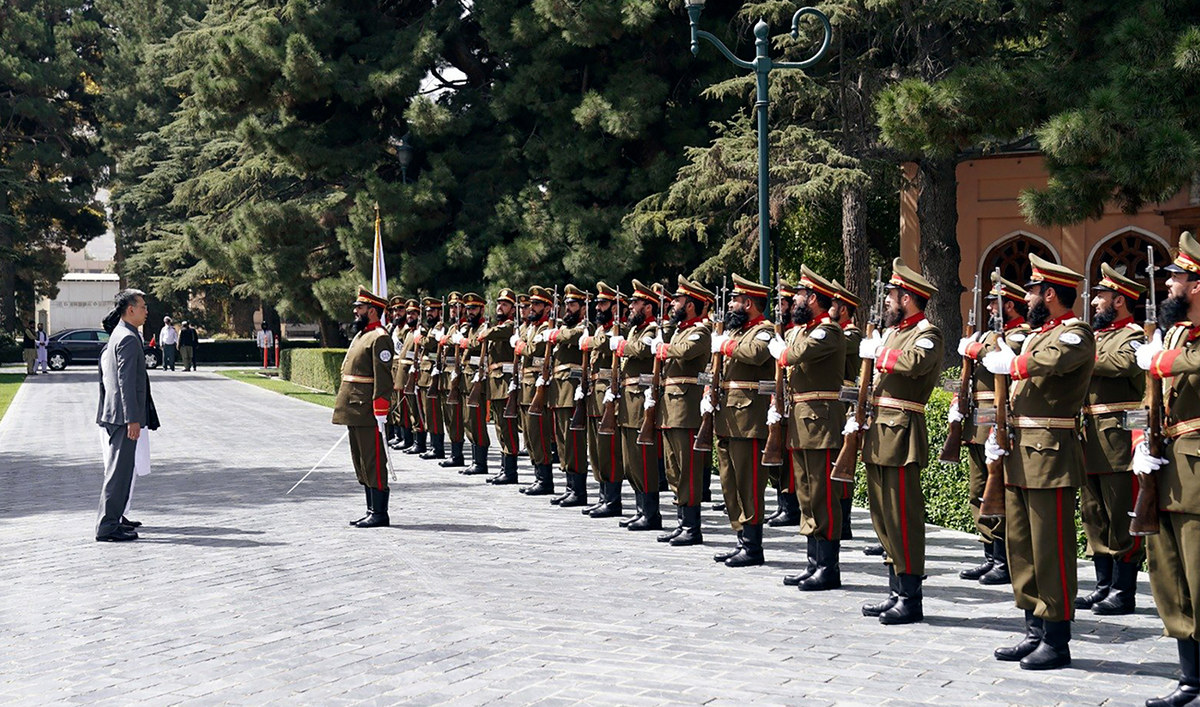


In this handout photo released by Taliban Prime Minister Media Office, China's new ambassador to Afghanistan Zhao Sheng (left) reviews an honor guards as he arrives to meet with with Taliban Prime Minister Mohammad Hasan Akhund, during the recognition ceremony at the Presidential Palace, in Kabul on September 13, 2023. (Taliban Prime Minister Media Office via AP)

“The Prime Minister called the relations between Afghanistan and China important,” Mujahid said.

“(He) expressed hope that more steps will be taken to strengthen bilateral relations.”

Abdul Waheed Waheed, an international relations expert based in Kabul, said Wednesday’s development was an “important success” for the Taliban.

“Despite the fact that the presentation of credentials by a Chinese ambassador to the Taliban does not necessarily indicate full diplomatic recognition, but it certainly is a significant development,” Waheed, who had also worked with the International Rescue Committee, told Arab News.

“Economic reasons certainly play a significant role in China’s engagement in Afghanistan, but the Chinese government’s approach is multifaceted, encompassing both economic and strategic interests.”


Report highlights role of British Muslim charitable giving in supporting UK public services

Updated 05 December 2025
Follow

Report highlights role of British Muslim charitable giving in supporting UK public services

  • The study, “Building Britain: British Muslims Giving Back,” finds that donations from British Muslims are helping to bolster overstretched service

LONDON: British Muslim charitable giving is playing an increasingly significant role in supporting frontline public services across the UK, according to a new report by policy and research organization Equi.

The study, “Building Britain: British Muslims Giving Back,” finds that donations from British Muslims are helping to bolster overstretched services, including local councils, the NHS and welfare systems, at a time of growing financial pressure.

The report estimates that Muslim donors contribute around £2.2 billion ($2.9 billion) annually, making them the UK’s most generous community.

This figure is around four times the national giving average and rises to almost 10 times the average among higher earners.

According to the findings, Muslim-led charities are providing a wide range of support, including housing assistance, emergency cash grants, food provision and mental health services, easing demand on statutory services.

Equi points to evidence from 2023 showing that housing support delivered by the National Zakat Foundation helped prevent evictions that would have cost councils an estimated £28.8 million, with every £1 of charitable spending generating £73 in public sector savings.

The report also highlights a generational shift, with younger British Muslims increasingly directing their donations toward domestic causes such as homelessness, child poverty and mental health challenges.

Despite their growing impact, Muslim charities face a number of barriers, including de-banking, restrictive funding rules, securitization measures and what the report describes as limited recognition from government. Equi argues that these challenges are constraining the sector’s ability to maximize its contribution.

“British Muslim giving is not just generosity but a lifeline for public services that needs recognizing,” said Equi Managing Director Prof. Javed Khan.

“From preventing evictions to supporting mental health, these donations are saving millions for the taxpayer and strengthening communities across Britain. The evidence is clear that Muslim-led action is delivering frontline support where the state is struggling,” he added.

Equi is calling on policymakers to engage more closely with Muslim-led charities and to move beyond what it describes as symbolic recognition.

The report recommends measures such as UK-based match-funding schemes and greater faith literacy within policymaking, which it says could unlock billions of pounds in additional domestic spending while maintaining the UK’s global humanitarian commitments.

The study concluded that with greater collaboration between government and Muslim charities, charitable giving could play an even more transformative role in strengthening public services and social cohesion across the country.