

In southern Pakistan, Bronze age musical instrument sounds its parting notes

Zulfiqar Ali, a 53-year-old musician in Pakistan's Tharparkar district plays borrindo on September 10, 2023. (AN photo)
Short Url
Updated 12 September 2023
Follow

In southern Pakistan, Bronze age musical instrument sounds its parting notes

  • Borrindo is a type of vessel flute made of clay, holes in the instruments used to produce sounds and control notes
  • Surviving makers and players of the borrindo both fear the new generation will give up on the musical tradition

THARPARKAR, Sindh: Last week, Allah Jurio carried a lump of clay to a pottery wheel inside his chaunra, a small thatched-roof hut common in Tharparkar district in Pakistan’s southern Sindh province, and began to spin it into a round shape.

He then used his fingers to turn the clay into a small, hollow ball with four holes called a borrindo, a musical instrument in which the sound is produced by blowing into the largest of the holes, while fingertips placed on the smaller ones help to control notes.

The 76-year-old, who has been making borrindos for around 60 years in the remote village of Allah Jurio Khumber, now only has one customer, Zulfiqar Ali, a 53-year-old musician from a nearby village in the same district, as both the demand and supply has dwindled for the ancient instrument, which traces its origins to the centuries-old Mohenjo Daro city of the Indus Valley Civilization, a Bronze Age culture in the northwestern regions of South Asia, lasting from 3300 BCE to 1300 BCE.
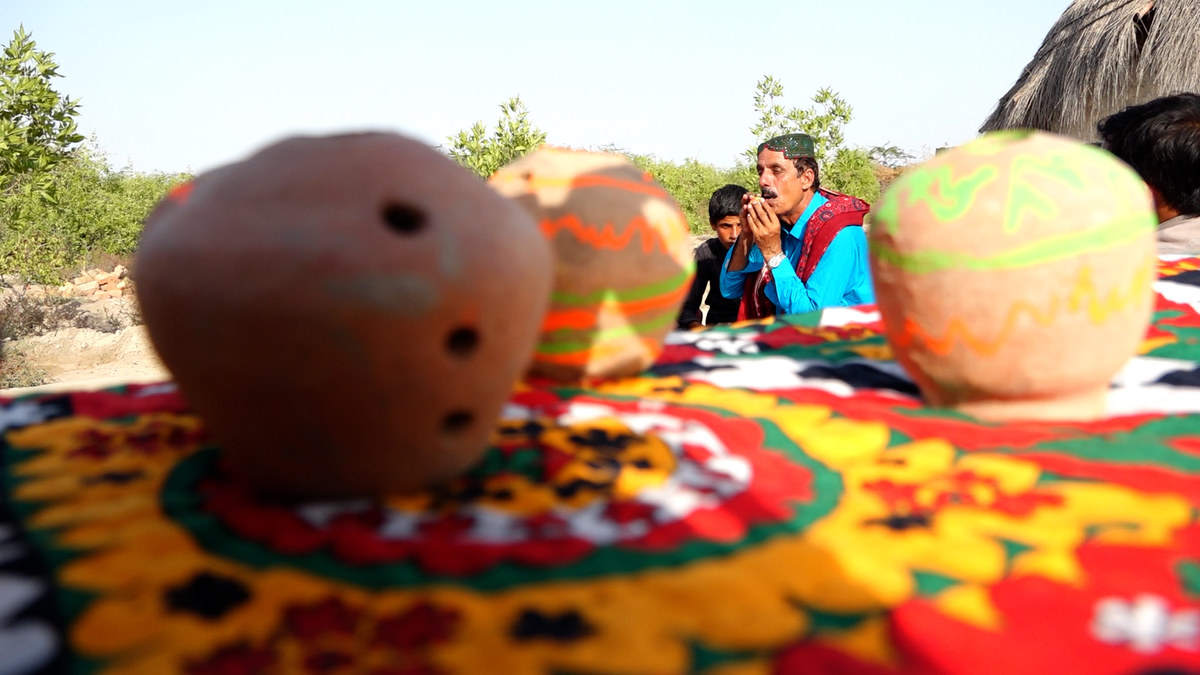


The still image taken from a video shows multiple borrindos (musical instrument made out of clay) displayed on a colorful cloth while musician Zulfiqar Ali plays the instrument in the background in Tharparkar district in the Sindh province of Pakistan, on September 10, 2023. (AN Photo)

Jurio, whose fading eyesight, has made it difficult for him to keep producing borrindos, first started making the instrument six decades ago for Ali’s father Mir Muhammad Khan, also a musician, after Khan showed him a sketch of what the instrument must have looked like when used in Mohenjo Daro.

“My younger son could make them, if Zulfiqar places an order, he can make fifty, a hundred, or even five hundred,” Jurio told Arab News. “But these items are not sold or made anymore.”

Making the borrindo requires craftsmanship but also time, Jurio explained.

The wet clay is dried under the harsh sun after which it is heated in a kiln for two to three days. Once the borrindo is hardened by fire, Jurio’s 72-year-old wife Jamiat and daughter-in-law Mariyam Abdul Rahim paint the instrument in different colors to provide the finishing touches.
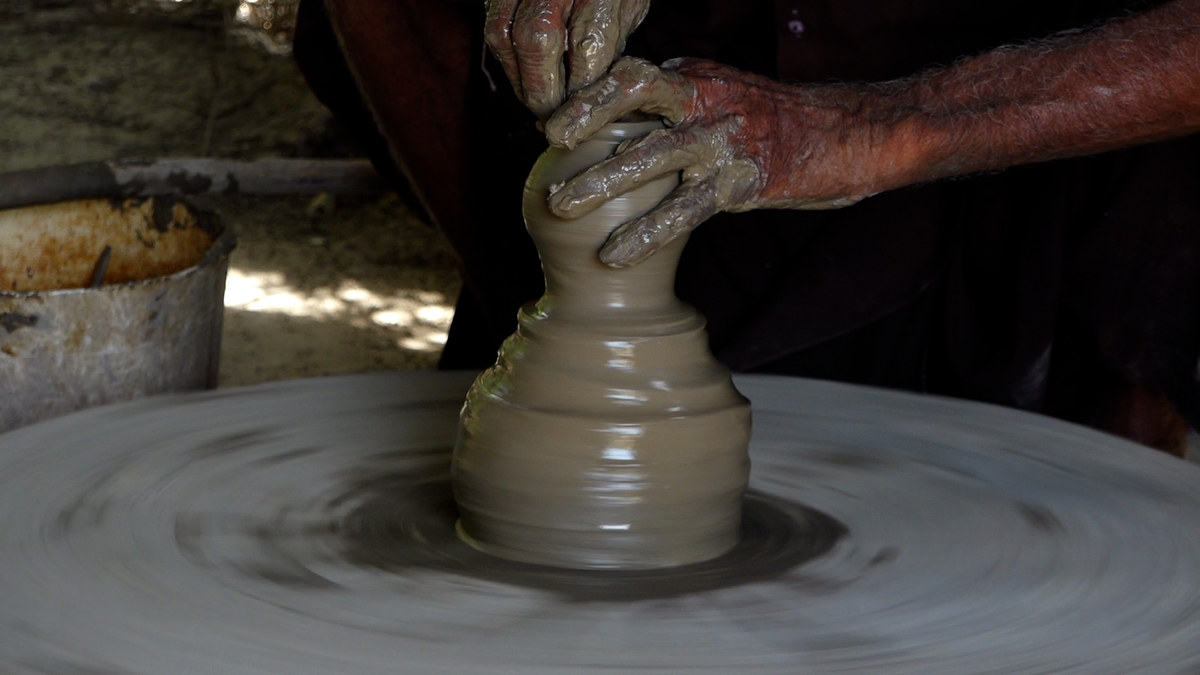


The screen grab taken froma video shows the musical instrument Borrindo being shaped out of clay in the Tharparkar district in the Sindh province of Pakistan, on September 10, 2023. (AN Photo)

Ali introduced his own variation of the centuries-old instrument, which originally featured three holes, adding an extra hole to enhance the borrindo’s capacity to produce a wider range of notes.

“Its physical shape is similar [to the ones that were made in Mohenjo-Daro], but witnessing a rise in diverse melodies in this era, I came to the realization that it [borrindo] was deficient in tones,” Ali told Arab News. “So, I sat down and worked hard and kept adding tones and I succeeded in expanding it to seven tones.”

A third-generation player of the borrindo, Ali is a recipient of the President’s Pride of Performance award in 2021. His father got the award in 1990.

The musician said around forty years ago, the borrindo was played popularly among people in Sindh as they herded animals or traveled to farmlands.

“But it was my father who brought it to music, and introduced it as a musical instrument,” he explained.
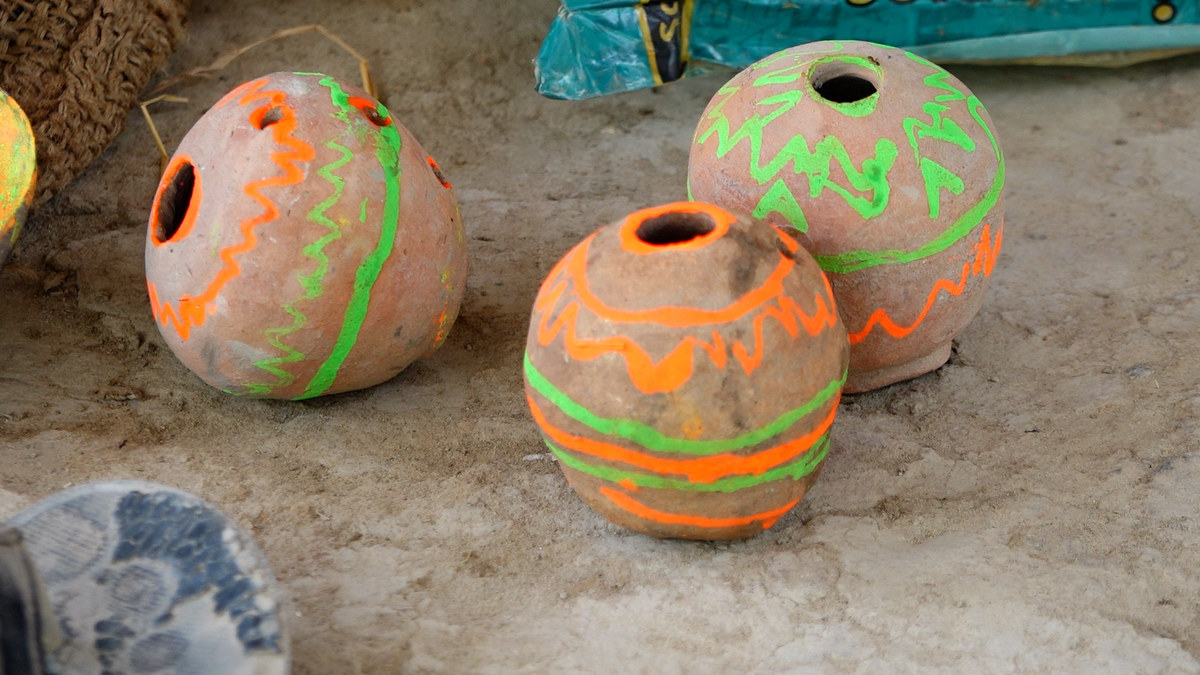


The still image taken from a video shows multiple borrindos (musical instrument made out of clay) designed in bright colours in the Tharparkar district in the Sindh province of Pakistan, on September 10, 2023. (AN Photo)

Though Ali hopes the new generation of his family would keep the tradition of playing the borrindo alive, he feared it would soon be a relic of the past.

“The world has embraced modernity and with the introduction of contemporary instruments, it has faced a loss,” he said. “It can be said that it remains alive through me and through Allah Jurio.

“If we were to quit it, it would make a significant difference,” he lamented, “perhaps resulting in no one playing it.”


Pakistan opposition rallies in Khyber Pakhtunkhwa to demand release of Imran Khan

Updated 07 December 2025
Follow

Pakistan opposition rallies in Khyber Pakhtunkhwa to demand release of Imran Khan

  • PTI-led gathering calls the former PM a national hero and demands the release of all political prisoners
  • Government says the opposition failed to draw a large crowd and accuses PTI of damaging its own politics

ISLAMABAD: Pakistan’s opposition led by the Pakistan Tehreek-e-Insaf (PTI) party demanded the release of jailed former prime minister Imran Khan at a rally in the northwestern Khyber Pakhtunkhwa province on Sunday, describing him as a national hero who continues to command public support.

The gathering came days after a rare and strongly worded briefing by the military’s media chief, Lt. Gen. Ahmed Sharif Chaudhry, who dismissed Khan as “narcissistic” and “mentally ill” on Friday while responding to the former premier’s allegations that Pakistan’s chief of defense forces was responsible for undermining the constitution and rule of law.

He said that Khan was promoting an anti-state narrative which had become a national security threat.

The participants of the rally called for “civilian supremacy” and said elected representatives should be treated with respect.

“We, the people of Pakistan, regard Imran Khan as a national hero and the country’s genuinely elected prime minister, chosen by the public in the February 8, 2024 vote,” said a resolution presented at the rally in Peshawar. “We categorically reject and strongly condemn the notion that he or his colleagues pose any kind of threat to national security.”

“We demand immediate justice for Imran Khan, Bushra Bibi and all political prisoners, and call for their prompt release,” it added, referring to Khan’s wife who is also in prison. “No restrictions should be placed on Imran Khan’s meetings with his family, lawyers or political associates.”

Addressing the gathering, Sohail Afridi, the chief minister of Khyber Pakhtunkhwa, denied his administration was not serious about security issues amid increased militant activity. However, he maintained the people of his province had endured the worst of Pakistan’s conflict with militancy and urged a rethinking of long-running security policies.

The resolution asked the federal government to restore bilateral trade and diplomatic channels with Afghanistan, saying improved cross-border ties were essential for the economic stability of the region.

The trade between the two neighbors has suffered as Pakistan accuses the Taliban administration in Kabul of sheltering and facilitating armed groups that it says launch cross-border attacks to target its civilians and security forces. Afghan officials deny the claim.

The two countries have also had deadly border clashes in recent months that have killed dozens of people on both sides.

Some participants of the rally emphasized the restoration of democratic freedoms, judicial independence and space for political reconciliation, calling them necessary to stabilize the country after years of political confrontation.

Reacting to the opposition rally, Information Minister Attaullah Tarrar said the PTI and its allies could not gather enough people.

“In trying to build an anti-army narrative, they have ruined their own politics,” he said, adding that the rally’s reaction to the military’s media chief’s statement reflected “how deeply it had stung.”

“There was neither any argument nor any real response,” he added, referring to what was said by the participants of the rally.