

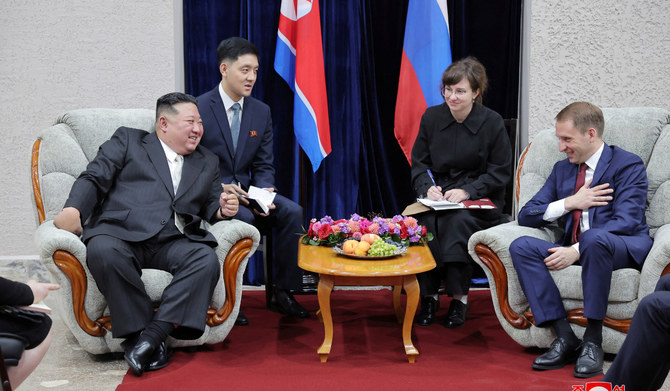
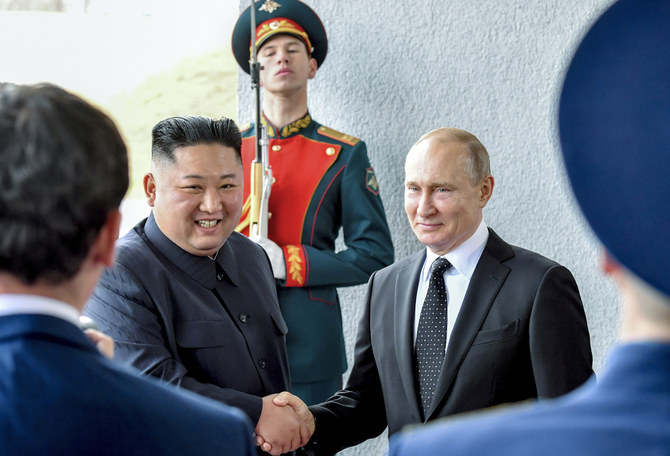

SEOUL, South Korea: North Korea’s Kim Jong Un rolled through Russia on an armored train Tuesday toward a meeting with President Vladimir Putin, a rare encounter between isolated leaders driven together by their need for support in escalating standoffs with the West.
Kim is expected to seek economic aid and military technology for his impoverished country, and, in a twist, appears to have something Putin desperately needs: munitions for Russia’s grueling war in Ukraine.
It’s a chance for the North Korean leader to get around crippling UN sanctions and years of diplomatic isolation. For Putin, it’s an opportunity to refill ammunition stores that the war has drained.
Any arms deal with North Korea would violate the sanctions, which Russia supported in the past.
Kim’s personal train stopped in Khasan, a station on the Russia-North Korea border, early Tuesday where it was met by a military honor guard and a brass band. He was met on a red carpet by regional Gov. Oleg Kozhemyako and Natural Resources Minister Alexander Kozlov, according to North Korean state media and video posted on social media channels.
Kim said his decision to visit Russia four years after his previous visit — his first foreign trip since the COVID-19 pandemic — showed how Pyongyang is “prioritizing the strategic importance” of its relations with Moscow, North Korea’s official news agency said Wednesday.
The Korean Central News Agency said Kim then left for his destination, but it didn’t specify where.
Many had assumed he and Putin would meet in Vladivostok, a Russian city close to the border where the two leaders had their last meeting in 2019, and which Putin is visiting this week for an economic forum.
But Kremlin spokesman Dmitry Peskov confirmed only that Kim has entered Russia, and state news agency RIA-Novosti later reported his train had headed north after crossing the Razdolnaya River, taking it away from Vladivostok. The South Korean news agency Yonhap later published a photo it said showed the train in Ussuriysk, a city about 60 kilometers (about 40 miles) north of Vladivostok that has a sizable ethnic Korean population.
Some Russian news media speculate he is headed for the Vostochny spaceport, which Putin is to visit soon. At the forum, Putin declined to say what he intended to do there. The launch facility is about 900 kilometers (550 miles) northwest of Ussuriysk, but the route there is circuitous and it is unclear how long Kim’s slow-moving train would take to reach it.
Peskov said Putin and Kim will meet after the Vladivostok forum, and that the meeting would include a lunch in Kim’s honor.
Kim left Pyongyang on his train Sunday, accompanied by members of the ruling party, government and military, KCNA said.
Officials identified in North Korean state media photos could hint at what Kim might seek from Putin and what he would be willing to give.
Kim is accompanied by Jo Chun Ryong, a ruling party official in charge of munitions policies who joined him on recent tours of factories producing artillery shells and missiles, according to South Korea’s Unification Ministry. Russian Defense Minister Sergei Shoigu will be part of the Russian delegation, Peskov said.
Kim’s delegation also includes Foreign Minister Choe Sun Hui and his top military officials, including Korean People’s Army Marshals Ri Pyong Chol and Pak Jong Chon and Defense Minister Kang Sun Nam.
North Korea may have tens of millions of aging artillery shells and rockets based on Soviet designs that could give a huge boost to the Russian army in Ukraine, analysts say.
Also identified in photos were Pak Thae Song, chairman of North Korea’s space science and technology committee, and navy Adm. Kim Myong Sik, who are linked with North Korean efforts to acquire spy satellites and nuclear-capable ballistic missile submarines. Experts say North Korea would struggle to acquire such capabilities without external help, although it’s not clear if Russia would share such sensitive technology.
Kim Jong Un may also seek badly needed energy and food supplies, analysts say. Deputy Foreign Minister Andrei Rudenko said Russia may discuss humanitarian aid with the North Korean delegation, according to Russian news agencies.
Data from FlightRadar24.com, which tracks flights worldwide, showed an Air Koryo An-148 took off from Pyongyang on Tuesday and flew to Vladivostok. North Korea’s national airline has only just resumed flying internationally after being grounded during the COVID-19 pandemic. There had been speculation that North Korea could use a plane to fly in support staff.
Kim is making his first foreign trip since the pandemic, during which North Korea imposed tight border controls for more than three years. After decades of hot-and-cold relations, Russia and North Korea have drawn closer since Moscow’s invasion of Ukraine in 2022.
Lim Soo-suk, South Korea’s Foreign Ministry spokesperson, said Seoul was maintaining communication with Moscow while closely monitoring Kim’s visit.
“No UN member state should violate Security Council sanctions against North Korea by engaging in an illegal trade of arms, and must certainly not engage in military cooperation with North Korea that undermines the peace and stability of the international community,” Lim said at a briefing.
US deputy ambassador Robert Wood said Tuesday that Moscow’s potential deals with North Korea could include “the provision of raw materials that would assist Russia’s defense industrial base.” Wood’s comments came during a UN Security Council meeting called by Russia to protest Western weapons supplies to Ukraine.
According to US officials, Putin could focus on securing more supplies of North Korean artillery and other ammunition to refill arsenals as Moscow seeks to rebuff a Ukrainian counteroffensive and show that he’s capable of grinding out a long war of attrition. That could potentially put more pressure on the US and its partners to pursue negotiations as concerns over a protracted conflict grow despite their huge shipments of advanced weaponry to Ukraine in the past 18 months.
The United States has accused North Korea of providing Russia with arms, including selling artillery shells to the Russian mercenary group Wagner. Both Russian and North Korean officials denied such claims.
Speculation about their military cooperation grew after Shoigu, the Russian defense minister, visited North Korea in July. Kim invited him to a massive military parade in the capital showcasing ICBMs designed to target the US mainland.
Following that visit, Kim toured North Korea’s weapons factories. Experts say Kim’s visits to the factories likely had a dual goal of encouraging the modernization of North Korean weaponry and examining artillery and other supplies that could be exported to Russia.


