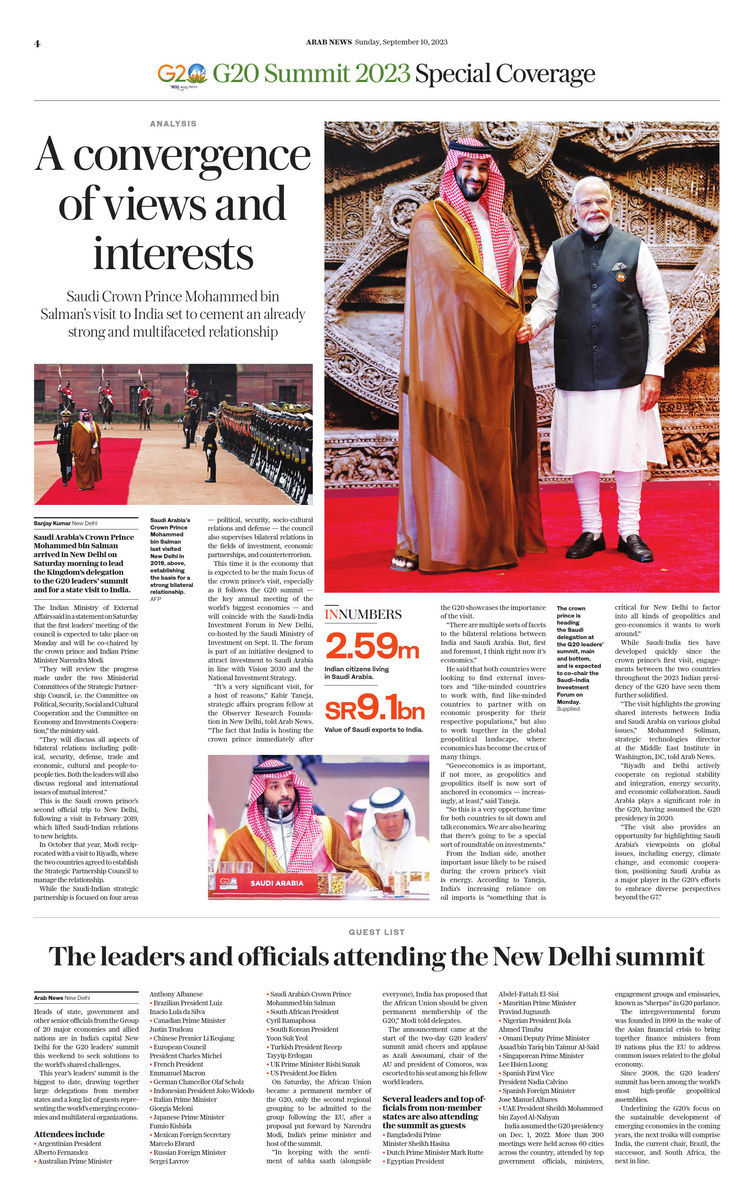

NEW DELHI: Saudi Arabia’s Crown Prince Mohammed bin Salman arrived in New Delhi on Saturday morning to lead the Kingdom’s delegation to the G20 leaders’ summit and for a state visit to India.
The Indian Ministry of External Affairs said in a statement on Saturday that the first leaders’ meeting of the council is expected to take place on Monday and will be co-chaired by the crown prince and Indian Prime Minister Narendra Modi.

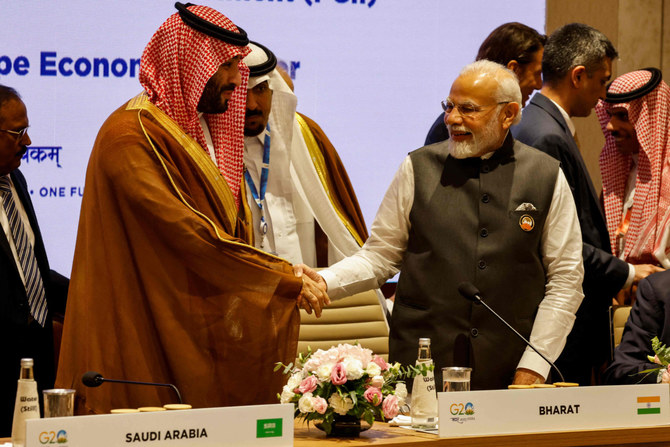
Saudi Arabia’s Crown Prince and Prime Minister Mohammed bin Salman at the G20 Leaders’ Summit in New Delhi on Sept. 9, 2023. (Twitter: @Bandaralgaloud)
“They will review the progress made under the two Ministerial Committees of the Strategic Partnership Council, i.e. the Committee on Political, Security, Social and Cultural Cooperation and the Committee on Economy and Investments Cooperation,” the ministry said.
“They will discuss all aspects of bilateral relations including political, security, defense, trade and economic, cultural and people-to-people ties. Both the leaders will also discuss regional and international issues of mutual interest.”
This is the Saudi crown prince’s second official trip to New Delhi, following a visit in February 2019, which lifted Saudi-Indian relations to new heights.
In October that year, Modi reciprocated with a visit to Riyadh, where the two countries agreed to establish the Strategic Partnership Council to manage the relationship

Saudi Crown Prince Mohammed bin Salman (2nd L) inspects a guard of honor during a ceremonial reception at the presidential palace in New Delhi on February 20, 2019. (AFP/File)
While the Saudi-Indian strategic partnership is focused on four areas — political, security, socio-cultural relations and defense — the council also supervises bilateral relations in the fields of investment, economic partnerships, and counterterrorism.
This time it is the economy that is expected to be the main focus of the crown prince’s visit, especially as it follows the G20 summit — the key annual meeting of the world’s biggest economies — and will coincide with the Saudi-India Investment Forum in New Delhi, co-hosted by the Saudi Ministry of Investment on Sept. 11.
The forum is part of an initiative designed to attract investment to Saudi Arabia in line with Vision 2030 and the National Investment Strategy.
INNUMBER
2.59 million Indian citizens living in Saudi Arabia.
SR9.1 billion Value of Saudi exports to India (May 2023).
“It’s a very significant visit, for a host of reasons,” Kabir Taneja, strategic affairs program fellow at the Observer Research Foundation in New Delhi, told Arab News. “The fact that India is hosting the crown prince immediately after the G20 showcases the importance of the visit.
“There are multiple sorts of facets to the bilateral relations between India and Saudi Arabia. But, first and foremost, I think right now it’s economics.”
He said that both countries were looking to find external investors and “like-minded countries to work with, find like-minded countries to partner with on economic prosperity for their respective populations,” but also to work together in the global geopolitical landscape, where economics has become the crux of many things.

Saudi Arabia's Crown Prince and Prime Minister Mohammed bin Salman attending the G20 summit in New Delhi on September 9, 2023. (SPA)
“Geoeconomics is as important, if not more, as geopolitics and geopolitics itself is now sort of anchored in economics — increasingly, at least,” said Taneja.
“So this is a very opportune time for both countries to sit down and talk economics. We are also hearing that there’s going to be a special sort of roundtable on investments.”
From the Indian side, another important issue likely to be raised during the crown prince’s visit is energy. According to Taneja, India’s increasing reliance on oil imports is “something that is critical for New Delhi to factor into all kinds of geopolitics and geo-economics it wants to work around.”
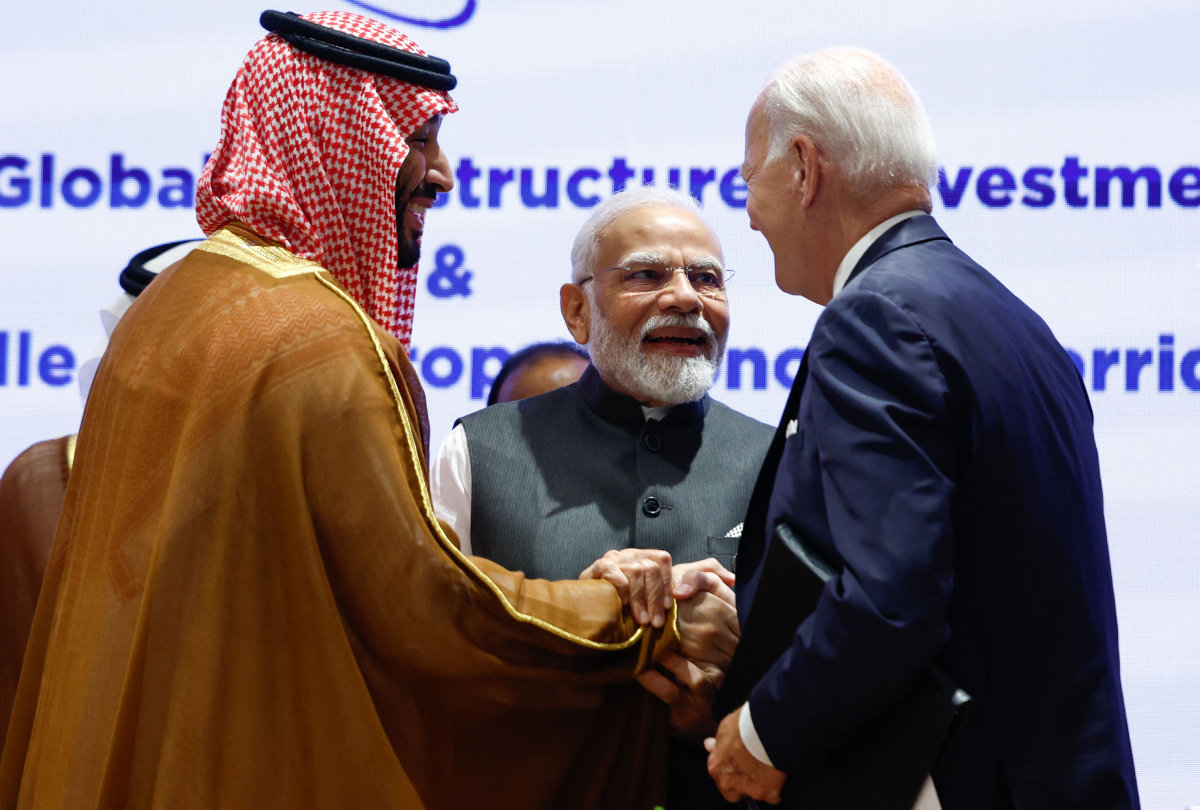
India's Prime Minister Narendra Modi (2R), US President Joe Biden (R) and Saudi Arabia's Crown Prince and Prime Minister Mohammed bin Salman hold hands before the start of a session at the G20 summit in New Delhi on September 9, 2023. (POOL / AFP)
While Saudi-India ties have developed quickly since the crown prince’s first visit, engagements between the two countries throughout the 2023 Indian presidency of the G20 have seen them further solidified.
“The visit highlights the growing shared interests between India and Saudi Arabia on various global issues,” Mohammed Soliman, strategic technologies director at the Middle East Institute in Washington DC, told Arab News.
“Riyadh and Delhi actively cooperate on regional stability and integration, energy security, and economic collaboration. Saudi Arabia plays a significant role in the G20, having assumed the G20 presidency in 2020.
“The visit also provides an opportunity for highlighting Saudi Arabia’s viewpoints on global issues, including energy, climate change, and economic cooperation, positioning Saudi Arabia as a major player in the G20’s efforts to embrace diverse perspectives beyond the G7.”