

Pakistan launches new visa regime for businesses to attract foreign investment

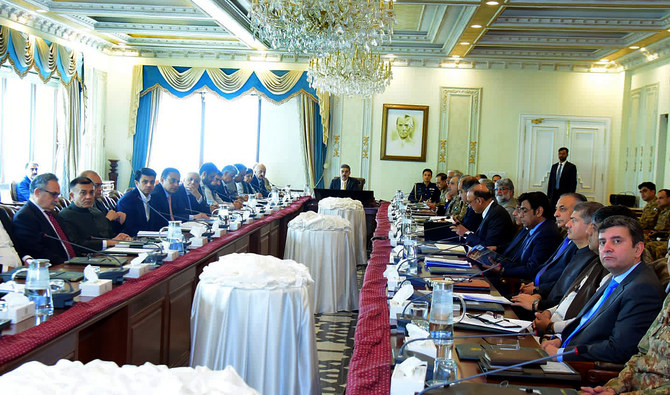
Pakistan Caretaker Prime Minister Anwaar-ul-Haq Kakar chairs the meeting of a Special Investment Facilitation Council in Islamabad on September 9, 2023. (Photo courtesy: Prime Minister's Office)
Short Url
Updated 09 September 2023
Follow

Pakistan launches new visa regime for businesses to attract foreign investment

  • Under the new policy, foreign investors will be able to get long-term visas without lengthy documentation
  • Foreign Minister Jilani says Pakistan wants to increase ease of doing business to secure more investment

ISLAMABAD: Caretaker Prime Minister Anwaar-ul-Haq Kakar unveiled a business-friendly visa regime on Saturday as part of his administration’s initiatives to bolster the national economy following a meeting of the country’s Special Investment Facilitation Council (SIFC).

The council, which is grounded in civil-military collaboration, aims to streamline economic decision-making processes and promote foreign investment, with a special emphasis on enticing financial support from Middle Eastern countries.

A June 17 notification from the office of former Prime Minister Shehbaz Sharif outlined the SIFC’s mission to attract investments across sectors, including energy, information technology, minerals, defense, and agriculture.

“Today, from the platform of SIFC, very important decisions were taken regarding the new visa regime related to an open Pakistan, under which businesspeople who are abroad, if they want to come to Pakistan, will be able to get visas easily from all [diplomatic] missions of the country on the basis of a document from their country or international business organizations,” the prime minister said in a short video statement.

“Along with this, all the entities and businesspeople associated with [local] chambers [of commerce] will also be able to issue [sponsorship] document to any person outside of Pakistan and, based on that, it will be easier to issue visas,” he continued.

Kakar said the new visa policy was not just limited to individuals but would also benefit small and big businesses.

He maintained that Pakistan was entering a new era of business and economy which would take it toward greater prosperity.

His message was followed by a news conference of key members of his interim administration in which foreign minister Jalil Abbas Jilani said the country was pursuing “proactive diplomacy” and had increased its trade with nearly all of its international partners.

He maintained the SIFC was set up to provide a “one-window operation” to all investors and was going to play a vital role in increasing the ease of doing business in the country.

“Pakistan’s diplomatic missions are trying to create greater awareness about the SIFC,” he said. “We have shared all the support material with them [to promote it].”

Jilani informed the new policy would help Pakistan issue “long-term visas” to people interested in doing business in the country.

The fifth meeting of the council’s apex committee was also attended by army chief General Asim Munir, who pledged unwavering support of his institution to the government’s efforts for the economic revival of Pakistan.


Pakistan assembly speaker warns opposition against anti-state remarks in parliament

Updated 17 January 2026
Follow

Pakistan assembly speaker warns opposition against anti-state remarks in parliament

  • Ayaz Sadiq says criticism of judiciary and armed forces will not be allowed on assembly floor
  • He calls violence during protests unacceptable, vows neutrality as National Assembly speaker

ISLAMABAD: Pakistan’s National Assembly Speaker Sardar Ayaz Sadiq said on Saturday that opposition lawmakers would not be allowed to speak against Pakistan, the judiciary or the armed forces on the floor of parliament, calling such remarks unacceptable.

Speaking to reporters during a visit to the eastern city of Lahore, Sadiq said parliamentary debate must remain within constitutional and legal limits, while reiterating his commitment to act impartially as speaker.

“No one will be allowed to speak against Pakistan, the judiciary or the armed forces on the floor of the National Assembly,” Sadiq said. “Negative or controversial remarks about judges or the armed forces are unacceptable.”

His comments come amid heightened political tensions after opposition groups held protests in the past, criticizing state institutions and targeting government and military properties.

The speaker said peaceful protest was a democratic right but drew a sharp line at violence and vandalism.

“Protest is the right of every citizen in a democratic society, but it must remain peaceful and within the bounds of the constitution and the law,” he continued, adding that arson, damage to property and the use of sticks or weapons in the name of protest were “unacceptable” and posed a threat to the rule of law.

“No opposition lawmaker will be allowed to speak on the National Assembly floor if they speak against Pakistan,” Sadiq said.

The speaker also noted the country’s economic indicators were gradually improving, citing an increase in foreign exchange reserves, and said Pakistan had further strengthened relations with countries including the United States, China, Russia, Türkiye and Saudi Arabia.