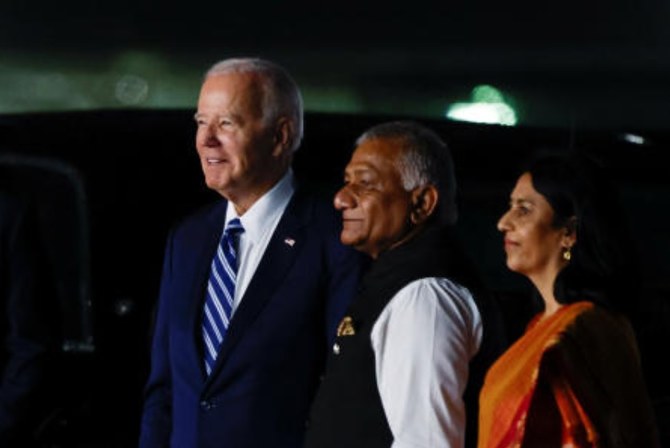
NEW DELHI: US President Joe Biden was welcomed warmly by Indian Prime Minister Narendra Modi on Friday ahead of a G20 summit in New Delhi, but journalists were blocked from covering the key meeting.
Media access to such bilateral encounters on the sidelines of major summits like the G20 is always tightly controlled, but it is rarely blocked entirely.
The incident comes after protracted negotiations were needed before Indian officials agreed to Modi taking one question from US reporters at a press briefing when he made a state visit to Washington in June — the Indian leader rarely if ever takes questions from foreign media.
The White House “pool” of journalists accompanying Biden usually attends the start of face-to-face meetings such as Friday’s, hearing preliminary statements, taking a few photographs — and asking some questions.
“The President believes the free press is the pillar of our democracy,” White House spokeswoman Karine Jean-Pierre told journalists on board the airplane taking Biden to India, saying they were doing all they could to secure media access.
After landing, Biden headed to the Indian leader’s residence, but journalists traveling with him were told to remain outside.
“We in the US government work hard to ensure and obtain access for US journalists to everything the President does,” National Security Adviser Jake Sullivan had said on board Air Force One.
“What we can pledge to you is what’s in our control — which is ensuring that we are transparent and comprehensive in our readout of what the two leaders discussed.”
At the Washington press conference with Biden in June, the one question to Modi came from Wall Street Journal reporter Sabrina Siddiqui, who asked the Hindu nationalist about accusations of repression of Muslims in India and the country’s record on human rights.
“In India’s democratic values, there is absolutely no discrimination, neither on basis of caste, creed, or age or any kind of geographic location,” Modi replied.
Siddiqui was subsequently subjected to “intense online harassment,” the White House Correspondents’ Association said in a statement, “including from people with ties to the prime minister’s political party.”


Journalists barred as India’s Modi welcomes Biden
https://arab.news/72ztx
Journalists barred as India’s Modi welcomes Biden

- Media access to such bilateral encounters on the sidelines of major summits like the G20 is always tightly controlled, but it is rarely blocked entirely
- After landing, Biden headed to the Indian leader’s residence, but journalists traveling with him were told to remain outside


Airspace closed, flights canceled as US-Iran conflict flares
- Major carriers from the Middle East, Europe, Asia-Pacific and the US announced widespread cancelations
- FlightAware said more than 19,000 flights had been delayed globally and more than 2,600 were canceled as of Sunday
PARIS: Thousands of flights have been delayed or canceled in the biggest disruption to global air transport since the Covid pandemic as airlines suspend services to the Middle East following the US and Israeli attacks on Iran.
Iran, Iraq, Israel, Syria, Kuwait and the United Arab Emirates all announced at least partial closures of their skies after Saturday’s strikes and Iran launching missiles at capital cities around the wealthy Gulf region.
Major carriers from the Middle East, Europe, Asia-Pacific and the United States announced widespread cancelations, leaving thousands of passengers stranded.
Notable airlines that canceled services included Emirates, Etihad, Air France, British Airways, Air India, Turkish Airlines, and Lufthansa.
According to aviation analytics company Cirium, of around 4,218 flights scheduled to land in Middle Eastern countries on Saturday, 966 (22.9 percent) were canceled, with the figure rising above 1,800 if also including outbound flights.
For Sunday, 716 flights out of 4,329 scheduled to the Middle East have been canceled, Cirium said.
Flight tracking website FlightAware meanwhile said more than 19,000 flights had been delayed globally and more than 2,600 were canceled as of 0230 GMT Sunday.
Airspace closures
Iran swiftly closed its airspace as the strikes began “until further notice,” said the spokesman of Iran’s Civil Aviation Organization, quoted by the Tasnim news agency.
Israel also closed its airspace to civilian flights, Transport Minister Miri Regev announced.
Qatar’s civil aviation authority said it had temporarily closed the Gulf state’s airspace.
Iraq shut down airspace, state media said.
The United Arab Emirates said it was closing its skies “partially and temporarily.”
Syria closed part of its airspace in the south along the border with Israel for 12 hours, the Civil Aviation Authority said.
Jordan’s air force was conducting drills to “defend the kingdom’s skies,” its military said.
Kuwait closed its airspace.
Middle East and North Africa airlines
Gulf carriers Emirates and Etihad canceled 38 percent and 30 percent of their flights respectively, Cirium said.
Qatar Airways suspended all flights from Doha. It canceled 41 percent of total flights, according to Cirium.
Syria Air, the country’s national carrier, canceled all flights until further notice.
Egypt’s national airline, EgyptAir, announced the suspension of its flights to cities across the Middle East, including Dubai, Doha, Manama, Abu Dhabi, Beirut and Baghdad among others.
European airlines
Russia’s air transport authority Rosaviatsia said all commercial flights to Israel and Iran were canceled “until further notice.”
Turkish Airlines canceled flights to Lebanon, Syria, Iraq, Iran, and Jordan until March 2.
Air France canceled its Dubai, Riyadh and Beirut flights for Saturday, and flights to Tel Aviv until Sunday.
British Airways said it was not flying to Tel Aviv and Bahrain until March 4, and canceled flights to the Jordanian capital Amman on Saturday.
Swiss International Air Lines suspended flights to and from Tel Aviv until March 7, and canceled flights from Zurich to Dubai scheduled for Saturday and Sunday.
Germany’s Lufthansa, which comprises Swiss and ITA Airways, canceled its flights to and from Tel Aviv, Beirut, Amman, Irbil and Tehran until March 7.
The airline group and its subsidiaries suspended flights to and from Dubai and Abu Dhabi until Sunday.
North America airlines
Delta Air Lines suspended New York-Tel Aviv flights until Sunday.
American Airlines “temporarily suspended” Doha-Philadelphia flights.
United flights to Tel Aviv are canceled until Monday, and flights to Dubai until Sunday.
Air Canada said it canceled flights from Canada to Israel until March 8 and to Dubai until March 3.
Asia-Pacific airlines
India’s two largest private carriers IndiGo and Air India suspended flights to all destinations in the Middle East.
Pakistan International Airlines, the flag carrier of the country that borders Iran, said it had suspended flights to the UAE, Bahrain, Doha and Kuwait.
Hong Kong’s Cathay Pacific suspended flights to Dubai and Riyadh.
Garuda Indonesia, Indonesia’s flag carrier, temporarily suspended flights to and from Doha “until further notice,” the company said in a statement Sunday.
Singapore Airlines and Singapore’s Scoot canceled six flight routes in the region until the end of Sunday, local media reported.
Philippine Airlines flights from Manila to Doha, Riyadh to Manila, and Dubai to Manila were canceled on Saturday, as well as one Doha-Manila flight on Sunday.
Other major airlines including Australia’s Qantas and Japan’s All Nippon Airways did not announce any flight cancelations.
Africa airlines
Ethiopian Airlines canceled its flights to Amman, Tel Aviv, Dammam, and Beirut.
Kenya Airways has suspended its flights to Dubai and Sharjah until further notice.


