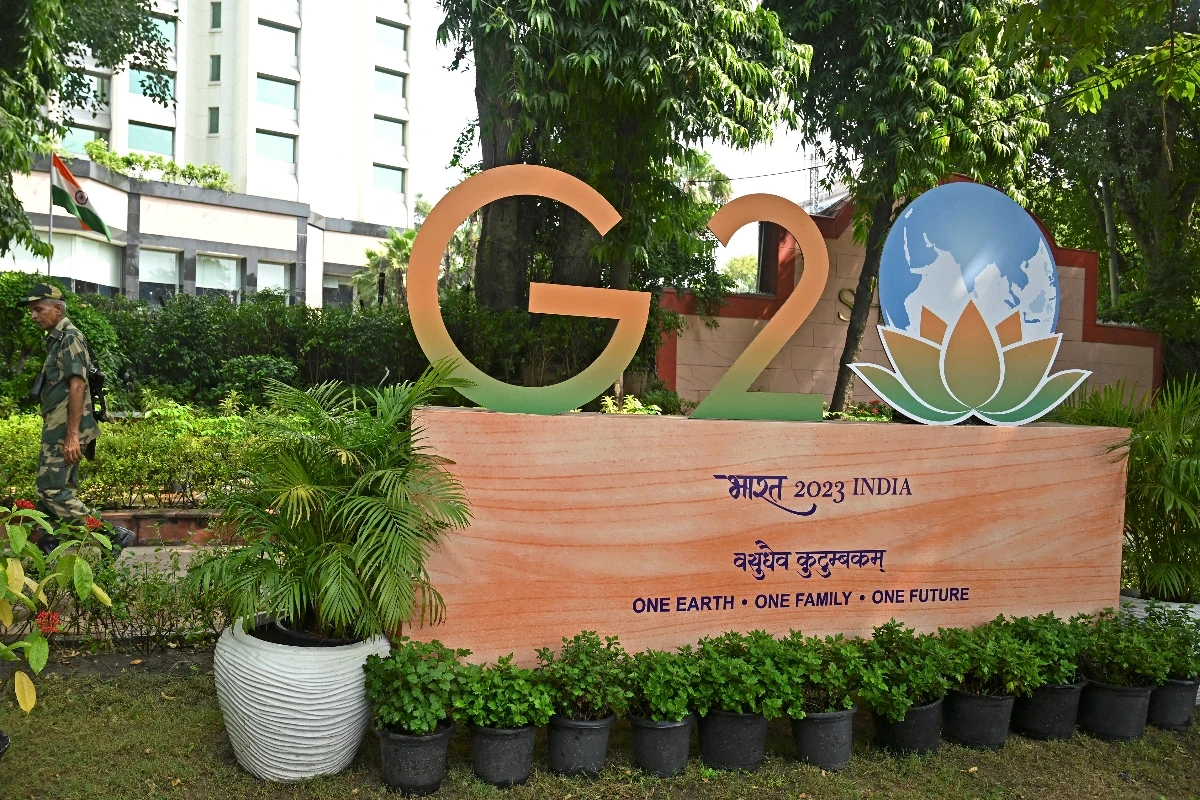
- The G20 was conceived in the throes of the 2008 financial crisis as a way of managing the global economy
NEW DELHI: G20 leaders began to descend on New Delhi Friday, hoping to make progress on trade, climate and a host of other global problems despite the Chinese and Russian president’s skipping the summit.
The G20 was conceived in the throes of the 2008 financial crisis as a way of managing the global economy.
But as presidential and prime ministerial jets began landing in the Indian capital, the pointed absence of China’s Xi Jinping raised questions about what, if anything, the disparate bloc can still agree on.
As the summit was set to begin, officials had yet to achieve the normally routine task of smoothing over disagreements and finalizing a joint communique for leaders to sign off on.
No official reason has been given for Xi’s no-show, but China has been open about its desire to upend traditionally US-led groupings such as the G20 and replace them with something more amenable to Beijing’s interests.
Xi will instead host the leaders of Venezuela and Zambia in Beijing.
Diplomatic opprobrium and war crimes charges are also keeping Russian leader Vladimir Putin away, although Moscow continues to press allies to water down international condemnation of its invasion of Ukraine.
“Once again, Vladimir Putin is failing to show his face at the G20,” said British Prime Minister Rishi Sunak.
“He is the architect of his own diplomatic exile, isolating himself in his presidential palace and blocking out criticism and reality.”
“The rest of the G20, meanwhile, are demonstrating that we will turn up and work together to pick up the pieces of Putin’s destruction.”
Heading to the summit, US President Joe Biden also insisted that the meeting would still “deliver”, even as markets fretted that a trade war between the world’s two largest economies was poised to escalate.
Rumours have swirled that China may be poised to ban Apple’s ubiquitous iPhone.
US National Security Adviser Jake Sullivan, speaking on Air Force One bound for the summit, parried queries about those rumors.
Questions such as “what’s motivating them, what the scope of this will be, and what they think the net effect of that will be” were for Beijing to answer, he said.
Many G20 leaders fear their economies are already at risk of being collateral damage as the big beasts of world trade lock horns.
Economists say US restrictions on the transfer of sensitive technologies to China have deepened a slowdown in the world’s second-largest economy.
They also point, however, to serious structural problems in China such as a shrinking labor force, slower productivity and an overheated real estate market.
Speaking in Delhi on Friday, US Treasury Secretary Janet Yellen warned a Chinese slowdown carried risks for the entire globe.
“China faces a variety of both short- and longer-term global challenges, economic challenges that we’ve been monitoring carefully,” she said.
“That said, China has quite a bit of policy space to address these challenges”.
The summit’s host Indian Prime Minister Narendra Modi — sensing an opportunity to burnish his credentials as a statesman ahead of a re-election tilt early next year — has thrust himself into the political void.
Motorcades roaring in from New Delhi’s international airport — named after the once all-powerful ever-present prime minister Indira Gandhi — can be in no doubt who is in charge today.
From posters, placards and billboards, Modi’s image gazes down as the very public face of the two-day summit.
In some, Modi simply welcomes delegates. In others, he delivers domestically bankable slogans about development, jobs and “giving voice to the global south”.
Sumedha Dasgupta, senior Asia analyst with the Economist Intelligence Unit, believes that “India will try to be a credible voice that can facilitate dialogue between the global north and south”.
Modi looks set to secure at least one concrete step in that direction — with several leaders expressing support for expanding the bloc into the “G21” and including the African Union as a permanent member.
Modi’s efforts to get the G20 to tackle global debt restructuring and commodity price shocks following Russia’s Ukraine invasion have been less successful.
A G20 energy ministers’ meeting in July also failed to agree on a roadmap to phase down the use of fossil fuels — or even mention coal, the dirty fuel that remains a key energy source for economies like India and China.