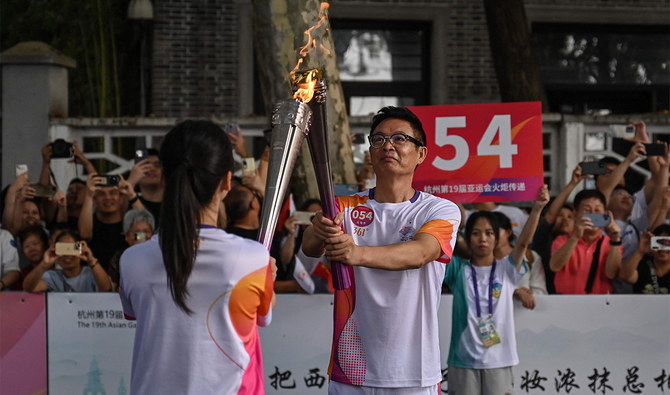

TOKYO: The Asian Games are set to go in China, the first multi-sport international event in the country since pandemic restrictions were lifted there about nine months ago.
This giant sports festival in the eastern city of Hangzhou involves more athletes than the Olympics with 12,417 entered, according to organizers.
About 11,000 participated two years ago in the scandal-filled Tokyo Olympics, and about 10,500 are headed to next year’s Paris Games.
Unmatched for size, the Asian Games may even surpass the Olympics for controversy, power politics, and intrigue.
The games begin on Sept. 23 amid an open power struggle between International Olympic Committee President Thomas Bach and Kuwait’s Sheikh Ahmad Al-Fahad Al-Sabah, a long-time IOC member who is often described as the “kingmaker” who helped Bach win election in Buenos Aires in 2013.
Bach is due to step down in 2025 because of IOC term limits and hardball politics are in play around who succeeds him.
In a rare move, the Switzerland-based IOC openly intervened in early July to invalidate the presidential election of the Olympic Council of Asia, which oversees the Asian Games and Olympic sports on the continent.
The July 8 election was ostensibly won by Kuwait’s Sheikh Talal Fahad Al-Ahmad Al-Sabah, the younger brother of Sheikh Ahmad. The elder sheikh is the former 30-year president of the OCA, an organization that was created by his father.
Sheikh Talal defeated another Kuwaiti, Husain Al-Musallam, the veteran director general of the OCA and Sheikh Ahmad’s loyal aide. Since 2021, Al-Musallam has also been the head of swimming’s governing body World Aquatics.
A few weeks after the election, the IOC suspended Sheikh Ahmad for three years for influencing the result of the election after he was cautioned not to be the IOC.
He was already self-suspended as an IOC member since 2018 after he was indicted in Switzerland for forgery that led to his conviction two years ago. He has appealed the ruling.
“This is all about raw power and wielding influence through titles, money, and privilege,” said Jules Boykoff, a political scientist at Pacific University and the author of “Power Games: A Political History of the Olympics.”
“If the IOC doesn’t figure out a way to allow Bach to extend his tenure beyond the 12 allotted years — and I would not be surprised if the group in fact did that — space will open up for someone new at the reins at the IOC,” Boykoff told Associated Press.
Sheikh Ahmad has also revived his political career in Kuwait and is now its defense minister and deputy prime minister. Despite the IOC’s moves, he is unlikely to be sidelined.
“As this battle for the (IOC presidency) job heats up, Sheikh Ahmad could wield significant influence,” Boykoff said.
In July, addressing the Kuwaiti legislature, Sheikh Ahmad gave no indication he would back down. And he carries more power now as the representative of a sovereign government.
“I am personally the president of the Olympic Council of Asia,” he told the body. “This is my second hat.”
The IOC has said it will continue to recognize Randhir Singh of India as interim president of the OCA until new elections are held. The IOC has said Bach will attend the opening ceremony in Hangzhou.
Bach and the IOC have distanced themselves from the sheikh since an indictment by Geneva prosecutors was revealed in November 2018. The forgery case was unrelated to sports and involved a factional rivalry in the Kuwaiti royal family and government.
Thousands of athletes care little about the leadership, but billions are in play over who runs Olympic sports in Asia. Many sports body in Asia, as elsewhere, depend heavily on monetary payments from the IOC.
The Asian Games involve China and India, the world’s two most populous countries — and Indonesia, the world’s fourth most populous.
Asian sports powers Japan and South Korea are also on hand, as is the self- governing island of Taiwan, which China views as a renegade province.
The biggest event of the games might be a possible India vs. Pakistan gold-medal game in cricket on Oct. 7, which would be one of the most-watched global sports events all year.
Organizers say 45 nations and territories in Asia will participate at 56 competition venues. Twelve venues are newly built, and 44 venues are renovated or temporary buildings.
China’s state-run media says the total cost of competition or training venues is 10.19 billion yuan, or $1.4 billion.