Oil Updates – crude ticks higher as tight supply trumps macroeconomic gloom

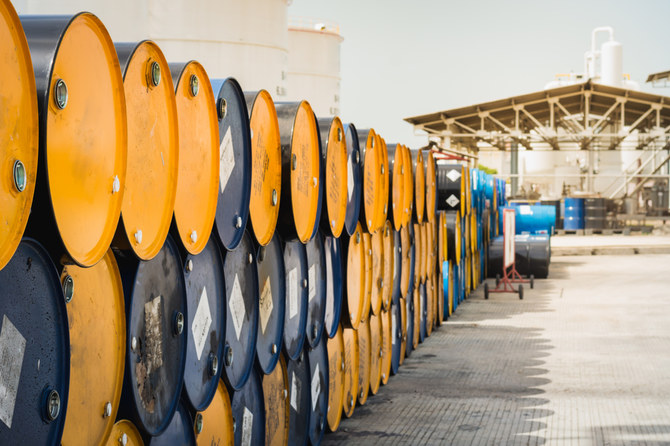
Brent crude futures were up 53 cents to $90.45 a barrel by 16:08 Saudi time. (Shutterstock)
Short Url
Updated 08 September 2023
Follow

Oil Updates – crude ticks higher as tight supply trumps macroeconomic gloom

LONDON: Oil prices hovered above $90 a barrel on Friday, on track to end the week higher as investors chose to focus on tighter supply, despite broader macroeconomic uncertainty.

Both oil benchmarks hit 10-month highs earlier this week after Saudi Arabia and Russia extended their voluntary supply cuts of a combined 1.3 million barrels per day to the end of the year.

However, both benchmarks ended Thursday slightly lower amid volatile trade on multiple signals warning of weaker demand in the coming months.

Traders who took some profit on Thursday were back as they believe that the path of least resistance is certainly skewed to the upside, and oil prices are well on track to close another week in positive territory, said Naeem Aslam of Zaye Capital Markets.

BACKGROUND

Brent crude futures were up 53 cents to $90.45 a barrel by 16:08 Saudi time, while US West Texas Intermediate crude futures were up 39 cents at $87.26 a barrel.

Brent crude futures were up 53 cents to $90.45 a barrel by 16:08 Saudi time, while US West Texas Intermediate crude futures were up 39 cents at $87.26 a barrel.

Both benchmarks closed up about 2 percent last week — at $88.49 a barrel for Brent and $85.02 a barrel for WTI — in anticipation of the cut announcements.

On the demand side, a key concern is China, the world’s largest oil importer. The country has frustrated markets due to its sluggish post-pandemic recovery, while stimulus pledges have fallen short of expectations.

Data on Thursday showed overall Chinese exports and imports fell in August, as sagging overseas demand and weak consumer spending squeezed businesses.

However, even in times of lacklustre economic activity, China tends to bolster its storage capacity, particularly with the availability of cheap Russian crude. Last month, Chinese crude imports rose nearly 31 percent.

Demand for crude could also benefit from workers going on strike at projects in Australia which produce about 5 percent of the world’s supply of liquefied natural gas.

Meanwhile, questions remain about whether central banks in the US and Europe will continue their aggressive interest rate hike campaigns to tame persistent inflation.

On the global stocks markets, prices were subdued on Friday after prolonged pressure, with investors watching the contrasting fortunes of the dollar and yuan, and mulling central bank meetings and US data on the horizon.

US stock index futures were little changed.

The tech sector was in focus after about $200 billion was wiped from Apple’s market capitalization in two days on reports of China curbing iPhone use by state employees and on Friday protectionism fears were weighing on shares of suppliers.

Apple shares were flat in pre-market trading on Friday.

The dollar was set to clock up its best winning streak since 2014, bolstered by a resilient run of US economic data.

In contrast, the yuan fell to its weakest level since 2007 on worries about China’s slowing economy.

Investors were focused in upcoming central bank meetings this month and next batch of US data.

“Everything is geared toward the next couple of weeks, with European Central Bank, Federal Reserve and Bank of England meeting. I think they will all sit on their hands,” said Mike Hewson, chief market strategist at CMC Markets.

Robust economic data in the US this week have left some investors worried that even if the Fed leaves rates unchanged this month, they could remain high for longer than anticipated.

The US Consumer Price Index reading for August is due on Sept. 13 ahead of the Fed’s next meeting in the following week.

Stocks sought to stabilize after a week of easing, with the MSCI All Country stock index slightly weaker at 676.83 points, and down about 1.5 percent for the week so far, though still up nearly 12 percent for the year.

In Europe, the STOXX index of 600 companies eased 0.3 percent and heading for a loss of about 1 percent for the week, and on course for its longest run of losses since November 2016.

Patrick Spencer, vice chair of equities at Baird, said investors were trying to guess at what pace the Fed could begin cutting interest rates next year.

“Maybe you are going to see slightly higher for longer rates and they may not come down as quickly next year, and that in itself will slow consumption and consumer confidence,” Spencer said, adding that a US government shutdown is also a worry.


How lifestyle-led real estate is reshaping Saudi Arabia’s urban future

Updated 25 January 2026
Follow

How lifestyle-led real estate is reshaping Saudi Arabia’s urban future

  • Government spending, regulatory changes, and incentives for foreign investors are fueling development

RIYADH: Saudi Arabia’s real estate sector is entering a new phase, one defined by lifestyle, experience, and quality of life rather than sheer housing volume.

Driven by Vision 2030, lifestyle-focused developments are set to outperform traditional residential projects, reshaping how people live, work, and connect across the Kingdom.
Government spending, regulatory changes, and incentives for foreign investors are also fueling development. Rising demand across residential, commercial, and logistics sectors, along with the push for smart cities and sustainability, is reshaping the market.
Saudi Arabia’s real estate market was valued at $77.2 billion in 2025 and is projected to grow to $137.8 billion by 2034, with a compound annual growth rate of 6.7 percent from 2026 to 2034, according to IMARC Group.

Lifestyle-focused real estate market 
Saudi Arabia’s real estate landscape has evolved beyond conventional housing. Guided by Vision 2030, it now plays a key role in enhancing quality of life, boosting tourism, and driving economic diversification.
According to Sally Menassa, partner at Arthur D. Little, what stands out today is a clear shift from volume-driven residential supply to lifestyle-led, experience-based development.
“As a result, the lifestyle-focused segment is expected to outperform conventional residential real estate, growing at around 8 percent annually over the next five years. This growth is being driven by changing consumer expectations, population growth, rising incomes, and the scale of public investment shaping new urban environments,” Menassa said.
She added that demand in the Kingdom’s real estate is rising across four key segments: mixed-use districts near urban hubs such as King Salman Park; wellness-focused communities prioritizing walkability and services; coastal living along the Red Sea with branded residences; and heritage-driven districts like Diriyah and Al Balad that blend culture, hospitality, and long-term value.
“Overall, this marks a fundamental shift in the Kingdom. Real estate is no longer an end in itself and about delivering buildings; it is becoming a platform for place-making, economic diversification, and sustained value creation,” the ADL partner explained.
From another perspective, Houssem Jemili, senior partner at Bain and Co. Middle East said: “Saudi’s real estate market is forecast at roughly 7–8 percent CAGR to 2030; ‘lifestyle’ demand is being pulled most by amenity-led mixed-use communities plus higher-spec, greener and wellness-leaning homes.”
A report from PwC Middle East released in 2025 focused on the future of sustainable real estate in Saudi Arabia, and  showed that the sector is shifting toward livability-focused, high-quality urban developments. Giga-projects are driving demand for mixed-use, wellness-focused, and socially connected communities that enhance quality of life.
Imad Shahrouri, cities sector lead partner, consulting, in Riyadh at PwC Middle East said: “By placing livability and human experience at the foundation of its urban agenda, Saudi Arabia is shaping a market where lifestyle-led developments will play an increasingly influential role in driving demand and investment.”

Core lifestyle elements developers are prioritizing  
Saudi developers are shifting from the traditional “build and sell” model to creating integrated lifestyle communities focused on long-term value and everyday living.
Menassa from ADL highlighted that the shift centers on enhancing public spaces — with walkable areas, parks, and wellness facilities — to promote healthier, more social lifestyles, especially for a younger, health-focused population.
“Convenience is also playing a bigger role in shaping residential districts. Schools, childcare centers, clinics, co-working spaces and a wide range of food and beverage options are increasingly located within walking distance of homes, reducing commuting time and making everyday life more efficient and connected,” she said.
The partner added: “Equally important is the role of culture and social activity. Many developments now incorporate cultural venues, entertainment spaces and destination dining, ensuring that neighborhoods remain active throughout the day and week rather than becoming dormant outside working hours.”
Menassa went on to stress that real estate in Saudi Arabia is evolving into a strategic tool for quality of life, tourism, and talent attraction. Driven by Vision 2030, developments now integrate smart infrastructure and global lifestyle standards, while staying rooted in local culture to meet the needs of a young, urban population.

FASTFACT

Driven by Vision 2030, lifestyle-focused developments are set to outperform traditional residential projects, reshaping how people live, work, and connect across the Kingdom.

From Bain’s lens, Jemili said: “Developers are prioritizing livable neighborhoods. Walkability, parks and sport, culture and entertainment access, and everyday convenience, shaped by Vision 2030’s Quality of Life agenda and the 70 percent homeownership-by-2030 push.”
Shahrouri from PwC shed light on how developers in the Kingdom prioritizing livability, wellbeing, and inclusive, community-focused spaces are, aligning with Vision 2030’s push to enhance daily life and promote social integration while reflecting local identity.
“As a result, lifestyle-led elements such as walkable neighborhoods, activated public spaces and integrated community facilities are becoming central to new destinations, ensuring future developments foster more connected, resilient and experience-rich ways of living,” he said.

Regions, cities key hubs for experiential development 
Several Saudi cities are emerging as prominent centers for lifestyle-focused, experiential development, each defined by its unique urban and economic character.
From ADL’s perspective, Riyadh is leading this shift as it positions itself as a global capital. The city is seeing strong demand for integrated, mixed-use districts that support live-work-play lifestyles.
“Developments such as KAFD, Diriyah, and areas surrounding King Salman Park reflect a growing preference for urban living that combines employment, culture, green space, and entertainment in close proximity,” Menassa said.
“Jeddah’s appeal is different, but equally compelling. Its strength lies in its coastal character, historic fabric, and more relaxed urban rhythm. Waterfront regeneration and heritage-led districts, particularly around Al Balad, are driving interest in developments that blend walkability, culture, and sea-facing lifestyles — attracting residents, investors, and tourists alike,” she added.
The partner continued to underline that destination developments along the Red Sea coast focus on sustainable, low-density communities blending hospitality, nature, and residential living, promoting wellness and eco-tourism.
Menassa noted that secondary cities like Abha and AlUla are emerging as hubs for outdoor living, culture, and heritage, supported by government policies and investments. 
These lifestyle-driven districts appeal to residents for livability and job access, and to investors for scale and stability, offering resilience through everyday services and cultural experiences.
From Bain’s side, Jemili explained that Riyadh and Jeddah stand out as the main hubs because they combine jobs, population growth, liquidity and are where “integrated community” formats scale fastest.
“We’re seeing the same in Makkah and Madinah; the focus is shifting from delivering more units to delivering higher-quality development and standards,” he said.
From PwC’s perspective, Shahrouri noted that regions across Saudi Arabia are becoming hubs for lifestyle-driven development, with large-scale regeneration creating sustainable, well-designed environments that enhance urban living and attract global investment.
“Flagship projects are reshaping their surroundings by focusing on the character and feel of place, bringing together community elements, environmental responsibility, and integrated urban design.”

 Their growing appeal comes from the balance they strike between modern infrastructure and a human-centered approach to planning, creating destinations where daily life feels more seamless and connected,” he said.

Next phase of Saudi real estate evolution
The next phase of Saudi Arabia’s real estate evolution is likely to be defined by integration, intelligence, and regeneration.
From ADL’s lens, Menassa explained that  Riyadh is set to feature highly vertical, dense urban environments designed for land efficiency and sustainability, with fully integrated live-work-play ecosystems that reduce commuting, boost productivity, and enhance social cohesion.
“The real shift, however, is toward AI-enabled and data-driven communities, where energy, mobility, and services are actively managed rather than passively consumed. Real estate will increasingly be judged not by how much is sold, but by how well places perform — in terms of livability, productivity, and environmental outcomes,” she said.
The partner noted that Saudi Arabia is boosting private sector involvement, public-private partnerships, and institutional investments to develop public spaces and social infrastructure. The focus is shifting from just constructing cities to designing lifestyles, using real estate as a key driver for economic growth and social transformation.
Jemili from Bain said: “The next phase is more about operating districts like platforms, digital twins, and real-time data to optimize energy, maintenance, mobility, and resident experience, creating tighter live-work-play loops. Rather than ‘building more.’”
From PwC’s side, Saudi Arabia is building a strong foundation for future cities by focusing on resilient, resource-efficient developments and adaptable infrastructure, paving the way for smart, connected urban models like vertical districts and digital neighborhoods.
“These emerging environments are set to respond more naturally to the needs of their communities. As the quality and experience of urban life continue to rise, our cities are poised to become more intelligent, enriching and future ready, evolving with their residents and reflecting the ambition of a nation transforming at pace,” Shahrouri concluded.