Copenhagen: A Dane who claims he was jailed due to work spying on Daesh group militants wraps up his court case Friday aimed at forcing Danish authorities to confirm his story — or not.
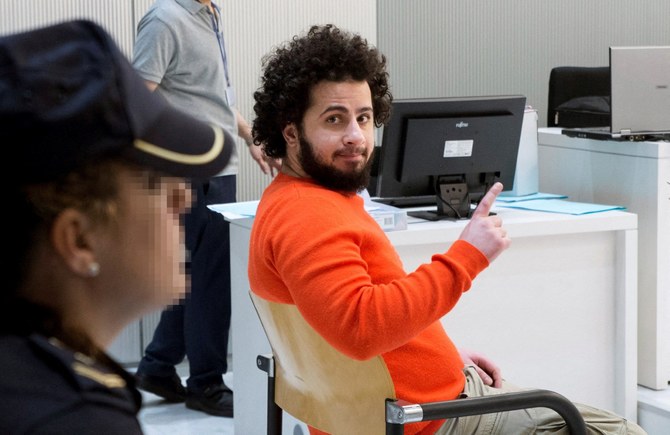
A ruling in favor of Ahmed Samsam could help the 34-year-old fight a conviction in Spain over his alleged Daesh ties, but a win in Denmark is far from assured.
Samsam has sued Denmark’s intelligence secret service PET and military intelligence service FE to force them to admit that he was spying on foreign militant fighters for them in Syria in 2013 and 2014.
But even if his claims are true, the security services are under no obligation to confirm them.
The verdict is due in about a month.
Five years ago, the Danish national of Syrian origin was unable to prove his claim in a Spanish court, which convicted him over his Daesh ties and sent him to prison for eight years.
Samsam reiterated his claim during a trial that opened in Denmark in August, calling witnesses and citing investigative newspaper reports that backed up his claims after digging into the affair.
The intelligence services have insisted they cannot confirm the identities of their informants.
“To do so would harm their ability to speak to sources, to protect them and prevent terrorism,” their defense lawyer Peter Biering told the court when proceedings began last month.
“It’s a question of national security.”
Samsam, who has a long criminal record, traveled to Syria in 2012 of his own accord to fight the regime of Bashar Assad.
Danish authorities investigated him after his return but did not press charges.
He claims he was then sent to the war zone on several occasions, with money and equipment provided by PET and later FE, according to Danish media outlets DR and Berlingske citing anonymous witnesses and money transfers to Samsam.
In 2017, threatened by Copenhagen thugs in a settling of scores unrelated to his trips to Syria, Samsam headed to Spain.
There, he was arrested by Spanish police, who were surprised to find pictures of him on Facebook posing with a Daesh flag.
Samsam was sentenced the following year to eight years in prison for having joined Daesh, after the Danish authorities refused to come to his defense.
Since 2020 he has been serving his sentence — reduced to six years — in Denmark.
He is due to be released this autumn, according to his lawyer Irbil Kaya.
In the Danish trial, the court heard testimony from several media representatives, including the former news editor at daily newspaper Berlingske, Simon Andersen.
He testified that he had been contacted about the Samsam case on his personal email by the former head of FE, Lars Findsen — who has been indicted in an unrelated case for leaking information to the press.
Andersen told the court that Findsen suggested FE wanted to make amends by negotiating a settlement with Samsam’s lawyer at the time, Thomas Braedder.
“I perceived it as an official request coming from a person in a position of authority,” Andersen told the court.
Braedder also testified about his contacts with the intelligence services but was unable to provide the court with details for reasons of national security, he said.
Like a good spy novel, the case has enthralled the Danish public for more than six years, but embarrassed the intelligence community and politicians.
The government has been opposed to an inquiry, and in parliament, a preliminary investigative committee probe that was opened in February to shed light on Samsam’s claims was quietly dropped in June.


![]()

A Daesh militant or an undercover agent? Danish court to decide
Short Url
https://arab.news/gycd9
A Daesh militant or an undercover agent? Danish court to decide
- Ruling in favor of Ahmed Samsam could help the 34-year-old fight a conviction in Spain over his alleged Daesh ties
- The intelligence services have insisted they cannot confirm the identities of their informants


Latest updates


Recommended


© 2026 SAUDI RESEARCH & PUBLISHING COMPANY, All Rights Reserved And subject to Terms of Use Agreement.