

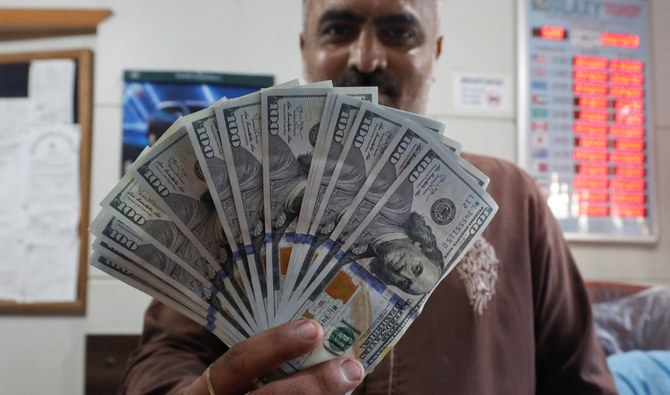

KARACHI: Pakistan’s exchange companies witnessed a massive influx of customers, predominantly sellers, seeking to convert their dollar bills on Thursday as authorities continue to crack down on currency hoarders, smugglers, and black marketers, currency dealers and financials analysts said.
The development took place days after Pakistan announced a crackdown against illegal currency smugglers and hoarders following army chief General Syed Asim Munir’s meeting with leading business figures in Lahore and Karachi last week. Munir assured the business community of fostering “transparency” in the dollar exchange and interbank rates.
The greenback’s smuggling to Afghanistan and its illegal trading at the black market widened the gap between the interbank and open market rates last week. After the clampdown, the rupee gained 0.7 percent in the last three trading sessions to close at Rs304.94 against the dollar on Thursday. In the open market, the rupee appreciated around 7 percent since September 4 to close at Rs307 on Thursday.
“We complained and requested the army chief to take action against elements who were coercively taking our customers away from outside our exchange companies to buy and sell dollars in black market,” Malik Bostan, president of the Forex Association of Pakistan, told Arab News.
Bostan said over 90 percent of the exchange business had been diverted to the black market, adding that exchange companies were losing massive chunks of business.
“After losing major chunks of business, it was feared that the rupee would hit the Rs400 mark against the greenback,” Bostan said. He added that the timely crackdown and deployment of law enforcement personnel at exchange companies had fortunately reversed the trend.
Bostan said exchange companies have deposited $30 million in the interbank market during the last two days.
Meanwhile, currency dealers said the government has taken strict action against hoarders and has enhanced security measures at the borders to stop the smuggling of US dollars.
“More sellers are rushing to our counters than buyers as the crackdown has nullified demand,” Zafar Paracha, general secretary of the Exchange Companies Association of Pakistan (ECAP), told Arab News. He added that exchange companies witnessed 30 percent more sellers at their counters on Thursday after the measures were taken.
Separately, Pakistan’s Federal Investigation Agency (FIA) arrested five suspects involved in the hawala hundi (informal transfer of money) business in different parts of Pakistan’s commercial hub Karachi.
The agency in a statement said initially, a sum of $35,000 was recovered from the individuals while the suspects failed to provide satisfactory explanations about the sale and purchase of $23,000.
“During the investigation, dozens of foreign currency-related messages, including Hawala transactions, were found on the accused individuals’ mobile phones,” the FIA said.
Pakistani analysts appreciated the government’s recent actions but called on authorities to maintain efforts to curb smuggling and unofficial dollar dealings.
“In the medium and long term, the focus should shift toward implementing more substantial strategies, such as attracting Foreign Direct Investment (FDI) and effectively managing the current account deficit to bolster our reserves,” Ali Nawaz, CEO of the financial services company Chase Securities, told Arab News.
Senior financial analyst Khurram Hussain agreed with Nawaz, saying that similar measures have been taken numerous times in the past but always ended up being short-lived ones.
“These actions only created short-term impacts due to the underlying economic conditions of the country as governments have been printing money to meet their expenses which has been fueling inflation amid limited supply of dollars,” Hussain told Arab News.
To regulate foreign exchange business, Pakistan’s central bank announced reforms in the exchange companies’ sector on Wednesday.
As per these reforms, the central bank called on leading banks actively engaged in foreign exchange business to establish wholly-owned exchange companies.
Meanwhile, existing exchange companies would now be consolidated into a single category and their minimum capital requirement has been increased to Rs500 million.


