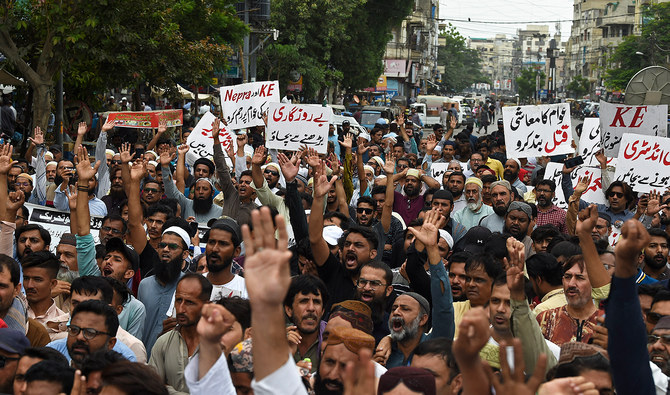
KARACHI: A group of prominent businessmen this week urged the government to review contracts with independent power producers, in the wake of a crisis over record electricity prices that has fueled nationwide protests and traders strikes since last month.
IPPs are private, non-utility generator companies that produce electricity and sell it to the government and end users. Among major criticisms of IPP contracts is that they require the government to make capacity payments even when power generated by them is not fully utilized. Experts say the arrangement leads to a high cost of electricity which augments the production costs of factories and industrial units. IPPs have also been accused of making exorbitant profits and dividends on capital invested under existing contracts.
Speaking to reporters earlier this week, Caretaker Prime Minister Anwaar-ul-Haq Kakar acknowledged problems with IPP contracts when questioned about record electricity bills that have led to nationwide protests. He said the government was “thoroughly discussing” renegotiating the contracts among the various options it was considering in response to the unrest.
“We request the government not to revise the agreements with the IPPs on old terms,” Mirza Akhtar Baig of the United Business Group said at a news conference in Karachi on Wednesday. “We should not renew contracts with them on old terms.”
Baig said under the contracts, the government had been paying capacity surcharges to IPP companies, which he said even exceeded the country’s defense budget.
Representatives from the Power Division told Senate last week capacity payments to IPPs for the current fiscal year had reached a staggering Rs1.3 trillion. Over the years, IPPs have also been accused of over invoicing and misreporting, and experts and politicians have called for a heat rate audit.
At Wednesday’s press conference, the business group also requested the government to put the names of all domestic and foreign IPPs owners on the exit control list to probe irregularities in the power generation sector.
“At present, Pakistani industries are facing problems due to our declining national economy,” Khalid Tawab, another influential businessman at the press conference, said. “Traders and industrialists are all worried because of the electricity bills. Forty percent of industries have been closed in Pakistan.”
Kakar’s government has also announced it is trying to bring down electricity tariffs, and blamed electricity theft for the revenue shortfall of Rs589 billion ($1.9 billion) in the power sector annually.
Interim energy minister, Muhammad Ali, said this week the government was setting up a task force to crackdown against those stealing electricity or not paying bills on time.
An electricity price hike was agreed with the IMF earlier this year when the international lender approved a short-term $3 billion bailout package for Pakistan.


![]()

Pakistani businesses demand new contracts with independent power producers amid electricity bills crisis
Short Url
https://arab.news/5auyt
Pakistani businesses demand new contracts with independent power producers amid electricity bills crisis
- PM Kakar this week acknowledged problems with IPP contracts, said “thoroughly discussing” renegotiating
- Pakistan has been in the grips of sporadic protests and strikes since last month over record electricity bills
Latest updates


Recommended


© 2026 SAUDI RESEARCH & PUBLISHING COMPANY, All Rights Reserved And subject to Terms of Use Agreement.