

Pakistan and Italy mark 70 years of archaeological cooperation in Swat

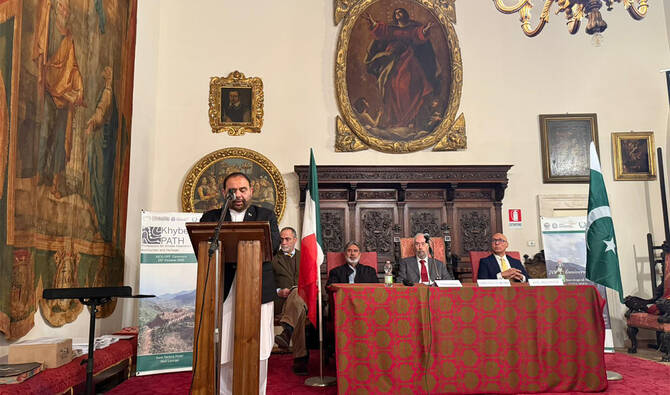
Federal Minister for National Heritage & Culture, Aurangzeb Khan Khichi, speaking at an event marking 70 years anniversary of Italian Archaeology Center at Swat, in Italy on December 14, 2025. (MoFA)
Short Url
Updated 14 December 2025
Follow

Pakistan and Italy mark 70 years of archaeological cooperation in Swat

  • Founded in 1955, Italy’s Swat mission has led excavations and conservation work at major Gandhara sites
  • Italian archaeologists have also contributed to training Pakistani researchers and museum development

ISLAMABAD: Pakistan and Italy marked 70 years of archaeological cooperation, said an official statement on Sunday, with officials highlighting decades of joint work in preserving ancient sites in the country’s northwest, where Italian researchers have played a central role in documenting and conserving remnants of the Gandhara civilization.

The Italian Archaeological Mission in Swat was established in 1955 by Italian scholar Giuseppe Tucci, a leading expert on Asian art and religions, with the aim of studying, excavating and preserving Buddhist and pre-Islamic sites in what is now Pakistan’s Khyber Pakhtunkhwa province.

Over the decades, the mission has become one of the longest-running foreign archaeological projects in the country, working closely with Pakistani authorities and academic institutions.

“Pakistan is committed to advancing archaeological research, conservation and education, and looks forward to deepening cooperation with Italy in both scope and dimension,” Pakistan’s Minister for National Heritage and Culture Aurangzeb Khan Khichi said while addressing a ceremony in Rome marking the mission’s anniversary.

The event was organized by Italy’s International Association for Mediterranean and Oriental Studies (ISMEO), with support from the Italian Agency for Development Cooperation and the University of Venice, and was attended by Pakistani and Italian academics, diplomats and cultural officials.

The Italian mission was originally conceived to systematically document Buddhist sites in the Swat Valley, once a major center of the ancient Gandhara civilization, which flourished from around the first century BCE and became a crossroads of South Asian, Central Asian and Hellenistic influences.

Since its inception, the mission has led or supported excavations and conservation work at several key sites, including Barikot, believed to be ancient Bazira mentioned by classical sources, as well as Butkara and Saidu Sharif, helping establish chronologies, preserve stupas and monasteries and train generations of Pakistani archaeologists.

Italian researchers have also worked with local authorities on site protection, museum development and post-conflict rehabilitation, particularly after natural disasters and periods of unrest that threatened archaeological heritage in the region.

The anniversary program featured sessions on the history of the mission, its collaboration with the provincial government of Khyber Pakhtunkhwa, and future research areas such as archaeobotany, epigraphy and geoarchaeology.

The event was moderated by Professor Luca Maria Olivieri of the University of Venice, who has been associated with archaeological fieldwork in Pakistan for nearly four decades and was awarded Pakistan’s Sitara-e-Imtiaz for his contributions to heritage preservation.

Officials said the mission’s longevity reflected a rare continuity in international cultural cooperation and underscored Pakistan’s efforts to protect its archaeological legacy through partnerships with foreign institutions.


Pakistan says India, Israel pushed false narrative linking Sydney attack suspects to Islamabad

Updated 8 sec ago
Follow

Pakistan says India, Israel pushed false narrative linking Sydney attack suspects to Islamabad

  • Ata Tarar says Indian police and foreign authorities have confirmed the suspects are of Indian origin
  • Minister commends Australia for a professional investigation and for refraining from assigning blame

ISLAMABAD: Federal Minister for Information and Broadcasting Attaullah Tarar on Wednesday criticized India and Israel for running a disinformation campaign to falsely link suspects in a deadly shooting incident on Sydney’s Bondi Beach to Pakistan, saying the allegations were baseless and aimed at maligning the country.

Tarar’s briefing came after a mass shooting on Dec. 14 in which two gunmen opened fire on a crowd, killing 15 people and injuring dozens, in what Australian officials described as a terrorist attack targeting the Jewish community. Soon after, media reports claimed the attack was carried out by a father and son named Sajid and Naveed Akram.

Subsequently, Indian news channels and social media accounts started circulating unverified claims the suspects were Pakistanis, amplifying images of a Sydney resident with the same name — Naveed Akram — wearing a Pakistan cricket team shirt, a claim later denied by the man in a video in which he said he feared for his life after receiving threats.

“This campaign was launched from hostile countries trying to malign Pakistan,” Tarar said while briefing foreign journalists in Islamabad. “In Israel, in India, this campaign was proliferated and posted on social media platforms as well as electronic media platforms, which is very, very sad because Pakistan has been a front line state in the war against terrorism.”

He said Pakistan condemned the Sydney attack and expressed solidarity with Australia, noting that it understands the pain of such incidents as a country that has suffered decades of militant violence.

“There was no verification, no documentation, no evidence whatsoever,” he said. “Yet a false campaign was launched, and even reputed media outlets failed to uphold basic journalistic standards.”

He said Indian police later confirmed the father involved in the attack was from India’s Telangana state and that his passport had been issued by the Indian embassy in Sydney, adding that Philippine authorities had also confirmed the suspect had recently traveled to their country on an Indian passport.

Tarar praised Australian authorities for what he called a professional investigation and for refraining from assigning blame until facts were verified.

He questioned whether legal action or apologies would follow for what he described as reputational damage to Pakistan, saying the country had lost more than 90,000 lives in its fight against terrorism, including schoolchildren killed in the 2014 Army Public School attack in Peshawar, which Pakistan commemorates annually on Dec. 16.

The minister reiterated Pakistan’s long-standing accusations that India supports militant activity inside Pakistan, particularly in Balochistan and Khyber Pakhtunkhwa, claims New Delhi has repeatedly denied.

Pakistan, he said, would continue to condemn terrorism “in all its forms and manifestations” and urged international media to verify information before publishing unsubstantiated allegations.