BANGKOK: A court in Myanmar sentenced a photojournalist for a news agency to 20 years in prison with hard labor for his coverage of a deadly May cyclone’s aftermath, the media organization said Wednesday.
The sentence given Sai Zaw Thaike, a photographer for the independent online news service Myanmar Now, appeared to be the most severe for any journalist detained since the military overthrew the elected government of Aung San Suu Kyi in February 2021.
The press freedom group Reporters Without Borders said in April that Myanmar is the world’s second- biggest jailer of journalists, behind only China. The country ranks near the bottom of the group’s 2023 World Press Freedom Index, placing 176th out of 180 countries.
Myanmar Now, which operates underground, reported that a military tribunal tried, convicted and sentenced Sai Zaw Thaike, 40, during the first court hearing since he was detained in the western state of Rakhine.
The proceedings took place inside Insein prison in Yangon, Myanmar’s biggest city, where the photographer was jailed after his arrest. The news agency said Sai Zaw Thaike was allowed no family visits and denied legal representation.
“His sentencing is yet another indication that freedom of the press has been completely quashed under the military junta’s rule, and shows the hefty price independent journalists in Myanmar must pay for their professional work,” the news site quoted Myanmar Now Editor-in-Chief Swe Win as saying.
The news outlet said Sai Zaw Thaike was arrested on May 23 in Rakhine’s capital of Sittwe while recording the damage caused by Cyclone Mocha, the country’s most destructive storm in at least a decade. Mocha made landfall near Sittwe just over a week before his arrest and caused widespread flash floods and power outages.
The storm killed at least 148 people in Rakhine state, many of them members of the persecuted Muslim Rohingya minority living in internal displacement camps, and damaged more than 186,000 buildings.
The news service said he was initially indicted on several charges, including under a statute that falls under the general heading of treason but is sometimes referred to as sedition. Other charges included incitement for allegedly causing fear, spreading false news and agitating against a government employee or the military, which carries a maximum prison term of three years.
He also was charged with online defamation, which is punishable by three years’ imprisonment, and with violating a Natural Disaster Management law for allegedly spreading false information about a disaster with the intention of causing public panic, which carries a potential prison term of up to one year.
Myanmar Now said it did not know which charges Wednesday’s conviction covered. Details of political trials are generally closely held by the authorities, and Myanmar Now’s report could not be independently confirmed.
The conviction of Sai Zaw Thaike is the latest assault on press freedom and journalists by the country’s military-installed government, which has cracked down heavily on independent media.
At least 13 media outlets, including Myanmar Now, have had their media licenses revoked and at least 156 journalists were arrested, about 50 of whom remain detained, according to the local monitoring group Detained Journalists Information. Nearly half of those still in custody have been convicted and sentenced.
At least four media workers have been killed and others were tortured while in detention.
Some of the media outlets ordered closed have continued operating underground without a license, publishing online as their staff members carry on reporting while trying to avoid arrest. Others operate from exile.
The military raided Myanmar Now’s office in Yangon a month after the 2021 takeover and some staff members, including chief editor Swe Win, fled criminal charges and went into hiding as authorities had their homes sealed.
Sai Zaw Thaike was the second journalist from Myanmar Now to be arrested. Video journalist Kay Zon Nway was detained while covering an anti-coup protest in Yangon in late February 2021 and released four months later under a broad amnesty.
“We will not waver in our commitment to continue providing news and information to the people of Myanmar, despite the immense challenges we are facing,” Swe Win said from exile.


Myanmar photojournalist gets 20-year sentence over reports on cyclone’s aftermath, news site says
https://arab.news/vs6jg
Myanmar photojournalist gets 20-year sentence over reports on cyclone’s aftermath, news site says

- Online news site Myanmar Now says Sai Zaw Thaike was arrested on May 23 in Rakhine region while recording the damage caused by Cyclone Mocha, which killed 148 people
- He was reportedly slapped with various charges including spreading false information about a disaster with the intention of causing public panic and online defamation


Saudi Media Forum urges ethical coverage as crises redefine Arab journalism
- Raw news without context can mislead audiences and distort credibility, experts say
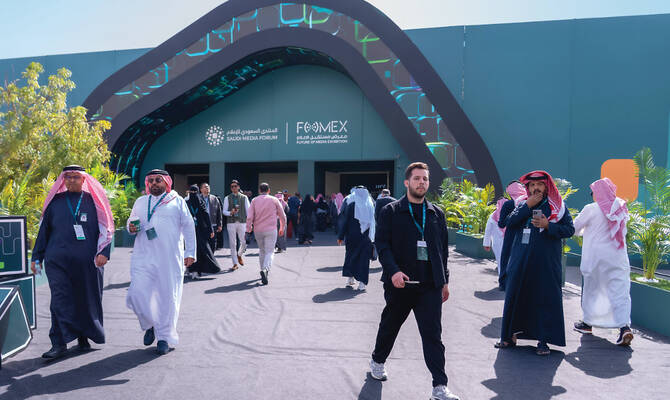
RIYADH: Arab media was born in crisis and shaped by conflict rather than stability, Malik Al-Rougi, general manager of Thaqafeyah Channel, said during the Saudi Media Forum in Riyadh on Wednesday.
Al-Rougi was speaking during a panel titled “Media and Crises: The Battle for Awareness and the Challenges of Responsible Coverage,” which examined how news organizations across the region navigated credibility and professional standards amid fast-moving regional developments.
“Today, when you build a media organization and invest in it for many years, a single crisis can destroy it,” he said.
Referring to recent events, Al-Rougi said that he had witnessed news channels whose credibility “collapsed overnight.”
“In journalistic and political terms, this is not a process of news production. It is a process of propaganda production,” he said. “The damage caused by such a post … is enormous for an institution in which millions, perhaps billions, have been invested.”
When a media outlet shifts from professionalism and credibility toward “propaganda,” he added, it moves away from its core role.

“A crisis can work for you or against you,” Al-Rougi added. “When, in the heart of a crisis, you demonstrate high credibility and composure, you move light-years ahead. When you fail to adhere to ethical standards, you lose light-years as well.”
Abdullah Al-Assaf, professor of political media studies at Imam Muhammad bin Saud Islamic University, said that in many crises across the Arab world, agendas and directives had often prevailed over professionalism.
“Credibility was buried,” he added.
Hasan Al-Mustafa, writer and researcher at Al-Arabiya channel, said that raw information could be subject to multiple interpretations if not placed within a proper political, security, historical or geographical context.
He added that such an approach was urgently needed during periods of political and security volatility in the Middle East.

When, in the heart of a crisis, you demonstrate high credibility and composure, you move light-years ahead. When you fail to adhere to ethical standards, you lose light-years as well.
Malik Al-Rougi Thaqafeyah, Channel general manager
“This objectivity, or this reliability, is a great responsibility,” Al-Mustafa said. “It is reflected not only in its impact on the audience, but also on the credibility of the content creator.”
Al-Mustafa warned against populism and haste in coverage, saying that they risked deepening crises rather than providing informed public perspectives.
He also said that competition with social media influencers had pushed some traditional outlets to imitate influencer-driven models instead of strengthening their own professional standards.
“Our media has been crisis-driven for decades,” he said, describing much of the region’s coverage as reactive rather than proactive.
During a separate panel titled “The Official Voice in the Digital Age: Strategies of Influence,” speakers discussed how rapid technological and social changes were reshaping the role of institutional spokespersons.
Abdulrahman Alhusain, official spokesperson of the Saudi Ministry of Commerce, said that the role was no longer limited to delivering statements or reacting to events.
“Today, the spokesperson must be the director of the scene — the director of the media narrative,” he said.
Audiences, he added, no longer accept isolated pieces of information unless they were presented within a clear narrative and structure.
“In the past, a spokesperson was expected to deliver formal presentations. Today, what is required is dialogue. The role may once required defense, but now it must involve discussion, the exchange of views, and open, candid conversation aimed at development — regardless of how harsh the criticism may be.”
He said that spokespersons must also be guided by data, digital indicators and artificial intelligence to understand public opinion before speaking.
“You must choose the right timing, the right method and the right vocabulary. You must anticipate a crisis before it happens. That is your role.”
Abdullah Aloraij, general manager of media at the Riyadh Region Municipality, said that the most important skill for a spokesperson today was the ability to analyze and monitor public discourse.
“The challenge is not in transferring words, but in transferring understanding and impact in the right way,” he said.


