Pakistan’s top court reserves verdict on petition against changes to accountability laws

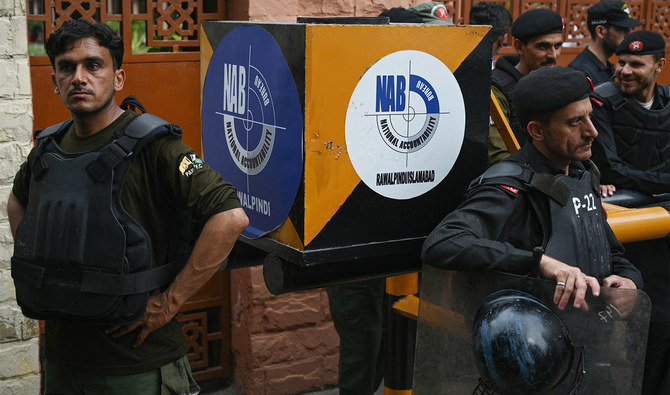
Pakistan's frontier constabulary personnel stand guard at the entrance of National Accountability Bureau (NAB) court, during the case hearing of former Pakistan's prime minister Imran Khan, in Islamabad, Pakistan, on May 23, 2023. (Photo courtesy: AFP/File)
Short Url
Updated 05 September 2023
Follow

Pakistan’s top court reserves verdict on petition against changes to accountability laws

  • Ex-PM Khan challenged amendments in top court last year, saying they provided benefit to influential persons
  • Changes made to accountability laws last year restrict NAB from acting on federal, provincial or local tax matters

ISLAMABAD: The Supreme Court of Pakistan on Tuesday reserved its verdict on former prime minister Imran Khan’s petition against amendments made to Pakistan’s accountability laws last year, local media widely reported. 

The NAB (Second Amendment) Bill 2021, passed by both houses of parliament in May 2022, states that all “pending inquiries, investigations, trials or proceedings under this ordinance, relating to persons or transactions... shall stand transferred to the authorities, departments and courts concerned under the respective laws.”

It also restricts the country’s anti-corruption watchdog, the National Accountability Bureau (NAB) from acting on federal, provincial or local tax matters and removes regulatory bodies from NAB’s domain. The bill reduces the four-year term of the NAB chairman and prosecutor-general to three years, sets a three-year term for judges of accountability courts, and makes it mandatory for them to decide a case within a year.

On June 25, 2022, Khan moved the Supreme Court against the NAB (Second Amendment) Bill 2021. Khan’s petition said the amendments were made to benefit influential accused persons and legitimize corruption, adding that the amendments were tantamount to “depriving the citizens of Pakistan of having access to law.”

A three-member bench of the apex court, comprising Chief Justice Umar Ata Bandial, Justice Ijazul Ahsan and Justice Syed Mansoor Ali Shah, heard Khan’s petition on Tuesday. During the hearing, the chief justice inquired whether there were any sections in the amendments according to which the cases could be transferred to another relevant forum. 

“After these amendments, a lot of the National Accountability Bureau’s work has come to an end,” Justice Bandial said, according to Pakistan’s English language newspaper Dawn, after he was told by Khan’s lawyer Khawaja Haris that a lot of pending NAB cases have returned after the amendments. 

Haris said that as per the amendments, an investigation would be conducted, after the review of which the cases could be sent to other forums. Khan’s counsel also informed the court that after changes to the law, neither did NAB have the authority to deal with the cases nor to send them to other relevant forums.

“After the amendments, the pending investigations and inquiries have gone to the mortuary,” Justice Ahsan was quoted as saying by Dawn. “Till the mechanism for the transfer of inquiries is formed, the public’s rights will be directly affected.”

The chief justice said toward the end of the hearing that ensuring the public prospers and is secure is the state’s responsibility. “We will soon announce a short and sweet verdict of the case,” Justice Bandial said, according to Dawn. 


UNESCO lists Pakistan’s ancient Bareendo instrument as endangered cultural heritage

Updated 9 sec ago
Follow

UNESCO lists Pakistan’s ancient Bareendo instrument as endangered cultural heritage

  • 5,000-year-old Sindhi clay wind instrument placed on UNESCO urgent safeguarding list
  • Only two known practitioners remain as Pakistan launches four-year preservation plan

ISLAMABAD: Pakistan’s 5,000-year-old folk instrument Bareendo has been added to UNESCO’s Intangible Cultural Heritage list for urgent safeguarding, the UN agency said this week, placing it among cultural traditions considered at immediate risk of disappearing.

Believed to originate in the ancient Indus Valley Civilization, the clay wind instrument is the oldest known surviving musical form in the southern Sindh province. Its soft, breath-driven tones have accompanied Sufi devotional gatherings, winter festivals and village ceremonies for generations, forming a core part of Sindh’s musical and spiritual identity.

The inscription was approved at the 20th Session of UNESCO’s Intergovernmental Committee for Intangible Cultural Heritage, which documents vulnerable cultural practices globally, from oral folklore to craftsmanship, to ensure they are preserved and passed on.

UNESCO announced the listing on X on Tuesday:

“New inscription on the Urgent Safeguarding List of Intangible Heritage: Boreendo, Bhorindo: ancient dying folk musical instrument, its melodies, knowledge, and skills.”

Pakistan’s Permanent Delegate to UNESCO, Ambassador Mumtaz Zahra Baloch, welcomed the move, calling it the recognition of a tradition preserved through centuries of community transmission.

“Bareendo is not only an emblem of the Indus Valley’s cultural continuity but also a living expression of Sindh’s artistic and spiritual heritage,” she was quoted as saying by Pakistan’s Embassy in France. 

“This recognition by UNESCO reaffirms Pakistan’s commitment to the protection and promotion of our diverse cultural traditions.”

Only two people are believed to retain full mastery of Bareendo today, musician Ustaad Faqeer Zulfiqar and master potter Allah Jurio, underscoring why the nomination was marked urgent, the embassy said. 

The nomination followed an intensive consultation process between the Sindh government, Pakistan’s Mission to UNESCO and UNESCO headquarters in Keti Mir Muhammad Loond village and led to a four-year safeguarding strategy (2026–2029). Planned measures include a community music school, integration into formal and informal education and digital archiving to open access beyond Sindh’s rural belt.

With this recognition, Bareendo joins existing UNESCO-listed intangible traditions like Suri Jagek (the astronomical knowledge of the Kalash people), Falconry, and Nowruz, the regional spring new year.