PARIS: France has started talks with some Niger army officials over withdrawing some troops from the African country following a coup in July, Le Monde reported on Tuesday.
At this stage, neither the number of French soldiers involved nor the timing of their departure have been decided, Le Monde said, citing several unidentified French sources close to the matter.
The talks are not being held with putsch leaders, but with regular army officials with whom France has long cooperated, the newspaper said.
Following the coup, France, the former colonial power in Niger, said it would end military cooperation and cut all development aid to the country.
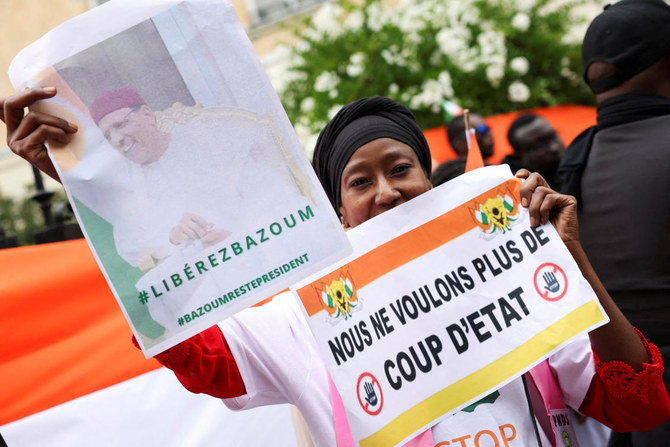
But Paris had so far rejected calls by the putsch leaders to withdraw the 1,500 French troops currently in Niger, saying it still regards democratically elected President Mohamed Bazoum, currently held prisoner, as the country’s legitimate leader.
The French defense ministry did not immediately reply to a Reuters request for comment.
Tens of thousands of protesters gathered outside a French military base in Niger’s capital Niamey last Saturday demanding that its troops leave.
According to Le Monde, some French troops could be redeployed in the region, notably in neighboring Chad, while others could return to France. But a withdrawal from Niger would be a blow to France’s influence in the region, after having had to leave Mali, where Russian mercenaries have moved in.
Niger has been a security partner of France and the United States, which have used it as a base to fight an Islamist insurgency in West and Central Africa’s wider Sahel region.

France in talks with Niger officials over troops withdrawal — Le Monde
Short Url
https://arab.news/zhk3j
France in talks with Niger officials over troops withdrawal — Le Monde
- At this stage, neither the number of French soldiers involved nor the timing of their departure have been decided, Le Monde said
- The talks are not being held with putsch leaders, but with regular army officials with whom France has long cooperated
US reaches nuclear deal with Armenia during Vance visit
- JD Vance’s visit to Armenia follows US-brokered peace accord with Azerbaijan mending relations after decades of war
- Agreement will allow up to $5bn in initial US exports to Armenia, plus an additional $4bn in longer-term fuel and maintenance contracts
TBILISI: Armenia and the United States agreed on Monday to cooperate in the civil nuclear sector as Washington sought to bolster ties with a former close ally of Russia, months after Washington brokered a peace agreement in the South Caucasus.
A statement on the nuclear sector deal was signed by Armenian Prime Minister Nikol Pashinyan and US Vice President JD Vance, who is on a two-day visit to the country.
The two said they had completed negotiations on what is known as a 123 Agreement, which allows the US to legally license nuclear technology and equipment to other countries.
The agreement will allow up to $5 billion in initial US exports to Armenia, plus an additional $4 billion in longer-term fuel and maintenance contracts, Vance said.
“This agreement will open a new chapter in the deepening energy partnership between Armenia and the United States,” Pashinyan said at a joint press conference with Vance.
Long heavily dependent on Russia and Iran for its energy supplies, Armenia is now reviewing proposals from US, Russian, Chinese, French and South Korean companies to construct a new nuclear reactor to replace its sole, aging Russian-built nuclear power plant, Metsamor.
No choice has yet been made, but Monday’s announcement paves the way for an American project to be selected. That would deal a blow to Russia, which traditionally has viewed the South Caucasus as its sphere of influence but whose clout there has diminished as a result of its invasion of Ukraine.
'Diversify partners’
“Considering Armenia’s multiplicity of dependencies on Russia, it is a political priority to diversify partners when it comes to nuclear cooperation,” said Narek Sukiasyan, a political scientist in Yerevan.
“The United States seems to be the preference now.”
Vance’s visit comes just six months after the Armenian and Azerbaijani leaders signed an agreement at the White House seen as the first step toward peace after nearly 40 years of war.
Vance was also seeking to advance the “Trump Route for International Peace and Prosperity (TRIPP),” a proposed 43-kilometer (27-mile) corridor that would run across southern Armenia and give Azerbaijan a direct route to its exclave of Nakhchivan and in turn to Turkiye, Baku’s close ally.
The route would better connect Asia to Europe while — crucially for Washington — bypassing Russia and Iran at a time when Western countries are keen on diversifying energy and trade routes away from Russia due to the Ukraine conflict.
The TRIPP corridor, which envisages new or updated rail infrastructure, oil and gas pipelines and fiber-optic cables, would transform the South Caucasus, a region riven by closed borders and longstanding ethnic conflicts.
“We’re not just making peace for Armenia,” Vance said. “We’re also creating real prosperity for Armenia and the United States together.”
He is set to visit Azerbaijan on Wednesday and Thursday, according to the White House.
A statement on the nuclear sector deal was signed by Armenian Prime Minister Nikol Pashinyan and US Vice President JD Vance, who is on a two-day visit to the country.
The two said they had completed negotiations on what is known as a 123 Agreement, which allows the US to legally license nuclear technology and equipment to other countries.
The agreement will allow up to $5 billion in initial US exports to Armenia, plus an additional $4 billion in longer-term fuel and maintenance contracts, Vance said.
“This agreement will open a new chapter in the deepening energy partnership between Armenia and the United States,” Pashinyan said at a joint press conference with Vance.
Long heavily dependent on Russia and Iran for its energy supplies, Armenia is now reviewing proposals from US, Russian, Chinese, French and South Korean companies to construct a new nuclear reactor to replace its sole, aging Russian-built nuclear power plant, Metsamor.
No choice has yet been made, but Monday’s announcement paves the way for an American project to be selected. That would deal a blow to Russia, which traditionally has viewed the South Caucasus as its sphere of influence but whose clout there has diminished as a result of its invasion of Ukraine.
'Diversify partners’
“Considering Armenia’s multiplicity of dependencies on Russia, it is a political priority to diversify partners when it comes to nuclear cooperation,” said Narek Sukiasyan, a political scientist in Yerevan.
“The United States seems to be the preference now.”
Vance’s visit comes just six months after the Armenian and Azerbaijani leaders signed an agreement at the White House seen as the first step toward peace after nearly 40 years of war.
Vance was also seeking to advance the “Trump Route for International Peace and Prosperity (TRIPP),” a proposed 43-kilometer (27-mile) corridor that would run across southern Armenia and give Azerbaijan a direct route to its exclave of Nakhchivan and in turn to Turkiye, Baku’s close ally.
The route would better connect Asia to Europe while — crucially for Washington — bypassing Russia and Iran at a time when Western countries are keen on diversifying energy and trade routes away from Russia due to the Ukraine conflict.
The TRIPP corridor, which envisages new or updated rail infrastructure, oil and gas pipelines and fiber-optic cables, would transform the South Caucasus, a region riven by closed borders and longstanding ethnic conflicts.
“We’re not just making peace for Armenia,” Vance said. “We’re also creating real prosperity for Armenia and the United States together.”
He is set to visit Azerbaijan on Wednesday and Thursday, according to the White House.
© 2026 SAUDI RESEARCH & PUBLISHING COMPANY, All Rights Reserved And subject to Terms of Use Agreement.


