

'Can’t give my freedom away': Pakistani woman teacher rides past taboos on her vintage Vespa

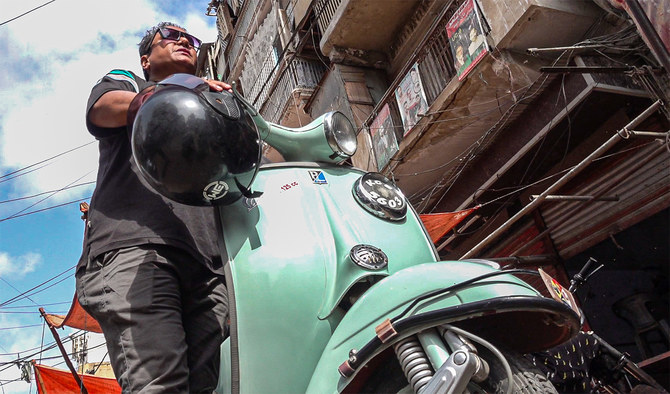
Mariam Mohammad Ali poses with her Vespa bike in Karachi. (AN photo)
Short Url
Updated 05 September 2023
Follow

'Can’t give my freedom away': Pakistani woman teacher rides past taboos on her vintage Vespa

  • Born in 1974, Mariam Mohammad Ali learnt about Vespa from her father, who was a mechanic and ran a shop in Karachi's Saddar
  • The 49-year-old schoolteacher got her bike license in the 90s and has since been commuting to work, running errands on her Vespa

KARACHI: Mariam Mohammad Ali, 49, had a penchant for bike-riding since the age of 5 and she decided not to give up on her passion while growing up in the Pakistani city of Karachi. Despite being frowned upon by relatives and neighbors, Ali got her bike license in the early 90s and has since been kicking the taboo around women bikers, riding her late father's Italian-made Vespa scooter for nearly three decades.

Born in 1974 to a Bohra father, Mohammad Ali, and a Roman Catholic mother, Victoria, Ali learnt about Vespa from her father, who was a mechanic and ran a shop in Karachi's Saddar business district.

Her passion for the Italian bike grew after one of her father's apprentices was asked to pick and drop her from school, according to the 49-year-old. During this time, she would often try to grab the bike’s accelerator.  

She first got her hands on one of her male friends' bikes when she turned 11. After one of their acquaintances saw her riding the bike, they informed Ali's father who asked her if she wanted a car or a bike.

Ali chose her passion over a four-wheeler.

Today, the 49-year-old, who is a teacher by profession, commutes to work and runs all her errands on the 1960 Vespa brought to her by her late father.  

"On my Vespa, I feel very satisfied. I bring my entire month’s grocery. And [with] my mother sitting at the back, we enjoy as we come and go," she told Arab News last week.

"I can’t give my freedom away."

But Ali, who teaches physical education at St. Joseph Convent School and St. Paul English High School in Karachi, says riding a Vespa bike can be very challenging as everyone cannot balance its weight.

"The weight is very much why because the engine is on one side and it's a very heavy bike. When you hold it also, you need a little power. And it's quite heavy. It's just like a mini rickshaw," she explained.

Ali also inherited 1964 and 1965 Vespa models from her father, which she sold to the Italian consulate in Karachi. She said they wanted her 1960 bike too, but she declined as it was the only memory left of her father, who passed away in 2006.  

Ali's mother says their acquaintances used to complain to her husband about their daughter riding a bike.

"My husband was a very broadminded guy. He said 'whatever she wants to do, let her do'," Victoria fondly recalled of her late husband.  

Victoria says she wanted to have a son when Ali was born, but believes her daughter was "chosen" to be the man of the house as she dresses like a man.  

Ali takes care of household responsibilities, according to her mother. She likes to cook and clean and spend time with her brother’s children.

Ali says she did try her luck getting married, however, the ones she considered either had an issue with her bike or their interests didn’t align with hers.  

“I was like, they are taking all my freedom away,” she said.


No casualties as blast derails Jaffar Express train in Pakistan’s south

Updated 26 January 2026
Follow

No casualties as blast derails Jaffar Express train in Pakistan’s south

  • Passengers were stranded and railway staffers were clearing the track after blast, official says
  • In March 2025, separatist militants hijacked the same train with hundreds of passengers aboard

QUETTA: A blast hit Jaffar Express and derailed four carriages of the passenger train in Pakistan’s southern Sindh province on Monday, officials said, with no casualties reported.

The blast occurred at the Abad railway station when the Peshawar-bound train was on its way to Sindh’s Sukkur city from Quetta, according to Pakistan Railways’ Quetta Division controller Muhammad Kashif.

No group immediately claimed responsibility for the bomb attack, but passenger trains have often been targeted by Baloch separatist outfits in the restive Balochistan province that borders Sindh.

“Four bogies of the train were derailed due to the intensity of the explosion,” Kashif told Arab News. “No casualty was reported in the latest attack on passenger train.”

The Jaffar Express stands derailed near Abad Railway Station in Jacobabad following a blast on January 26, 2026. (AN Photo/Saadullah Akhtar)

Another railway employee, who was aboard the train and requested anonymity, said the train was heading toward Sukkur from Jacobabad when they heard the powerful explosion, which derailed power van among four bogies.

“A small piece of the railway track has been destroyed,” he said, adding that passengers were now standing outside the train and railway staffers were busy clearing the track.

In March last year, fighters belonging to the Balochistan Liberation Army (BLA) separatist group had stormed Jaffar Express with hundreds of passengers on board and took them hostage. The military had rescued them after an hours-long operation that left 33 militants, 23 soldiers, three railway staff and five passengers dead.

The passenger train, which runs between Balochistan’s provincial capital of Quetta and Peshawar in the country’s northwest, had been targeted in at least four bomb attacks last year since the March hijacking, according to an Arab News tally.

The Jaffar Express stands derailed near Abad Railway Station in Jacobabad following a blast on January 26, 2026. (AN Photo/Saadullah Akhtar)

Pakistan Railways says it has beefed up security arrangements for passenger trains in the province and increased the number of paramilitary troops on Jaffar Express since the hijacking in March, but militants have continued to target them in the restive region.

Balochistan, Pakistan’s southwestern province that borders Iran and Afghanistan, is the site of a decades-long insurgency waged by Baloch separatist groups who often attack security forces and foreigners, and kidnap government officials.

The separatists accuse the central government of stealing the region’s resources to fund development elsewhere in the country. The Pakistani government denies the allegations and says it is working for the uplift of local communities in Balochistan.