

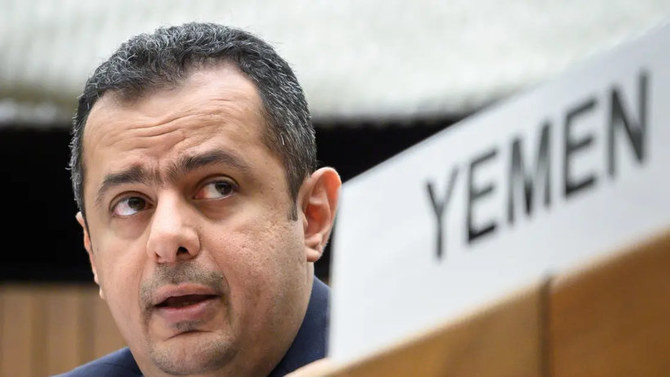

AL-MUKALLA: Yemeni Prime Minister Maeen Abdulmalik Saeed on Monday hailed a $1.2 billion financial aid package from Saudi Arabia to Yemen as a “lifeline” for the country.
He pointed out that the latest funding from the Kingdom would enable his government to pay public employees, help tackle the budget deficit, and control the depreciation of the Yemeni riyal.
The PM told reporters in Yemen’s port city of Aden, the country’s interim capital, that this year’s budget deficit was nearly 40 percent compared to 20 percent last year, and said that his government had adopted several reforms, such as combating smuggling, to ensure financial aid was properly targeted.
“The assistance provided by the brothers in Saudi Arabia was a lifeline for the government, allowing it to continue guaranteeing salary payments and financing the budget deficit,” Saeed added.
He accused unspecified “influential” people of hindering his government and noted that taxes and customs costs on oil imports had added 239 billion riyals ($63.7 billion) to the budget each year, up from zero in 2018.
“We are in a difficult situation. We need to succeed in the budget support grant. We need to succeed in the reform process. The situation of the people is difficult in education and health,” he said.
In a bid to break a Houthi monopoly on mobile and internet services, Saeed noted that the Yemeni government had signed an agreement with a UAE telecom company to build modern communication infrastructure in government-controlled areas, a move which was expected to bring the vital sector under government control.
“The scale of the towers and infrastructure, as well as the size of the Emirati company’s investment, are both large. We expect it to make a qualitative advance (in the communication industry),” the premier added.
Meanwhile, the World Health Organization reported that 413 Yemenis had died from measles, and more than 34,000 suspected cases of the disease had been registered in Yemen since the beginning of this year.
The number of cases this year has nearly doubled on that of 2022 when 220 individuals died, and 27,000 cases were recorded.
The UN health agency attributed the rapid increase in measles cases to the economic collapse, poverty, continuing displacement, overcrowded displacement camps, and a strained healthcare sector, adding that conditions had made it difficult for 27 percent of Yemeni children under the age of one to receive measles and rubella vaccines.
WHO representative in Yemen, Arturo Pesigan, said matters had been made worse by insufficient funding that had meant limiting vaccination efforts to children under the age of five, rather than all children under the age of 10.
“Ideally, the outbreak response vaccination campaign should target at least all children under the age of 10 to be comprehensive and effective; however, the current funding gap has eroded support and limited the target to children under five years of age, the group with higher mortality rates,” Pesigan added.
Since the beginning of this year, local and international health organizations have raised the alarm over an increase in measles cases throughout the country, particularly in the Houthi-controlled northern and western provinces.
In July, the UN Office for the Coordination of Humanitarian Affairs reported 25,935 suspected cases of measles and 259 deaths since January, blaming the Houthis for preventing mass vaccination of Yemeni youngsters under their authority, which exacerbated the measles outbreak.
Houthi health officials have publicly opposed vaccinating Yemeni children against measles and other vaccine-preventable diseases and urged parents not to have their kids vaccinated.


