

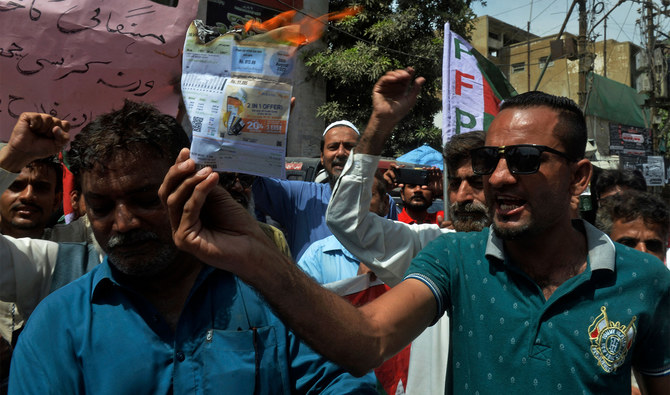

ISLAMABAD: Caretaker Prime Minister Anwaar-ul-Haq Kakar on Monday vowed to take stern action against “electricity thieves” as his government grapples with protests in various parts of Pakistan over high power bills.
Angry citizens took to the streets in various parts of the country over the past week against the government’s move to hike the power tariff in July. On Saturday, shops and markets remained closed in Lahore, Karachi, Peshawar, and other cities as angry citizens held protest demonstrations and torched their electricity bills in defiance.
The developments come months after Islamabad signed a crucial $3 billion deal with the International Monetary Fund (IMF) to avert a default due to decades of mismanagement and instability. A Rs7 increase in basic tariff was approved in July to be levied from September, while in August, the National Electric Power Regulatory Authority approved a further hike of Rs4.96 per unit, whose notification has been delayed due to ongoing protests.
PM Kakar has repeatedly said his government is working on a solution to provide relief to masses burdened by steep power bills and already reeling under skyrocketing inflation.
“Caretaker Prime Minister Anwaar-ul-Haq Kakar says the government will take stern action against electricity thieves,” the state-run Radio Pakistan said in a report.
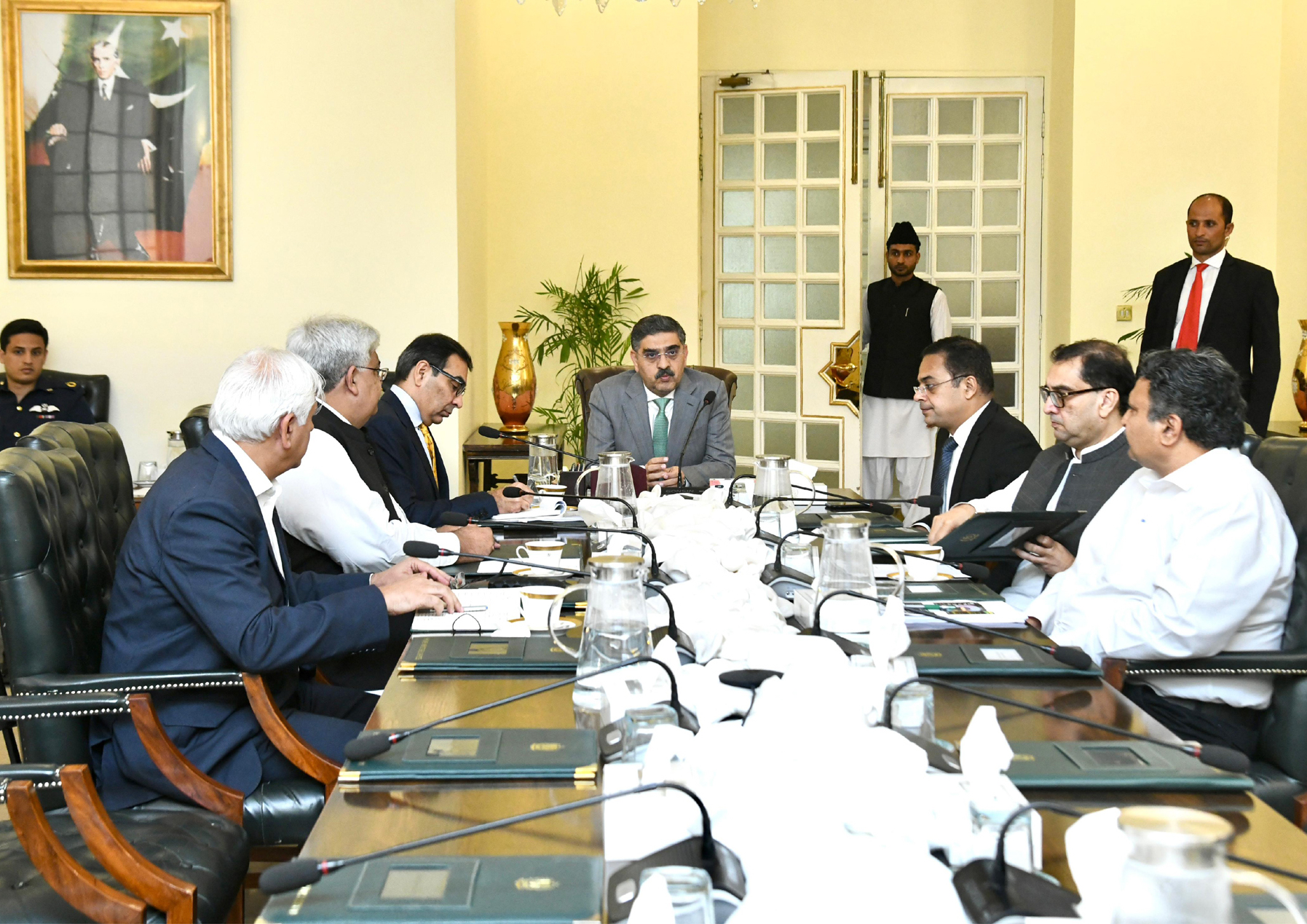
Pakistan Caretaker Prime Minister Anwaar-ul-Haq Kakar (center) chairs a meeting regarding the power sector in Islamabad, Pakistan, on September 4, 2023. (Photo courtesy: PID)
The report said the prime minister was presiding over a meeting in Islamabad where he was given a detailed briefing of the power sector.
“During the meeting, the Prime Minister was briefed over the overall electricity generating potential, installed capacity, actual generation, and power distribution in different weathers,” Radio Pakistan added.
While speaking to journalists on August 31, Kakar reiterated that Pakistan would not deviate from the agreements it had signed with international financial institutions.
“In a free market, obviously we have conditionalities [imposed on us], we have agreements with multi-financial institutions that we have to fulfill at any cost,” Kakar said. “Neither is anyone thinking of defying them nor will we allow them to. We are very much clear on that.”
The protests come at a time when Pakistan’s economy is in a tailspin, as its currency depreciates against the US dollar while the country’s stock exchange shed over 1,200 points last Thursday.


