3 killed as navy helicopter crashes in southwestern Pakistan

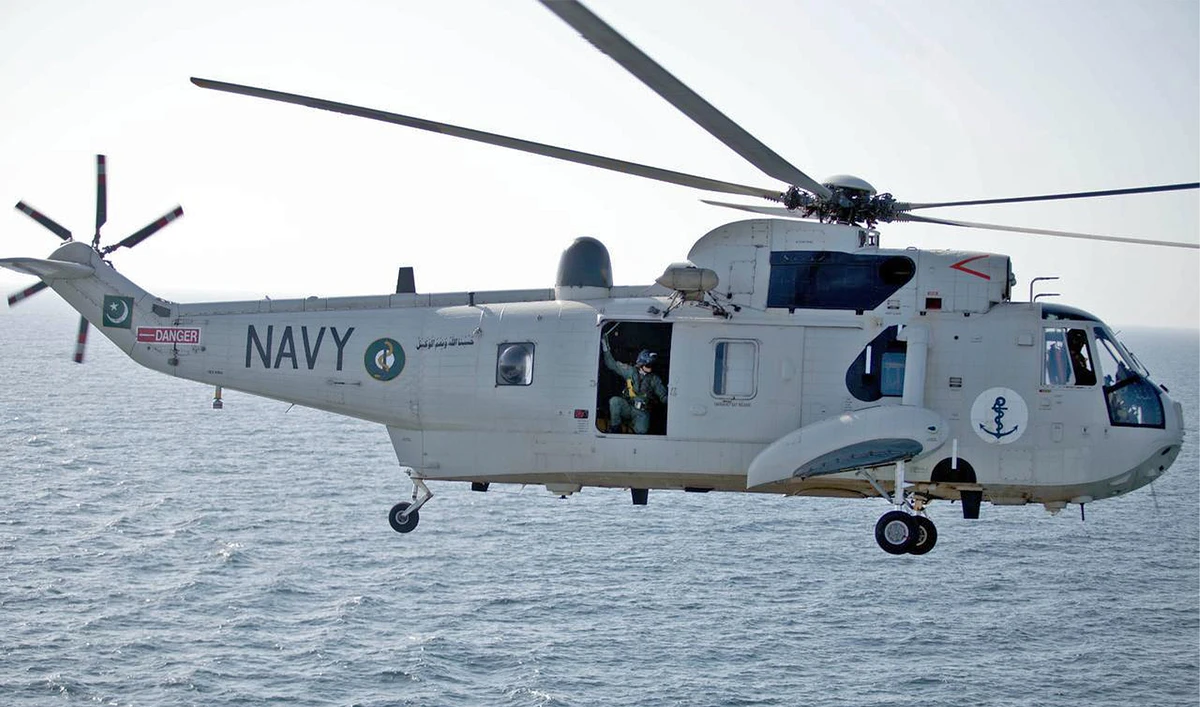
The picture shared by Pakistan Navy on September 4, 2023, shows a Pakistani Navy helicopter flying above a sea. (Photo courtesy: Pakistan Navy)
Short Url
Updated 04 September 2023
Follow

3 killed as navy helicopter crashes in southwestern Pakistan

  • Two Pakistan Navy officers, a soldier killed as helicopter crashes in southwestern city of Gwadar
  • Pakistan Navy starts investigation into crash, says technical fault may have caused accident

ISLAMABAD: Two Pakistan Navy officers and a soldier were killed on Monday when a helicopter crashed in the country’s southwestern city of Gwadar, the navy said in a statement. 

The helicopter was on a routine training flight in Gwadar when it crashed, the statement said, adding that a possible technical fault during the flight could have caused the accident. 

“Two Pakistan Navy officers and a soldier achieved martyrdom due to the accident,” the statement said. “Pakistan Navy has started an investigation into the accident.”

Caretaker Prime Minister Anwaar-ul-Haq Kakar expressed sorrow over the helicopter crash, the Prime Minister’s Office (PMO) said in a statement. 

“The prime minister expressed grief and regret over the martyrdom of three Pakistan Navy personnel and prayed for patience for families of the martyrs,” the PMO said. 

Former president and Pakistan Peoples Party’s (PPP) leader Asif Ali Zardari expressed his condolences over the helicopter crash and the loss of lives. 

“Asif Ali Zardari expressed condolences with the families of the martyrs,” the PPP wrote on the social media platform X. 

Pakistan’s National Assembly Speaker Raja Pervez Ashraf expressed sorrow and regret over the incident. 

“The sacrifices by Pakistan’s armed forces for the country and the nation will always be remembered,” Ashraf was quoted as saying by the National Assembly’s official account on X. 

Pakistan’s capital police look to military expertise to build elite SWAT force

Updated 8 sec ago
Follow

Pakistan’s capital police look to military expertise to build elite SWAT force

  • A SWAT force is an elite, specially trained police unit that is deployed in high-risk and complex security situations
  • Islamabad police have requested attachment of two army majors, 16 SSG commandos for training of personnel

ISLAMABAD: Islamabad police have sought the assistance of Pakistan Army to help establish a Special Weapons and Tactics (SWAT) unit, an official said on Friday, as the capital police department undertakes multifaceted duties.

The development comes amid a surge in militancy in Pakistan and follows a suicide blast that killed 12 people and injured 36 others outside a district court’s complex in Islamabad’s G-11 sector in Nov. last year, prompting heightened security measures by authorities.

A SWAT force is an elite, specially trained police unit that is deployed in high-risk and complex situations that regular police are not equipped to handle. Various countries train their SWAT personnel in close-quarters combat, tactical movement and breaching, explosives handling and crisis response.

In a letter written to the Islamabad chief commissioner, Inspector General Ali Nasir Rizvi noted the capital police were performing multifaceted duties, including maintenance of law and order, crime prevention as well as security and route assignments, requesting the attachment of army personnel.

“We are establishing a SWAT [unit] and we have asked for officers from them to impart training and the National Police Academy has requested too,” he said.

The Islamabad police have inducted 200 personnel in the SWAT force that is likely to operate under the command and supervision of a senior superintendent of police, according to local media reports.

The capital police department seeks services of two army majors and 16 commandos from the military’s elite Special Services Group (SSG), according to the letter seen by Arab News. Of the 16 commandos, 10 are to be deputed at the National Police Academy.

Late last year, the Islamabad Capital Territory (ICT) administration also introduced an electronic tagging system as part of a broader effort to enhance surveillance, regulate traffic and improve record-keeping in a city that hosts the country’s main government institutions, foreign missions and diplomatic enclaves.

Under the system, vehicles are fitted with electronic tags that can be read automatically by scanners installed at checkpoints across the capital, allowing authorities to identify unregistered vehicles without manual inspections.