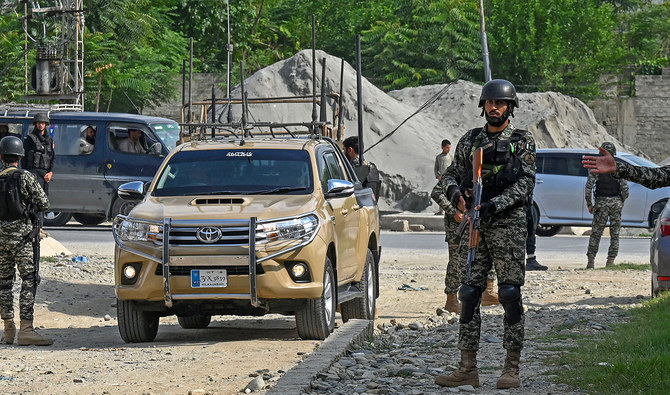
KARACHI: A report published by an Islamabad-based think tank said this week that Pakistan suffered the highest number of militant attacks across the country since November 2014, with experts attributing the surge in attacks to the freedom with which militants from Afghanistan have been operating from within their country since 2021.
The Pakistan Institute for Conflict and Security Studies (PICSS) recently released a report that said a total of 99 “acts of terrorism” took place across the country in August, adding that it was the highest number of militant attacks in Pakistan since November 2014, when suicide attacks were on the rise as Islamabad grappled with an insurgency led by the Pakistani Taliban in its northwestern tribal areas.
According to the report, the attacks last month caused 112 deaths and 87 injuries, with a majority of the casualties being security forces personnel and civilians.
“There was an 83 percent rise in militant attacks compared with July as 54 attacks were reported in July,” the report said.
The PICSS report mentioned four suicide attacks took place in August compared to five in July, of which three occurred in the tribal districts of Pakistan’s northwestern Khyber Pakhtunkhwa (KP) province while one took place in mainland KP.
“Overall, the country has witnessed 22 suicide attacks in the first eight months of 2023, in which 227 people have been killed and 497 injured,” the report stated.
Pakistan’s southwestern Balochistan province and the erstwhile Federally Administered Tribal Areas (FATA) in northwestern Pakistan were most affected by militant violence in August compared to July, the report said.
It added that Balochistan witnessed a 65 percent increase in militant attacks from 17 in July to 28 in August while the erstwhile FATA witnessed a 106 percent increase in attacks from 18 in July to 37 in August.
Both regions also saw a decrease in fatalities, by 19 percent and 29 percent respectively, the report added.
“The province of Khyber Pakhtunkhwa (excluding tribal districts) also saw a significant increase in militant attacks, from 15 in July to 29 in August, a 93 percent rise,” it said. “The deaths and injuries also increased by 188 percent and 73 percent respectively,” adding that most of these attacks were claimed by the Pakistani Taliban or the Tehreek-e-Taliban Pakistan (TTP) or their splinter groups.
The TTP has launched some of the deadliest attacks against Pakistan since over a decade-and-a-half, killing thousands of Pakistanis. The militant group seeks to enforce its own brand of strict, Islamic law and has stepped up attacks in Pakistan once again after a fragile truce between the state and TTP militants broke down in November 2022.
Abdullah Khan, the managing director of PICSS, noted the “free movement” that the TTP militants enjoyed in Afghanistan and safe havens for Baloch militants in Iran were contributing factors to the deteriorating security situation in Pakistan.
“As the Tehreek-e-Taliban Pakistan enjoys free movement in Afghanistan, the Baloch militants seem to operate from safe heavens in Iran despite the neighboring country’s assurance to Pakistan,” Khan told Arab News.
Khan attributed the rise in militant attacks by TTP against Pakistan to the change of regime in Afghanistan in 2021, adding that it provided the Pakistani Taliban with increased freedom and support from within the war-ravaged country.
“Previously people would go from Pakistan for Jihad-e-Afghanistan to fight against the USSR and later the USA,” he said. “Now, Afghan nationals are coming for ‘Jihad-e-Pakistan’ under the platform of the TTP, which is a big factor we have witnessed after Taliban’s takeover of Kabul.”
Khan said the Afghan Taliban’s victory in Afghanistan had also boosted the morale of the Pakistani Taliban, adding that mosques in Pakistan had celebrated the Kabul takeover in 2021.
Dr. Asfandyar Mir, a senior expert at the US Institute of Peace, emphasized that support from the Afghan Taliban had made the TTP a more lethal and “formidable threat” to Pakistan.
“The TTP is an increasingly formidable threat confronting Pakistan,” Mir said. “Not only has it been inspired by the Taliban’s takeover of Afghanistan in August 2021, it is also enjoying deep state support from the Taliban regime.”
He said that on the other hand, Pakistan’s response to the rising TTP challenge has been hampered by economic woes and political instability.
“And the TTP has exploited this to its advantage,” Mir concluded.


![]()

Pakistan saw highest number of militant attacks in August since 2014 — report
Short Url
https://arab.news/vd8w7
Pakistan saw highest number of militant attacks in August since 2014 — report
- Report by Islamabad-based think tank says attacks in August claimed 112 lives, injured 87
- Experts attribute rise in attacks to Afghan government’s support for the Pakistani Taliban
Latest updates


© 2026 SAUDI RESEARCH & PUBLISHING COMPANY, All Rights Reserved And subject to Terms of Use Agreement.