

Saudi Arabia’s date festivals reveal a vibrant economy, culture 

1 / 3
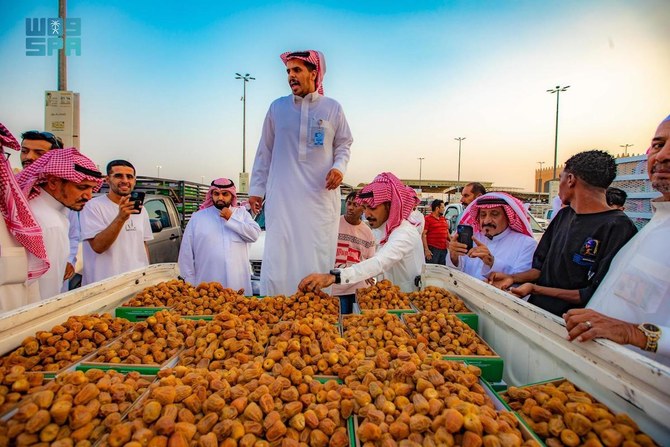
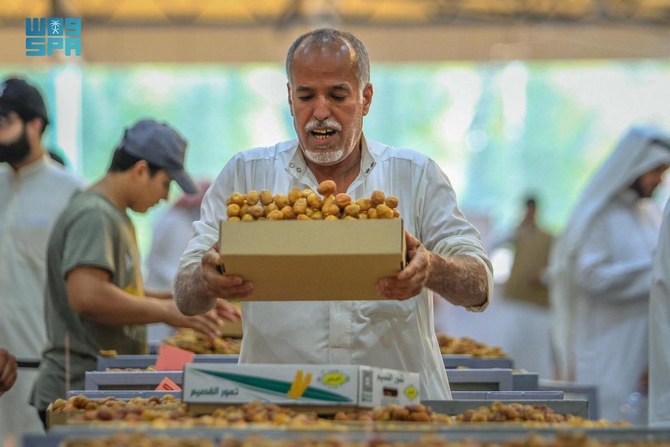
Date fairs provide an opportunity to showcase and promote Saudi Arabia’s rich cultural heritage related to date cultivation and production. (SPA)
2 / 3
Date fairs provide an opportunity to showcase and promote Saudi Arabia’s rich cultural heritage related to date cultivation and production. (SPA)
3 / 3
Date fairs provide an opportunity to showcase and promote Saudi Arabia’s rich cultural heritage related to date cultivation and production. (SPA)
Short Url
Updated 03 September 2023
Follow

Saudi Arabia’s date festivals reveal a vibrant economy, culture 

  • The Riyadh Seasonal Date Fair debuted in early August
  • Buraidah Date Festival lasts 30 days and features more than 40 different varieties of dates

RIYADH: Summer is considered the golden season in most regions of the Kingdom because it is when dates are harvested. Many Saudi regions known for producing dates compete by holding festivals to attract more customers to buy their produce.

The Riyadh Seasonal Date Fair, organized by the Ministry of Environment, Water and Agriculture in collaboration with the Riyadh Municipality and the National Center for Palms and Dates, debuted in early August. The 60-day fair, which features a number of agricultural associations, aims to support the palm and date sector, which accounts for SR7.5 billion ($2 billion), or 12 percent of the Kingdom’s total agricultural output.

Riyadh’s production exceeds 400,000 tons, accounting for nearly a quarter of the Kingdom’s total output, while the number of palm trees in the Kingdom exceeds 33 million, accounting for nearly 27 percent of the world’s total palm trees.

FASTFACT

The Riyadh Seasonal Date Fair features a number of agricultural associations, aims to support the palm and date sector, which accounts for SR7.5 billion ($2 billion), or 12 percent of the Kingdom’s total agricultural output.

According to Sulaiman Al-Jatily, director general of the General Administration of Agricultural Associations and Marketing at the ministry, the fair aims to improve the marketing environment for dates in Riyadh and create the right conditions to increase the benefits for farmers, investors and consumers.

“The fair targets farmers who have obtained the Saudi Dates mark, and the certificate of organic farming and quality, and also seeks to activate the role of the farmer by marketing his crop and displaying it directly inside the fair,” he said.

Meanwhile, the Buraidah Date Festival, which lasts 30 days and features more than 40 different varieties of dates, draws shoppers and date traders from the Arab Gulf nations every year. More than 4,000 young men and women, and a number of productive families and artisans take part, according to the festival’s organizers.

Majid Al-Khamis, director of the Majid Al-Khamis Agricultural Consulting Office, said that date festivals are very important in Saudi Arabia for a variety of reasons, including promoting culture and heritage.

The fairs provide an opportunity to showcase and promote Saudi Arabia’s rich cultural heritage related to date cultivation and production.

They exhibit various types of local dates and hosts heritage events and shows that highlight customs and traditions associated with date cultivation and harvesting.

Al-Khamis said that date festivals help to support the local economy while also attracting tourists and visitors from both within and outside the Kingdom. Many people come to watch and buy different types of dates, as well as to learn about the culture of date cultivation in Saudi Arabia. Visitors also enjoy the accompanying entertainment and cultural activities during these festivals.

The festivals, he said, serve as a venue for the presentation of new date cultivation and development techniques and scientific research. They also showcase modern techniques in date cultivation and improving quality and production efficiency. These events promote the exchange of knowledge and experience among scientists, farmers and those interested in the date industry.

Fawaz Abdulwahhab, a retail date trader from the town of Alkohaifiah, which is renowned for producing a type of date known as Al-Fankha, acknowledged that the Al-Fankha Festival in the town of Al-Khafah (160 km southeast of Hail) inspired him to make investments in the date industry. He also said that he received a sizable financial return from taking part in the festival, which was held in October of last year.

While he does not own a single farm, he has purchased the entire output of many farms and is now in the process of packing them. He begins to dry some of the dates and keeps the others in the palm fronds until it is time to harvest them, then packs them at the factory. After that, he prepares the quantities that are ready to be sold and displayed during festival days.


Balad Beast brings global beats to historic streets

Updated 31 January 2026
Follow

Balad Beast brings global beats to historic streets

  • ‘MDLBEAST put us on the international map,’ say Saudi electronic duo Dish Dash

JEDDAH: The music festival Balad Beast concluded its fourth edition this weekend, having transformed Jeddah’s UNESCO World Heritage district of Al-Balad into an open-air celebration of music, culture and creativity that attracted thousands of music lovers over two nights.

The festival, organized by Saudi music platform MDLBEAST, featured more than 70 local, regional and international artists across four stages, offering audiences a diverse journey through electronic, hip-hop and global sounds.

French Haitian singer-songwriter Naïka performed on the second night of Balad Beast. (Supplied)

Speaking to Arab News, MDLBEAST chief creative officer Ahmad Al-Ammary, also known as DJ Baloo, described Balad Beast as a “cultural takeover” adding that finding the right spaces for dance floors was a challenge, “but Balad is constantly evolving and we work with that change.”

Addressing the challenges of working in a heritage area, he said: “Balad is sensitive and condensed, so logistics can be complex. In our first year, heavy rain flooded one of the planned squares and we had to relocate the Souq Stage to a much smaller space, but it worked and it has remained there ever since.

HIGHLIGHT

Reggae superstar Shaggy noted that the reality of playing live in Saudi Arabia often surprises those who arrive with preconceptions.

“Yes, the alleys are narrow and the district is old, but they’re full of ideas, patterns, colors and visuals. Everything flows here,” he continued. “As a festival, it’s hard to define Balad, because it gives so much of itself creatively. It’s incredibly generous with its ideas and details, and inspiration comes from everywhere.”

Balad Beast featured more than 70 local, regional and international artists across four stages, offering audiences a diverse journey through electronic, hip-hop and global sounds. (Supplied)

Balad Beast featured performances from international artists including US rapper Playboi Carti, making his first appearance in Saudi Arabia; US rapper Destroy Lonely; Swedish DJ and producer Alesso; and Bosnian-German DJ Solomun on the opening night. The following night saw French-Haitian singer-songwriter Naïka, reggae superstar Shaggy, Dutch DJ Franky Rizardo, British DJ Pawsa, and US rapper Tyga, and more take the stage, while Saudi and regional artists including Cosmicat, TUL8TE, Zeina, Vinyl Mode, Moayed, Dish Dash, Musab, Varoo and HiFi appeared across the festival, offering audiences a mix of global and local talent.

Saudi electronic duo Dish Dash reflected on the festival organizer’s impact for local artists.

As a festival, it’s hard to define Balad, because it gives so much of itself creatively. It’s incredibly generous with its ideas and details, and inspiration comes from everywhere.

Ahmad Al-Ammary, MDLBEAST chief creative officer

“MDLBEAST put us on the international map,” the brothers told Arab News. “It helped us get recognized by festivals, promoters and event organizers abroad. When we travel, people don’t expect this level of talent coming from Saudi Arabia, especially considering we didn’t have this scene before.”

Shaggy, who performed a hit-filled set during the festival, told Arab News: “I’ve been blessed with some incredible songs, and I see music as a gift and a tool for service. When I go on stage, I’m there to entertain people, to make them smile and feel good, but that service also supports many livelihoods from the people working at this festival to those who work with me. These songs have become part of people’s lives, and I don’t take that lightly.”

Balad Beast featured more than 70 local, regional and international artists across four stages, offering audiences a diverse journey through electronic, hip-hop and global sounds. (Supplied)

Shaggy also noted that the reality of playing live in Saudi Arabia often surprises those who arrive with preconceptions.

“I’ve performed in Saudi Arabia more than once, and while there are certain rules that are different, it’s not an issue for me. My focus is always on delivering the hits and giving the audience a great time,” he said.

“There’s a big misconception. People have more freedom than (outsiders) think. Everyone has been extremely nice.”

Asked what advice he would offer to aspiring artists, Shaggy said: “Understand that what you’re given is a gift and a form of service. Stay humble, do the work, and remember why you’re doing it.”

As Al-Ammary noted, there are many such aspiring artists now making a name for themselves in the Kingdom.

“Talent is emerging everywhere, at different levels,” he said. “The scene is still in a mysterious and surprising phase. There’s a rawness to it.”