

India’s moon rover completes its walk, scientists analyzing data looking for signs of frozen water 

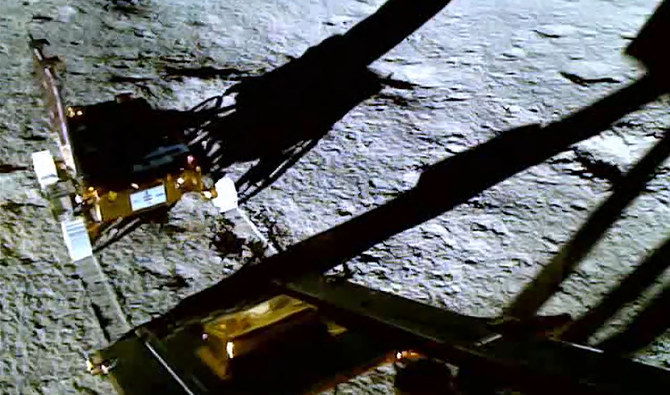
This handout screen grab taken and released by the Indian Space Research Organisation (ISRO) on August 25, 2023, shows the Chandrayaan-3 rover as it manoeuvred from the lunar lander to the surface of the Moon. (AFP/File)
Short Url
Updated 03 September 2023
Follow

India’s moon rover completes its walk, scientists analyzing data looking for signs of frozen water 

  • The Chandrayaan-3 lander and rover were expected to operate only for one lunar day, equal to 14 days on Earth 
  • The rover’s payloads are turned off and the data it collected has been transmitted to the Earth, New Delhi says 

NEW DELHI: India’s moon rover has completed its walk on the lunar surface and been put into sleep mode less than two weeks after its historic landing near the lunar south pole, India’s space mission said. 

“The rover completes its assignments. It is now safely parked and set into sleep mode,” with daylight on that part of the moon coming to an end, the Indian Space Research Organization said in a statement late Saturday. 

The rover’s payloads are turned off and the data it collected has been transmitted to the Earth via the lander, the statement said. 

The Chandrayaan-3 lander and rover were expected to operate only for one lunar day, which is equal to 14 days on Earth. 

“Currently, the battery is fully charged. The solar panel is oriented to receive the light at the next sunrise expected on September 22, 2023. The receiver is kept on. Hoping for a successful awakening for another set of assignments!” the statement said. 

There was no word on the outcome of the rover searches for signs of frozen water on the lunar surface that could help future astronaut missions, as a potential source of drinking water or to make rocket fuel. 

Earlier this week, the the space agency said the moon rover confirmed the presence of sulfur and detected several other elements. The rover’s laser-induced spectroscope instrument also detected aluminum, iron, calcium, chromium, titanium, manganese, oxygen and silicon on the surface, it said. 

The Indian Express newspaper said the electronics on board the Indian moon mission are not designed to withstand very low temperatures, less than minus 120 degrees Celsius ( minus 184 degrees Fahrenheit) during the nighttime on the moon. The lunar night also extends for as long as 14 days on Earth. 

Pallava Bagla, a science writer and co-author of books on India’s space exploration, said the rover has limited battery power. 

The data is back on Earth and will be analyzed by Indian scientists as a first look and then by the global community, he said 

By sunrise on the moon, the rover may or may not wake up because the electronics die at such cold temperatures, Bagla said. 

“Making electronic circuits and components that can survive the deep cold temperature of the moon, that technology doesn’t exist in India,” he said. 

After a failed attempt to land on the moon in 2019, India last week joined the United States, the Soviet Union and China as only the fourth country to achieve this milestone. 

The successful mission showcases India’s rising standing as a technology and space powerhouse and dovetails with Prime Minister Narendra Modi desire to project an image of an ascendant country asserting its place among the global elite. 

The mission began more than a month ago at an estimated cost of $75 million. 

India’s success came just days after Russia’s Luna-25, which was aiming for the same lunar region, spun into an uncontrolled orbit and crashed. It had been intended to be the first successful Russian lunar landing after a gap of 47 years. 

Russia’s head of the state-controlled space corporation Roscosmos attributed the failure to the lack of expertise due to the long break in lunar research that followed the last Soviet mission to the moon in 1976. 

Active since the 1960s, India has launched satellites for itself and other countries, and successfully put one in orbit around Mars in 2014. India is planning its first mission to the International Space Station next year, in collaboration with the United States. 


Irish minister defends ‘limited’ trade curbs on Israeli settlements

Updated 1 sec ago
Follow

Irish minister defends ‘limited’ trade curbs on Israeli settlements

DUBLIN: Ireland’s planned curbs on trade with Israeli settlements will be limited strictly to goods, a minister told Reuters, offering the first clear signal on the scope of the contested legislation and rejecting accusations that the country is antisemitic.
Ireland has been preparing a law to curb trade with settlements in the Israeli-occupied West Bank, facing pressure at home to widen the scope of the ban from goods to services, while Israel and the United States want the bill scrapped.
Ireland has been one of the European Union’s most outspoken critics of Israel’s assault in Gaza, which authorities in the Palestinian enclave say has killed more than 67,000 people.

’EXTREMELY LIMITED MEASURE’, SAYS MINISTER
But Thomas Byrne, Ireland’s Minister of State for European Affairs and Defense, told Reuters that the bill is limited to the import of goods and that it would not become law this year.
“It’s an extremely limited measure, which would prohibit imports of goods from illegally-occupied territories,” he said in an interview. “Similar measures have already been brought in in a number of European countries.”
Byrne’s comments give insight into Dublin’s thinking as Ireland seeks to deflect pressure, including from US companies based in the country, to soften its criticism of Israel. Ireland’s bill is expected to help shape how other European nations launch similar curbs on trade with Israeli settlements.
The Irish government has signalled the bill is imminent but has yet to publicly announce its scope.
Byrne declined to say when it would be sent to parliament, as the government weighs the bill’s implications. “It’s certainly not going to be implemented this year,” he said.
Earlier this year, sources told Reuters that the government intended to blunt the law, curbing its scope to just a limited trade of goods, such as dried fruit, and not services.
That more ambitious move could have entangled companies in technology and other industries in Ireland doing business in Israel. Business lobby groups had sought to kill the idea.
Limiting the bill to goods only would catch just a handful of products imported from Israeli-occupied territories such as fruit that are worth just 200,000 euros ($234,660) a year.

LAWMAKER BLACK SAYS SHE STILL WANTS SERVICES BAN
Most of the international community considers Israeli settlements in the West Bank illegal under international law. Israel disputes this, citing historical and biblical ties to the area. It says the settlements provide strategic depth and security.
On Gaza, Israel says it acted in self-defense following the deadly October 7, 2023, Hamas attack that killed 1,200 people and resulted in 251 hostages, according to Israeli tallies. Israel has repeatedly said it is committed to international law and tries to minimize harm to the civilian population of Gaza.
Frances Black, the lawmaker who proposed the Irish bill, told Reuters she would push to include a ban on services. “It will take a lot of work in the new year to get services included but that’s exactly what I’m prepared to do.”
Byrne also defended Ireland’s government, after Israeli Foreign Minister Gideon Saar recently posted a video online where he accused the Irish government of having an “antisemitic nature.”
Saar said the Irish government’s response had been slow to a local proposal to rename a park bearing the name of Chaim Herzog, the former president of Israel who was raised in Dublin.
Irish ministers had roundly criticized the idea and Dublin City Council has since delayed a decision on whether to remove the name.
US senator Lindsey Graham had also labelled Ireland a “cesspool of antisemitism.”

EU LAWMAKER REJECTS ANTISEMITISM CHARGE AS ‘NONSENSE’
“I reject outright that the country is in any way antisemitic,” said Byrne. “We’re deeply conscious of the contribution that Jewish people have made in Ireland.”
Ireland’s relations with Israel have been fraught. Last December, Israel shut its embassy in Dublin amid a row over Ireland’s criticism of its war in Gaza, including Ireland’s recognition of a Palestinian state last year.
Barry Andrews, an Irish member of the European parliament, urged Dublin to go ahead with its occupied territories bill. “Claims that Ireland is antisemitic are nonsense,” he said. Ireland has nothing to fear. We are no longer the only ones doing this.”
On Wednesday, Ireland’s central bank governor Gabriel Makhlouf was forced to abandon a public speech in Dublin by pro-Palestinian protesters objecting to the central bank’s earlier role in the sale of Israeli bonds.