

UAE’s Sultan AlNeyadi, first Arab astronaut on long-term space mission, back on Earth

1 / 2
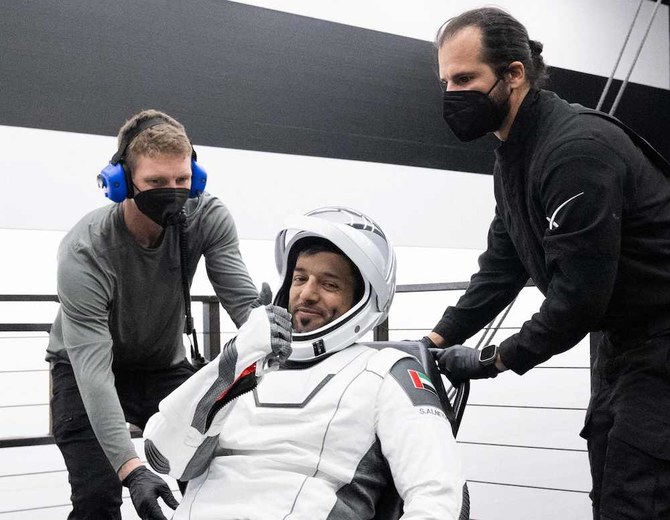
UAE astronaut Sultan AlNeyadi is helped out of the SpaceX Dragon Endeavour spacecraft after nearly six months in space. (NASA)
2 / 2
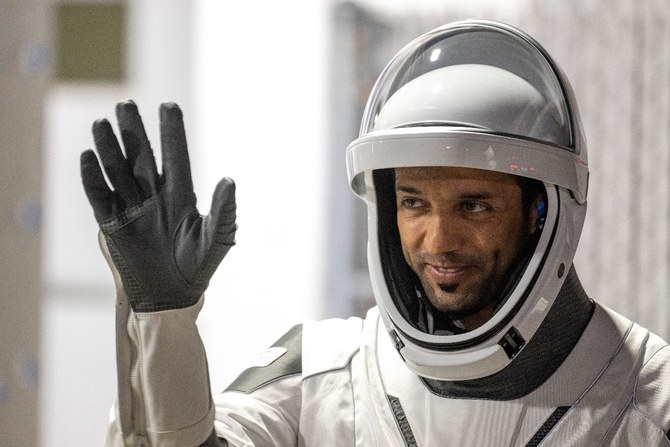
AlNeyadi, the first Arab astronaut deployed on a long-term space mission and the first to complete a spacewalk. (AFP)
Short Url
Updated 04 September 2023
Follow

UAE’s Sultan AlNeyadi, first Arab astronaut on long-term space mission, back on Earth

  • The return has been delayed due to unfavorable weather conditions on the splashdown site

DUBAI: Emirati astronaut Sultan Alneyadi and the rest of Crew-6 mission, NASA astronauts Stephen Bowen and Woody Hoburg and Rocosmos cosmonaut Andrey Fedyaev, returned to Earth after a six-month stay at the International Space Station (ISS).


Teams from NASA and SpaceX earlier on Sunday have given a ‘Go’ for Crew-6 mission to undock from the space station after scuttling earlier plans due to inclement weather on Earth. Their SpaceX capsule parachuted into the Atlantic off the Florida coast early Monday morning.

“Splashdown of Dragon confirmed – welcome back to Earth, Steve, @Astro_Woody, Andrey, and @Astro_Alneyadi!” SpaceX posted on the social media account X.


Before departing the space station, they said they were craving hot showers, steaming cups of coffee and the ocean air since arriving in March. Their homecoming was delayed a day because of poor weather at the splashdown locations.

SpaceX launched their replacements over a week ago.

UAE President Sheikh Mohamed bin Zayed extolled AlNeyadi’s feats, and in a social media posting said, “@Astro_AlNeyadi, the people of the UAE are immensely proud of you and the entire team for achieving major advances in space exploration. You carried the dreams of a nation to new frontiers, and we celebrate your pioneering journey and safe return.”


Sheikh Mohammed bin Rashid Al-Maktoum, the Vice President of the UAE and Ruler of Dubai, also commented on the safe return of AlNeyadi, who went on a long mission to the space station.


Another crew switch will occur later this month with the long-awaited homecoming of two Russians and one American who have been up there an entire year. Their stay was doubled after their Soyuz capsule leaked all of its coolant and a new craft had to be launched.

Between crew swaps, the space station is home to seven astronauts.

The Mohammed Bin Rashid Space Centre (MBRSC) announced Saturday morning that AlNeyadi's scheduled return from the ISS has been delayed due to unfavorable weather conditions.

AlNeyadi, the first Arab astronaut deployed on a long-term space mission and the first to complete a spacewalk, will undergo several days of medical testing, evaluation and mission debriefs in the US before returning home to the UAE.

with AP


Last Christians gather in ruins of Turkiye’s quake-hit Antakya

Updated 5 sec ago
Follow

Last Christians gather in ruins of Turkiye’s quake-hit Antakya

  • Saint Peter’s, one of the world’s oldest rock churches, is a sacred rallying point for the isolated Christians still left in quake-hit Antakya in southeastern Turkiye
ANTAKYA: Saint Peter’s, one of the world’s oldest rock churches, is a sacred rallying point for the isolated Christians still left in quake-hit Antakya in southeastern Turkiye, the city known in ancient times as Antioch.
“Since the earthquake, our community has scattered,” said worshipper Mari Ibri.
“Those who remain are trying to regroup. We each had our own church but, like mine, they have been destroyed.”
The landscape around the cave remains scarred by the disaster nearly three years ago, when two earthquakes devastated Hatay province on February 6, 2023 and its jewel, Antakya, the gateway to Syria.
Sad fields of rubble and the silhouettes of cracked, abandoned buildings still scar the city — all enveloped in the ever-present grey dust.
Since the earthquakes, Antakya city has emptied and the Christian community has shrunk from 350 families to fewer than 90, Father Dimitri Dogum told AFP.
“Before, Christmas at our house was grandiose,” Ibri recalled.
“Our churches were full. People came from everywhere.”
Ibri’s own church in the city center was rendered inaccessible by the earthquakes.
Now she and other worshippers gather at the cave on December 24 — Christmas Eve in some Christian calendars.
It is here, they believe, that Peter, the disciple Jesus assigned to found the Christian church, held his first religious service in the 1st century.
The rock church was later enlarged and 11th-century crusaders added a pale stone facade.
It is now a museum, opened to the faithful only on rare occasions.
Christmas Eve is one.
The morning sun was still glowing red in the sky when Fadi Hurigil, leader of Antakya’s Orthodox Christian community, and his assistants prepared the service.
They draped the stone altar and unpacked candles, holy oil, chalices and plastic chairs.
Out in front they placed figurines of Christ and three saints near a bottle of rough red wine, bread baskets and presents for the children.
The sound system played a recording of the bells of Saint Peter and Paul church, which now stands empty in Antakya city center.
“That was my church,” said Ibri, crossing herself. “They recorded the peals.”
Around one hundred worshippers soon squeezed into the incense-filled cave and at least as many congregated outside.
A large police contingent looked on. Sniffer dogs had already inspected the cave and esplanade.
“It’s normal,” said Iliye, a 72-year-old from Iskenderun, 60 kilometers (40 miles) further north. “We’re a minority. It’s to protect us.”
The slow chanting of Orthodox hymns heralded the start of the two-hour service, conducted entirely in chants sung in Arabic and Turkish by Dogum and another cleric.
“It’s very moving for us to be here in the world’s first cave church, where the first disciples gathered,” the priest said.
“There used to be crowds here,” he added.
“In 2022, there were at least 750 people outside, Christians and non-Christians alike.”
Since the earthquakes, the gathering has been much smaller, although it is now starting to grow again.
At the end of the service, when Christmas carols fill the air, Dogum and Hurigil cut a huge rectangular cake.
The Nativity scene at its center — Mary, baby Jesus, the ox and the ass — was edged with whipped cream.
“There’s the religious dimension but it’s also important that people can gather here again,” a worshipper said.
“After February 6, our fellow citizens scattered. But they’re starting to come back. We’re happy about that.”