PARIS: Human rights groups on Friday called for an investigation into the death in prison of an Iranian man arrested over last year’s protests, alleging he had been “horrifically tortured.”
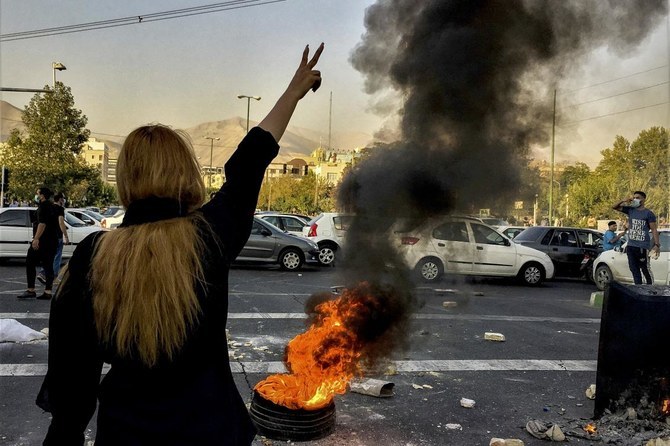
Javad Rouhi, 31, was arrested in September 2022 in Nowshahr in the northern Mazandaran province during the widespread protests that erupted over the death of Mahsa Amini who had been arrested for allegedly violating the strict dress rules for women.
He was convicted two months later and sentenced to death, although the sentence was later struck down and a retrial ordered.
Human Rights Watch said he was “horrifically tortured” following his arrest and then died “under suspicious circumstances” on August 31, 2023.
Norway-based Iran Human Rights echoed that he died “under suspicious circumstances.”
The Iranian judiciary’s Mizan Online news website reported he died early Thursday “after suffering a seizure while in prison” in Nowshahr.
“The Iranian prison authorities’ egregious record of torture and mistreatment makes Javad Rouhi’s death in custody more than a little suspicious,” said Tara Sepehri Far, senior Iran researcher at HRW.
“An international inquiry is needed since there’s no reason to believe Iranian authorities will carry out a transparent investigation.”
According to HRW, which cited an informed source, he had in custody suffered torture including being exposed to freezing temperatures and having ice cubes placed on his testicles and other parts of his body for 48-hour periods.
“The attackers also beat him severely with batons and whipped his body, including the soles of his feet, while he was tied to a pole,” it added.
IHR’s director, Mahmood Amiry-Moghaddam, said Rouhi’s death must be investigated “as an extrajudicial killing in prison” by the UN fact-finding mission set up to investigate human right abuse committed during Iran’s crackdown on the protests.
“The United Nations fact-finding mission should investigate all torture and deaths in custody related to the protests in Iran,” Sepehri Far said. “Sadly, the case of Javad Rouhi is just the latest one.”
The protests have now largely subsided, despite some sporadic outbursts, after a crackdown which saw thousands detained, according to the UN, and hundreds shot dead by security forces, according to activists.
Rouhi was sentenced to death on the charge of “corruption on Earth” for “leading a group of rioters,” “inciting people to create insecurity,” and “apostasy by desecration of the Qur'an by burning it,” Mizan said in January.


![]()


Iran protester’s custody death ‘suspicious’ after ‘torture’: rights groups
Short Url
https://arab.news/835pw
Iran protester’s custody death ‘suspicious’ after ‘torture’: rights groups
- Javad Rouhi, 31, was arrested in September 2022 in Nowshahr during the widespread protests that erupted over the death of Mahsa Amini
- Human Rights Watch said he was “horrifically tortured” following his arrest and then died “under suspicious circumstances” on August 31, 2023


Hamas says technocratic committee key to consolidating Gaza truce
- A senior Hamas official on Thursday welcomed the formation of a technocratic committee to govern post-war Gaza, saying it would help consolidate the ceasefire and prevent a return to fighting
GAZA: A senior Hamas official on Thursday welcomed the formation of a technocratic committee to govern post-war Gaza, saying it would help consolidate the ceasefire and prevent a return to fighting.
Egypt, a mediator in indirect ceasefire talks between Israel and Hamas, announced the formation of a 15-member Palestinian technocratic committee that would operate under the overall supervision of a so-called “Board of Peace,” to be chaired by US President Donald Trump.
“The formation of the committee is a step in the right direction,” said Bassem Naim, a senior leader in the Palestinian Islamist movement.
“This is crucial for consolidating the ceasefire, preventing a return to war, addressing the catastrophic humanitarian crisis and preparing for comprehensive reconstruction,” he said.
Hamas has exercised total control over public life in Gaza since 2007.
It has repeatedly said it does not seek a role in any future governing authority in Gaza and would limit its involvement to monitoring governance.
Naim said Hamas was ready to hand over administration of the Gaza Strip to the national transitional committee and to facilitate its work.
“The ball is now in the court of the mediators, the American guarantor and the international community to empower the committee,” he said.
He urged them to counter what he described as Israeli Prime Minister Benjamin Netanyahu’s attempts to “stall or obstruct” the next stages of the ceasefire.
Since the ceasefire took effect on October 10, Gaza has been split by a so-called “Yellow Line,” marking the boundary between territory controlled by Hamas and areas under Israeli military authority.
Washington’s top envoy, Steve Witkoff, said on Wednesday the ceasefire had moved into its second stage.
Key elements of the second stage include the gradual withdrawal of Israeli forces from Gaza, the demilitarization of the territory including the disarmament of Hamas, and steps to address the humanitarian crisis through accelerated aid deliveries and reconstruction.
The US-proposed Board of Peace is expected to be led on the ground by Bulgarian diplomat and politician Nickolay Mladenov, who has recently held talks with Israeli and Palestinian officials.
Mladenov previously served as the United Nations envoy for the Middle East peace process from early 2015 until the end of 2020.
Media reports say Trump is expected to announce the members of the Board of Peace in the coming days, with the body set to include around 15 world leaders.
Egypt, a mediator in indirect ceasefire talks between Israel and Hamas, announced the formation of a 15-member Palestinian technocratic committee that would operate under the overall supervision of a so-called “Board of Peace,” to be chaired by US President Donald Trump.
“The formation of the committee is a step in the right direction,” said Bassem Naim, a senior leader in the Palestinian Islamist movement.
“This is crucial for consolidating the ceasefire, preventing a return to war, addressing the catastrophic humanitarian crisis and preparing for comprehensive reconstruction,” he said.
Hamas has exercised total control over public life in Gaza since 2007.
It has repeatedly said it does not seek a role in any future governing authority in Gaza and would limit its involvement to monitoring governance.
Naim said Hamas was ready to hand over administration of the Gaza Strip to the national transitional committee and to facilitate its work.
“The ball is now in the court of the mediators, the American guarantor and the international community to empower the committee,” he said.
He urged them to counter what he described as Israeli Prime Minister Benjamin Netanyahu’s attempts to “stall or obstruct” the next stages of the ceasefire.
Since the ceasefire took effect on October 10, Gaza has been split by a so-called “Yellow Line,” marking the boundary between territory controlled by Hamas and areas under Israeli military authority.
Washington’s top envoy, Steve Witkoff, said on Wednesday the ceasefire had moved into its second stage.
Key elements of the second stage include the gradual withdrawal of Israeli forces from Gaza, the demilitarization of the territory including the disarmament of Hamas, and steps to address the humanitarian crisis through accelerated aid deliveries and reconstruction.
The US-proposed Board of Peace is expected to be led on the ground by Bulgarian diplomat and politician Nickolay Mladenov, who has recently held talks with Israeli and Palestinian officials.
Mladenov previously served as the United Nations envoy for the Middle East peace process from early 2015 until the end of 2020.
Media reports say Trump is expected to announce the members of the Board of Peace in the coming days, with the body set to include around 15 world leaders.
Latest updates


© 2026 SAUDI RESEARCH & PUBLISHING COMPANY, All Rights Reserved And subject to Terms of Use Agreement.